

When must a distance-nonincreasing transformation leave some point unchanged? OpenAI’s September 2026 preprint proves that a nonexpansive mapping from a nonempty, norm-closed, bounded, convex subset of a real reflexive Banach space into itself always has a fixed point. That answers the question left by Kirk’s 1965 theorem for the space’s given norm. The proof begins with an apparent obstacle. In a minimal counterexample, points that barely move under the map still get as far as possible from every fixed comparison point. The authors use those distances to build linear tests that must eventually miss every vector, even as weak compactness forces them all to detect the same one.
Table of Contents
1. What Is a Nonexpansive Mapping? Definition and Example
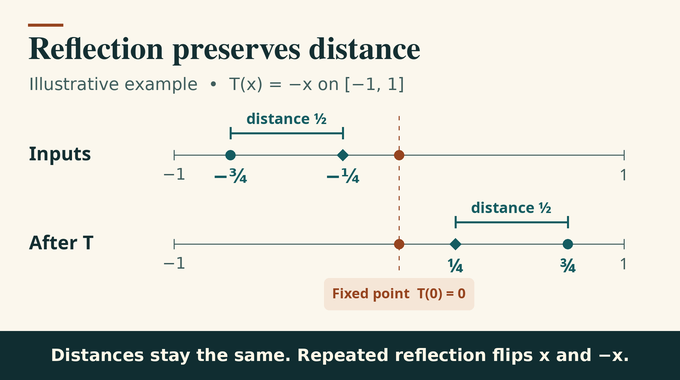
A self-map is nonexpansive if it never increases the distance between two points of its domain. The norm determines that distance. A fixed point is a point with .
| Topic | What the Preprint Establishes |
|---|---|
| Space | A real reflexive Banach space, with its given norm. |
| Domain | A nonempty, norm-closed, bounded, convex subset of that space. |
| Mapping | A self-map with Lipschitz constant at most one. |
| Conclusion | At least one point is unchanged by the map. |
| Geometric Hypotheses | Reflexivity suffices without normal structure or uniform convexity. |
| Formalization | The public Lean proof covers the main existence theorem. |
For a nonexpansive mapping example, take the reflection on . The distance between any two inputs stays exactly the same, so no Lipschitz constant below one works. Zero is fixed. Starting from any other point gives an orbit that alternates between and . The identity on the same interval fixes every point. Together the two examples separate existence from uniqueness and convergence of ordinary iteration.
2. OpenAI’s Fixed-Point Theorem for Reflexive Banach Spaces
Theorem 1.1 of the original preprint applies to every real reflexive Banach space . For any nonempty, norm-closed, bounded, convex subset , a nonexpansive self-map has a point with . This is the fixed point property for nonexpansive mappings in the given norm.
A Banach space is a complete normed vector space. Its continuous dual consists of bounded linear functionals, which assign real numbers to vectors. Reflexivity means that every element of the bidual is evaluation at some vector of . Closedness keeps norm limits in the domain, boundedness gives a finite diameter, and convexity keeps line segments and finite weighted averages in the domain. By reflexivity, a set with these three properties is weakly compact. The weak topology observes vectors through all continuous linear functionals, giving the proof compactness even when the domain is too large to be norm compact.
3. Why Banach, Browder–Göhde, and Kirk Did Not Settle the Problem
Banach’s contraction principle requires a uniform factor . Successive iteration then shrinks displacements geometrically, making the iterates Cauchy and forcing a unique fixed point. A nonexpansive map allows a factor of one. In 1965 Browder and Göhde established fixed-point existence for uniformly convex Banach spaces, where separated points in the unit ball have midpoints uniformly inside it. Kirk’s fixed point theorem uses another geometric hypothesis, normal structure, on the domain.
Normal structure requires every nonsingleton convex subset to contain a point whose supremal distance to that subset is strictly below its diameter. Diameter means the supremum of all pairwise distances. The open question was whether real reflexivity sufficed in the given norm. The preprint records an earlier proposed proof and subsequent announcement by Hanebaly, alongside literature that still treated the problem as unresolved.
4. The Missing Ingredient: Why Normal Structure Is No Longer Required
In a minimal invariant set, the map sends the set into itself and no smaller nonempty closed convex subset has that property. In the hypothetical counterexample, every point of this set is diametral. Its supremal distance to the set equals the diameter. Kirk’s geometric hypothesis rules that out immediately. OpenAI’s proof keeps the diametral behavior and turns it into inequalities that can be added across many tests.
Karlovitz showed that a particular norm on gives the fixed point property without normal structure. Alspach’s example goes the other way. A weakly compact convex subset of has a fixed-point-free nonexpansive self-map, so weak compactness alone in an arbitrary Banach space is insufficient. Domínguez Benavides showed that reflexive spaces admit an equivalent norm with the fixed point property. An equivalent norm preserves the norm topology but can change which maps are nonexpansive, leaving the original-norm question open.
5. Proof Step 1: Minimal Invariant Sets and the Goebel–Karlovitz Lemma
Assume a counterexample exists. Starting with one point, repeatedly take the norm-closed convex hull of the current set and its image. The norm closure of the union is invariant and separable, meaning it has a countable norm-dense subset. Within it, weak compactness gives a nonempty intersection for every decreasing chain of closed convex invariant sets. Zorn’s lemma then supplies a minimal such set , with the restricted map denoted by . Its diameter is positive because an invariant singleton would give a fixed point. Dividing the norm by that diameter preserves nonexpansiveness and sets the diameter to one.
The Goebel–Karlovitz lemma says that if , then
Minimality makes both the supremal distance to and the limsup distance to an approximate fixed-point sequence constant on . Their sublevel sets are closed, convex, and invariant. A weak limit along a free ultrafilter and the weak closedness of norm balls force the limsup to equal the diameter. The argument applies to every subsequence, which yields the full limit.
Lemma 2.4 turns distance into a signed measurement. For a norm-compact comparison set , take a finite net and average its points. An approximate fixed point with sufficiently small defect lies nearly a unit away from that average. A norming functional on the difference nearly saturates the average of the tests against individual net points. Each test is bounded above by one, so each must be near one. The net extends the bound to every point of , using the same functional. Weak compactness can supply a weak limit of the approximate fixed points, but the hypothesis only gives continuity for the norm topology. The separation argument uses weak compactness without having to pass the fixed-point equation through that limit.
6. Proof Step 2: Resolvents, Compact Semigroups, and an Idempotent Anchor
For an input and integer , the resolvent solves Equation (3.1). The right side, viewed as a function of the unknown point, is a strict contraction.
For the interval reflection, solving the resolvent equation gives . For instance, the anchor input gives , whose defect is . This example uses the unnormalized interval of diameter two. In the proof, each is nonexpansive and the domain has diameter one. Equation (3.2) bounds its output’s fixed-point defect by and its displacement from by . The first estimate makes approximate fixed points available at any accuracy. The second ensures that any fixed map built from resolvents and the identity by composition and finite convex averaging acts almost like the identity at points of sufficiently small defect.
Take the pointwise weak closures of the convex hulls of families whose outer resolvents have indices at least . As increases, these compact sets of maps are nested. Convexity upgrades weak approximation to simultaneous norm approximation at finitely many inputs, and nonexpansiveness then lets the authors compose the limits. In the intersection, right translation is continuous because the inner map supplies fixed evaluation points. Ellis’s lemma gives an idempotent map , with . Any point in its image satisfies .
Let be the intersection of the weak closures of the outer-resolvent tail images of . Separation and compactness show that belongs to the norm-closed convex hull of . This lets arbitrarily accurate approximate fixed points average back toward the same anchor in norm.
7. Proof Step 3: Adaptive Selection and Compact Prediction Sets
Lemma 3.5 cycles through finitely many targets in whose convex combination is near . Each target remains in the weak closure of every tail, so a new image can approach it weakly even when earlier choices dictate a tighter defect threshold. If selection continued forever, the closed convex hull of the chosen images would contain every target, and a finite average would already be close enough to stop. The coefficients are assigned after selection ends.
For a candidate node at depth , the paper must predict the root output just after the leaves under have switched. At depth , earlier candidates can contribute their own labels. The remaining weight under each parent goes to the common point . Unknown coefficients range over a compact polytope, with nonnegative weights and total at most one per parent. An earlier candidate later discarded can be represented by weight zero.
For each coefficient choice, the authors evaluate the entire root output first and then take its weak ultrafilter limit. A uniform Lipschitz bound in the coefficients survives that limit by weak lower semicontinuity of the norm. The limit outputs therefore form a norm-compact set. Adding the first points of a norm-dense sequence in gives . The prediction limits will detect switches. The dense points will make the same tests vanish on fixed vectors.
8. Proof Step 4: Constructing the Ordered Tree of Nonexpansive Maps
A node carries a map and label . The root carries the identity. Each sibling group has positive weights summing to one, and the path weight is the product from the root to . At each level the path weights sum to one. With denoting the parent, the output at an internal node is
The map acts on the average, which matters for nonlinear . At the cutoff, the prescribed values already count as node outputs, so the maps at that level are skipped. Nonexpansiveness bounds the effect of changing one cutoff output on the root by its path weight times the change.
Before assigning sibling weights, the authors give each candidate an error budget , with total at most for retained nodes. They demand a defect small enough for two tasks. The total movement of under its ancestor maps must be at most . A functional of norm at most one must satisfy for every . Adaptive selection then gives sibling averages close to , with a tolerance schedule that makes all deeper errors together at most the relevant node budget.
9. Proof Step 5: Weighted Switching and the Telescoping Estimate
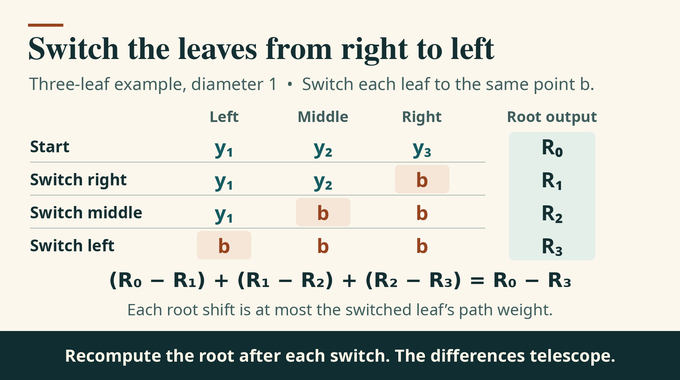
Fix a depth . For the finitely many node tests, choose one sufficiently late meeting all the predicted inequalities within an extra and nearly fixed by all maps in the truncation. Start with the leaf labels and replace them by from right to left, recalculating the root each time. The depth- descendants of form a consecutive block with total weight .
| Stage | Left | Middle | Right |
|---|---|---|---|
| Initial | |||
| Switch Right | |||
| Switch Middle | |||
| Switch Left |
Call the root values just before and after the block and . Before switching, the subtree under is close to because unchanged child averages return toward the anchor. Along the path back to the root, the off-path weights add up to . Together with the ancestor displacement bounds this gives . After switching, the subtrees on the left remain close to their labels, while the switched ones transmit with small error. The root is within of the predicted output. The functional sees a difference of at least between the label and that prediction, leaving .
For a single leaf , write . Root sensitivity gives . Because consecutive switches share the same intermediate root outputs, their signed differences telescope even though evaluation is nonlinear. The block bound becomes
Each deficit is nonnegative. Summing over nodes and grouping by leaf gives a weighted total of at most for the sums of deficits along paths. Any path with a test scoring at most contributes a deficit of at least before weighting. Such leaves have total weight at most , so Proposition 5.1 gets one leaf and one vector that scores above on every nonroot test along its path. Tiny path weights pose no problem because the argument sums weighted deficits without dividing by an internal node’s weight.
10. Proof Step 6: The Infinite-Branch Contradiction
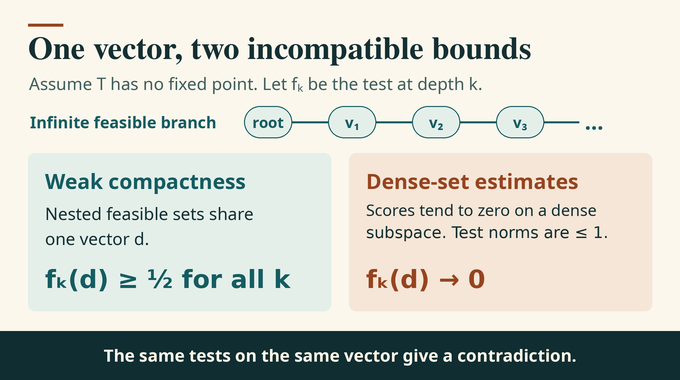
Set , the norm-closed linear span of differences from , and let be its closed unit ball. Every finite witness lies in . Call a node feasible if some vector in that ball scores at least on all its nonroot ancestor tests and its own. Feasibility passes to ancestors. The finitely branching tree has feasible nodes at every depth, so some infinite branch consists entirely of feasible nodes.
For each finite prefix of the branch, its constraints define a nonempty weakly closed subset of . The sets are nested, and reflexivity makes the ball weakly compact. One vector lies in their intersection. For the node at depth , this gives
Yet for any fixed indices , both and are included in the comparison set once . The two functional evaluations on differences from lie between and one. Subtracting gives . These differences span a dense subspace of . The uniform functional norm bound extends pointwise convergence to zero to all of , including . This contradicts the lower bound and rules out the counterexample.
11. What the Proof Establishes and What It Leaves Open
Corollary 1.2 applies Bruck’s theorem to any pairwise commuting family of nonexpansive self-maps under the same domain assumptions. The maps share a fixed point, and their common fixed set is a nonexpansive retract of the domain. Pairwise commutation means that applying any two maps in either order gives the same result. A retraction sends the whole domain into that set and leaves each point of the set unchanged. The existence theorem supplies neither uniqueness nor a convergence guarantee for ordinary iteration.
OpenAI’s October 6 release announced the collection. Its Lean formalization for this result covers the main fixed-point existence theorem, including nonseparable and zero-dimensional spaces, with no assumptions of normal structure, uniform convexity, or weak continuity. The commuting-family corollary is a separate consequence in the paper.
For a nonexpansive mapping in a real reflexive Banach space, the original norm is enough under the theorem’s domain assumptions. The proof gets there by turning approximate fixed points into a contradiction about one vector and an entire branch of linear tests. Follow Binary Verse AI for more research explainers on Banach-space geometry, operator inequalities, and proofs checked in Lean.
What is a nonexpansive mapping in functional analysis?
A nonexpansive mapping never increases the distance between two points in its domain. Reflection on the interval [−1, 1] is an example. It sends x to −x and fixes zero.
How does a nonexpansive mapping differ from a Banach contraction?
A Banach contraction has a Lipschitz constant strictly below one. A nonexpansive mapping permits equality, so uniqueness and convergence of ordinary iteration can fail.
What is a reflexive Banach space, and why is it important for fixed points?
A Banach space is reflexive when its canonical embedding into the continuous bidual is surjective. In such a space, every norm-closed, bounded, convex subset is weakly compact. That compactness is essential to the proof.
How does OpenAI’s proof extend Kirk’s fixed-point theorem?
Kirk’s theorem assumes normal structure. OpenAI’s Theorem 1.1 proves that every nonexpansive self-map of a nonempty, norm-closed, bounded, convex subset of a real reflexive Banach space has a fixed point in the given norm.
Why can’t approximate fixed points simply converge weakly to a fixed point?
A nonexpansive map is norm continuous but may fail to be weakly continuous. A weak limit of approximate fixed points therefore need not satisfy the fixed-point equation by continuity alone. The proof uses an adaptive anchor, compact prediction sets, and a weighted tree argument.
Does the theorem guarantee a unique fixed point or a convergent iteration?
The theorem guarantees existence. The identity on an interval fixes every point. Reflection on [−1, 1] fixes zero, but ordinary iteration from any other starting point alternates between that point and its negative.
Can commuting nonexpansive mappings share a common fixed point?
Yes. Corollary 1.2 states that, under the same domain assumptions, every pairwise commuting family of nonexpansive self-maps has a nonempty common fixed-point set. That set is a nonexpansive retract of the domain.