Meta’s latest coding model arrives with a familiar promise: frontier-level capability at a price developers can afford. The interesting part is not the slogan. It is how Meta chose to prove it.
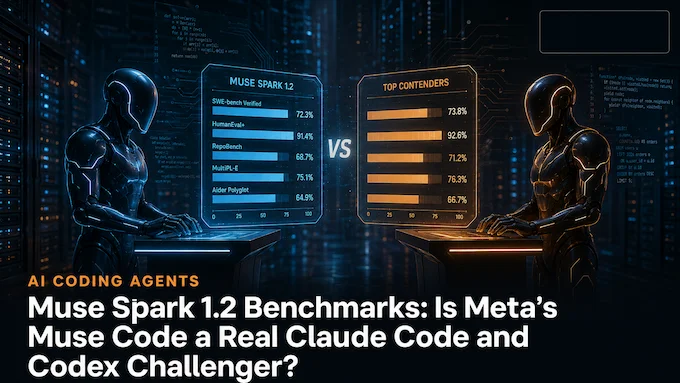
The Muse Spark 1.2 benchmarks cover terminal work, repository-level engineering, professional tasks, MCP tool use, Meta’s internal codebase, and long-running GPU kernel optimization. On paper, Muse Spark 1.2 is competitive with major proprietary systems, clearly stronger than Muse Spark 1.1, and the top performer in the supplied MCP Atlas comparison.
But Meta did not test every model inside one identical coding shell. Muse Spark 1.2 used Muse Code, Claude Opus 5 used Claude Code, GPT-5.6 Terra used Codex, Grok 4.5 used Grok Build, and Gemini 3.6 Flash used Antigravity. These are comparisons between complete agent systems, not clean measurements of raw model intelligence.
That distinction shapes the verdict. Muse Spark 1.2 and Muse Code form a serious coding-agent product, especially for tool-heavy and long-horizon work. The data does not yet prove that the underlying model independently beats Claude Code, Codex, or every competing model.
Table of Contents
1. Muse Spark 1.2 Benchmark Results At A Glance
The table combines every reported score in the supplied material. “Not reported” means no directly comparable result was shown, not a score of zero.
“`htmlMuse Spark 1.2 Benchmarks: Complete Model Performance Comparison
| Model | Terminal-Bench 2.1 | DeepSWE 1.1 | Meta Internal Code | GDPVal-AA v2 | MCP Atlas | KDA Speedup |
|---|---|---|---|---|---|---|
| Claude Opus 5 | 86.7% | 65.0% | 79.4% | 1852 | 85.8% | +74.0% |
| Muse Spark 1.2 | 82.9% | 59.3% | 70.6% | 1631 | 90.3% | +68.7% |
| GPT-5.6 Terra | 81.8% | 64.8% | 65.4% | 1577 | Not reported | +65.1% |
| Grok 4.5 | 81.6% | 56.6% | Not reported | 1526 | Not reported | Not reported |
| Gemini 3.6 Flash | 78.9% | 40.0% | 63.9% | 1423 | Not reported | +62.5% |
| Muse Spark 1.1 | 76.2% | 53.0% | 68.3% | 1371 | 88.1% | Not reported |
| GPT-5.6 Sol | Not reported | Not reported | Not reported | Not reported | 81.8% | +71.2% |
| Gemini 3.5 Flash | Not reported | Not reported | Not reported | Not reported | 83.6% | Not reported |
| Claude Fable 5 | Not reported | Not reported | Not reported | Not reported | 83.3% | Not reported |
| Claude Opus 4.8 | Not reported | Not reported | Not reported | Not reported | Not reported | +69.6% |
| Kimi K3 | Not reported | Not reported | Not reported | Not reported | 82.3% | Not reported |
Claude Opus 5 is the strongest all-round system in this set, leading Terminal-Bench, DeepSWE, Meta’s internal test, GDPVal-AA, and KDA speedup. Muse Spark 1.2 stays close on several coding tests. Its 82.9% Terminal-Bench score edges GPT-5.6 Terra, Grok 4.5, and Gemini 3.6 Flash, while its DeepSWE result improves by 6.3 points over Muse Spark 1.1.
MCP Atlas is the standout. Muse Spark 1.2 reaches 90.3%, ahead of every model shown. That points to strong tool selection and orchestration, though it does not establish superior coding in every setting.
2. Muse Spark 1.2 Pricing, API Access, And Data Terms
Meta is positioning Muse Spark 1.2 around cost as much as capability. Both launch tiers offer a one-million-token context window, but the prices and data-use conditions differ sharply.
“`htmlMuse Spark 1.2 Benchmarks: API Pricing, Context Window, and Data-Use Comparison
| Tier | Context Window | Input Per 1M | Cached Input Per 1M | Output Per 1M | Data-Use Position |
|---|---|---|---|---|---|
| Muse Spark 1.2 Contributor | 1M | $0.10 | $0.002 | $0.20 | Used to improve Meta products |
| Muse Spark 1.2 Standard | 1M | $1.25 | $0.15 | $4.25 | Not used to improve Meta products |
One million uncached input tokens plus 100,000 output tokens would cost about $0.12 on Contributor pricing and about $1.68 on the standard tier. With fully cached input, the estimates fall to roughly $0.022 and $0.575.
Cheap tokens do not guarantee a cheap completed task. Coding agents may generate long reasoning traces, repeat tool calls, retry failed steps, and run parallel subagents. The useful business metric is cost per accepted pull request or verified fix.
Meta lists Muse Code, Meta Model API, and OpenRouter as access paths. Its quickstart supports OpenAI-compatible clients, reducing migration work for teams that already use a model abstraction layer.
3. What Changed From Muse Spark 1.1, And Why The Harness Matters
Muse Spark 1.2 is a coding-focused update, with more training compute devoted to code, broader training environments, and greater emphasis on debugging, repository understanding, and full development workflows.
The larger change is that Meta co-trained Muse Spark 1.2 with Muse Code. Training included agent trajectories, goal conditioning, context compaction, subagent behavior, and the toolset inside the coding environment. Meta also used Muse Spark 1.1 to generate harder environments and instruction-following templates, then selected stronger examples through model grading.
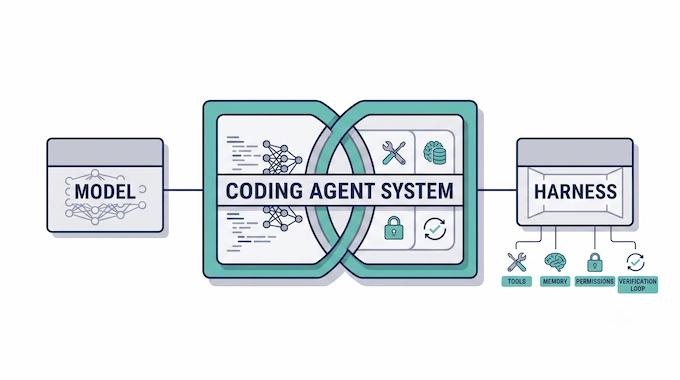
This makes the model and harness difficult to separate. A traditional benchmark tries to hold the environment steady and change only the model. Meta’s terminal evaluations compare products: Muse Code, Claude Code, Codex, Grok Build, and Antigravity. Reasoning levels also differ across systems.
Reading the Muse Spark 1.2 benchmarks correctly therefore requires treating the model, prompts, tools, memory, permissions, and verification loop as one system.
That approach mirrors real usage. Developers work through prompts, tools, permissions, memory, retries, and verification loops. The cost is attribution. When Muse wins, we cannot divide the gain cleanly among the model, system prompt, parallel workers, or context strategy. Meta also acknowledges that its setup may not be tuned to every proprietary competitor’s strengths.
4. Terminal-Bench 2.1 Tests Whether The Agent Can Finish The Job
Terminal-Bench 2.1 measures tasks completed in a terminal. Meta used all 89 official tasks, ran attempts in isolated Daytona sandboxes, and used executable verifiers to inspect the final container state. The score is average pass@1 across five attempts.
Muse Spark 1.2 scores 82.9%, 3.8 points behind Claude Opus 5 but slightly ahead of GPT-5.6 Terra and Grok 4.5. It improves by 6.7 points over Muse Spark 1.1.
This test is more revealing than snippet generation because the agent must inspect files, run commands, interpret errors, modify the environment, and leave behind a working state. Still, an 82.9% benchmark pass rate is not an 82.9% chance of safely completing your company’s migration. Production repositories contain unclear requirements, weak tests, hidden dependencies, and shifting code.
5. DeepSWE 1.1 Is The Harder Repository Test
Among the Muse Spark 1.2 benchmarks, DeepSWE provides one of the clearest tests of whether the model-and-agent pairing can make functional changes across real repositories.
DeepSWE v1.1 contains 113 tasks across 91 repositories in TypeScript, Go, Python, JavaScript, and Rust. Each task has a handwritten functional verifier and regression checks. Meta applies the final patch to a clean checkout in a fresh verification container, with external internet access blocked during rollout and grading.
Muse Spark 1.2 reaches 59.3%. Claude Opus 5 leads at 65.0%, while GPT-5.6 Terra scores 64.8%. Muse remains ahead of Grok 4.5 and Gemini 3.6 Flash in this comparison.
The official DeepSWE leaderboard uses mini-swe-agent for every model. Meta instead uses each model’s selected agent product, so its figures are not harness-identical to the official leaderboard. They are useful product comparisons, but should not be mixed casually with official leaderboard results.
A 59.3% score shows real repository skill. It also means roughly four out of ten attempts failed under this setup.
6. MCP Atlas May Be The Strongest Reason To Watch Muse Spark
MCP Atlas tests 1,000 human-authored tasks across 36 MCP servers and 220 tools. The environment includes target tools and distractors, so the model must select useful actions and satisfy ground-truth claims. A task passes when average claim coverage reaches at least 0.75.
Muse Spark 1.2’s 90.3% is the best result shown. That matters because coding agents increasingly work beyond the editor. They search repositories, call APIs, inspect tickets, run tests, and update external systems.
The result suggests strong orchestration, not universal coding superiority. Tool selection and code quality overlap, but they are different skills. For builders creating multi-tool agents, MCP Atlas may be the most commercially relevant Muse Spark benchmark.
7. GDPVal-AA And Meta’s Internal Test Need Different Levels Of Trust
GDPVal-AA v2 covers 220 professional tasks across 44 occupations and nine major US industries. Agents produce documents, spreadsheets, slides, diagrams, and reports inside Artificial Analysis’s Stirrup harness. Anonymous outputs are compared head-to-head, creating an Elo score anchored to a human baseline of 1,000.
Muse Spark 1.2 scores 1631, ahead of GPT-5.6 Terra, Grok 4.5, Gemini 3.6 Flash, and Muse Spark 1.1, but behind Claude Opus 5. This supports broader agent capability beyond coding.
Meta’s internal benchmark is harder to judge. Its 440 tasks come from internal pull requests covering bug fixes, features, refactoring, and cleanup, with submissions compiled and tested in isolated containers. Outsiders cannot inspect the tasks, reproduce the dataset, or check for Meta-specific overlap.
Treat the internal result as supporting evidence, not the final verdict.
8. The 24-Hour Kernel Test Shows Persistence, Not Universal Superiority
Meta also tested agents on KDA and MLA GPU kernel optimization for NVIDIA Hopper hardware. Runs could exceed 1,000 tool calls and continue for up to 24 hours while the agent wrote Triton code, compiled it, profiled performance, and revised the implementation.
Muse Spark 1.2 posts a 68.7% KDA speedup. It trails Claude Opus 5, GPT-5.6 Sol, and Claude Opus 4.8, while beating GPT-5.6 Terra and Gemini 3.6 Flash in the supplied table.
Kernel optimization is specialized, so this is not a general coding crown. The useful signal is persistence through failed attempts, compiler feedback, long plateaus, and incremental gains. That looks more like research engineering than autocomplete.
9. Muse Code Vs Codex And Claude Code Is A Systems Question
The popular “Muse Code vs Codex” and “Muse Code vs Claude Code” comparisons have no single winner.
Claude Opus 5 with Claude Code leads most published tables. GPT-5.6 Terra with Codex nearly matches Opus on DeepSWE and trails Muse slightly on Terminal-Bench. Muse’s clearest advantage is MCP Atlas, where the benchmark provider’s own harness is used rather than the CLI products.
Users have fairly asked why Meta emphasized GPT-5.6 Terra instead of Sol. Sol appears in the MCP and kernel results, while the main terminal tables focus on Terra. The supplied evidence does not provide a complete all-model, all-benchmark matrix. Missing entries should remain “not reported,” not be interpreted as hidden defeats.
The practical question is whether a system solves your tasks at an acceptable cost, with enough control and a failure mode your team can manage.
10. Muse Code’s Architecture May Matter More Than The Model
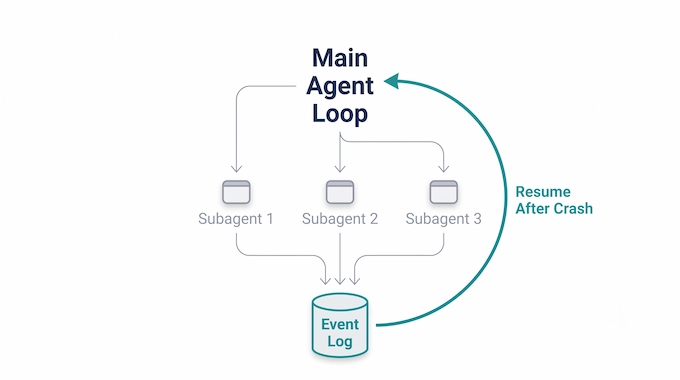
Muse Code combines a main agent loop with persistent background subagents. These workers remain active during a session, reducing repeated repository exploration and reporting useful findings to the main agent.
A local append-only event log records model calls, tools, approvals, and edits. After a crash, the session can resume from the previous state rather than reconstructing its work. Bundled skills include /plan for approval-gated planning, /grill for stress-testing a plan, and /goal for pursuing a defined outcome.
These features address lost context, duplicated research, conflicting edits, and fragile recovery. They do not remove the need for supervision. Parallel agents can still make incompatible assumptions, and restart safety is not correctness.
Meta’s strongest idea may be this integration of model, memory, orchestration, and recovery. It is also why separating Muse Spark 1.2 from Muse Code is so difficult.
11. Is Muse Spark Open Source, And Should You Switch?
The launch material presents Muse Spark 1.2 as an API-served model available through Muse Code, Meta Model API, and OpenRouter. It does not describe downloadable weights or self-hosting. Based on the supplied information, developers should treat it as a hosted proprietary model unless Meta publishes a separate open-weight release.
Muse Spark 1.2 is worth testing if you need low-cost experimentation, a one-million-token context window, strong MCP tool use, OpenAI-compatible access, or long-running multi-agent workflows. The Contributor tier is compelling for prototypes and non-sensitive workloads where Meta’s product-improvement terms are acceptable.
Teams using confidential repositories should examine the standard tier’s contract, retention details, regional availability, and internal security requirements. Claude Code or Codex users should run the same representative tasks across systems and measure completion rate, review time, regressions, latency, and total cost.
A small private benchmark will tell you more than another week of social-media scorekeeping.
12. What The Muse Spark 1.2 Benchmarks Actually Prove
The Muse Spark 1.2 benchmarks show a model that has moved beyond “cheap but interesting.” It is competitive on terminal and repository work, capable across broader professional tasks, and especially strong at MCP tool orchestration. Muse Code adds a thoughtful runtime built around persistent agents, context management, and crash recovery.
The limits matter. Meta compares different agent products, its DeepSWE setup is not harness-identical to the official leaderboard, and its internal test cannot be independently inspected. Token prices are attractive, but the real economic question is cost per verified result.
The sensible verdict is neither “Meta beat Claude” nor “benchmarks are meaningless.” Muse Spark 1.2 and Muse Code deserve serious evaluation, but on your code, your policies, and your definition of done.
Binary Verse AI will keep separating launch claims from usable evidence as independent tests arrive. Compare the systems, test the workflows that matter, and choose the agent that earns its place in your stack.
1. Is Muse Spark 1.2 free to use?
Explain the difference between any introductory credits, Muse Code access, the Contributor API tier, and the standard paid tier. Do not describe the Contributor tier as simply “free,” because it has usage charges and different data-use terms.
2. Does Muse Spark 1.2 have an API?
Yes. Cover the Meta Model API, OpenAI-compatible access, the one-million-token context window, standard and Contributor model identifiers, and availability through supported third-party platforms such as OpenRouter.
3. Is Muse Spark 1.2 open source?
Clarify separately whether:
Model weights are downloadable
Muse Code’s client source is available
The model can be self-hosted
It can be accessed through third-party providers
Do not use “open source,” “open weights,” and “API-accessible” interchangeably.
4. Is Muse Spark 1.2 better than Claude Code or Codex?
The accurate answer is that Meta reports competitive results, but no universal winner. Claude Opus 5 leads several reported evaluations, while Muse Spark 1.2 performs particularly strongly in MCP Atlas. The comparisons also use different agent harnesses, so they are system-level rather than clean model-only comparisons.
5. Does Meta train on code submitted to Muse Spark 1.2?
Explain the distinction between the Contributor model, which is offered at heavily discounted prices under product-improvement terms, and the standard model, which Meta describes as not being used to improve its products. The supplied pricing material lists Contributor rates of $0.10 per million input tokens and $0.20 per million output tokens, compared with standard rates of $1.25 and $4.25