Introduction
Google just shipped Gemini 3.6 Flash, and the reaction split almost immediately along job description. Developers who went straight to the coding benchmarks shrugged. Enterprise teams running document pipelines and agent workflows did not. That gap tells you most of what you need to know about where Google is placing its bets with this release.
Gemini 3.6 Flash isn’t trying to win a coding leaderboard fight it can’t win outright, at least not yet. Instead, it’s built around something less flashy but arguably more useful for the businesses actually paying for API tokens: cheaper and more accurate long-context processing, stronger computer-use skills, and enough token efficiency to change what a monthly bill actually looks like. Add a 1 million token context window that finally holds up under pressure, and you get a release that reads less like a headline grab and more like an infrastructure upgrade.
This piece breaks down what changed in Gemini 3.6 Flash, how it performs against Claude Sonnet 5 and GPT-5.6 Luna on the benchmarks that matter, what it costs to run, and where it actually makes sense over a heavier frontier model.
Table of Contents
1. What Is Gemini 3.6 Flash? Redefining the “Mid-Tier” Workhorse
Gemini 3.6 Flash is Google’s newest entry in the Gemini 3 series, built directly on top of Gemini 3.5 Flash rather than as a ground-up rebuild. It’s a natively multimodal reasoning model, meaning it handles text, images, video, audio, and PDF documents as input and returns text, backed by a 1 million token context window and a 64,000 token output ceiling.
What separates Gemini 3.6 Flash from its predecessor isn’t one flashy benchmark spike. It’s the combination of a leaner output profile (17% fewer output tokens than 3.5 Flash on the Artificial Analysis Index), lower latency, and computer use shipped as a built-in client-side tool instead of a bolted-on feature. Google is positioning it as the model you reach for when a task involves reading a lot, watching a lot, or clicking through a lot of interfaces, not just writing code from a blank file.
Here’s the quick-reference version:
Gemini 3.6 Flash Specs: Pricing, Context Window, and Availability
| Spec | Details |
|---|---|
| Model name | Gemini 3.6 Flash |
| Status | Preview |
| Input types | Text, image, video, audio, PDF |
| Context window | 1M tokens |
| Max output | 64K tokens |
| Input price | $1.50 per 1M tokens |
| Output price | $7.50 per 1M tokens |
| Knowledge cutoff | March 2026 |
| Best for | Agentic coding, long-context retrieval, computer use, multimodal analysis |
| Availability | Gemini App, Gemini API, Google AI Studio, Gemini Enterprise, Google Antigravity, Android Studio |
2. Gemini 3.6 Flash Benchmarks: How It Compares to Claude Sonnet 5 and GPT-5.6 Luna
This is where the Reddit arguments start, so let’s just look at the numbers.
Gemini 3.6 Flash Benchmarks: Full Performance and Pricing Comparison
| Benchmark | Gemini 3.6 Flash | Gemini 3.5 Flash | Gemini 3.1 Pro | GPT-5.6 Luna | Grok 4.5 | Claude Sonnet 5 |
|---|---|---|---|---|---|---|
| Input price ($/1M tokens) | $1.50 | $1.50 | $2.00 | $1.00 | $2.00 | $3.00 full / $2.00 discount |
| Output price ($/1M tokens) | $7.50 | $9.00 | $12.00 | $6.00 | $6.00 | $15.00 full / $10.00 discount |
| SWE-Bench Pro (Public) | 58.7% | 55.1% | 54.2% | 62.7% | 64.7% | 63.2% |
| DeepSWE v1.1 | 49% | 37% | 12% | 67% | 54% | 54% |
| Terminal-bench 2.1 | 78.0% | 76.2% | 73.8% | 84.7% | 83.3% | 80.4% |
| MLE-Bench | 63.9% | 49.7% | 42.6% | 47.6% | 43.2% | 66.9% |
| GDPVal-AA v2 (Elo) | 1421 | 1349 | 965 | 1584 | 1535 | 1607 |
| OSWorld-Verified | 83.0% | 78.4% | 76.2% | 72.6% | — | 81.2% |
| CharXiv Reasoning (no tools) | 85.2% | 84.2% | 83.3% | 82.7% | 81.6% | 77.0% |
| CharXiv Reasoning (with tools) | 89.4% | 84.9% | 83.2% | — | — | 88.3% |
| GDM-MRCR v2, 128k average | 91.8% | 77.3% | 84.9% | 74.8% | 81.4% | 71.6% |
| GDM-MRCR v2, 1M pointwise | 54.0% | 26.6% | 26.3% | — | — | — |
Read straight down the coding rows and the story is clear. On SWE-Bench Pro, Gemini 3.6 Flash lands at 58.7%, behind Claude Sonnet 5’s 63.2% and GPT-5.6 Luna’s 62.7%. MLE-Bench tells a similar story, with Sonnet 5 pulling ahead at 66.9% against 3.6 Flash’s 63.9%. Knowledge work, measured by GDPVal-AA v2 Elo, also favors Sonnet 5 (1607) and Luna (1584) over 3.6 Flash’s 1421.
But flip to OSWorld-Verified, CharXiv Reasoning, and long-context recall, and Gemini 3.6 Flash leads every single column. That split is the entire personality of this release: a model that isn’t chasing the software engineering crown, and isn’t pretending to.
3. Why Google Lost the Coding War but Won the Computer Use Race
If you’ve spent any time in AI forums this week, you’ve probably seen some version of “why is everyone acting like this model is impressive when it can’t even beat GPT-5.6 Luna on coding.” Fair question, but it misses what Gemini 3.6 Flash is actually optimized for.
OSWorld-Verified measures something different from writing code: it tests whether a model can operate a real computer interface, clicking through applications, filling forms, and completing multi-step tasks the way a human would. Gemini 3.6 Flash scored 83.0% here, ahead of Claude Sonnet 5’s 81.2% and well clear of GPT-5.6 Luna’s 72.6%. Computer use also ships as a built-in client-side tool in the Gemini API and Gemini Enterprise, not an experimental add-on you have to wire up yourself.
That distinction matters more than it sounds. Coding benchmarks measure how well a model writes Python or fixes a pull request. Computer use benchmarks measure whether a model can automate the unglamorous white-collar work that never touches a code editor: navigating a legacy internal dashboard, filling out a compliance form, or moving data between two systems that don’t talk to each other through an API. For robotic process automation and enterprise agent teams, that’s the more commercially relevant skill, even if it doesn’t trend on developer Twitter.
4. Fixing the “Needle in a Haystack”: The Gemini 3.6 Flash 1M Context Breakthrough
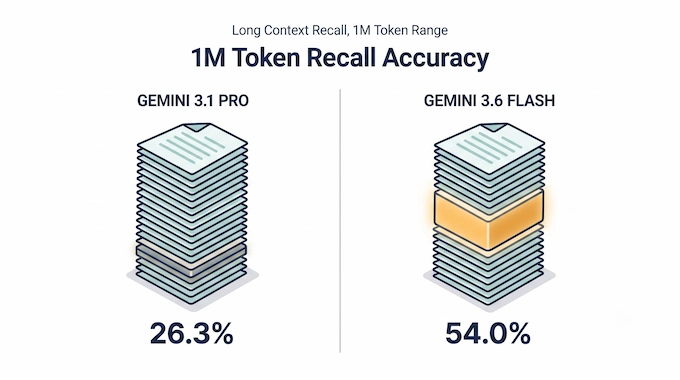
Long context windows have always had a credibility problem. Vendors advertise a million tokens, but ask the model to recall one specific detail buried deep inside that window and accuracy usually falls off a cliff. Gemini 3.1 Pro is a good example of the failure mode: at the full 1M token range, it managed only 26.3% on the GDM-MRCR v2 pointwise recall test, despite being Google’s higher-tier model at the time.
Gemini 3.6 Flash doesn’t just nudge that number, it roughly doubles it, hitting 54.0% on the same 1M pointwise test. At the more common 128k range, accuracy jumps even further, from 77.3% in Gemini 3.5 Flash to 91.8%.
In practical terms, that’s the difference between a context window that’s a marketing claim and one you can actually build a workflow around. Feeding the model a 100-page financial filing, a stack of legal contracts, or an entire mid-sized codebase and expecting it to reliably surface a specific clause or function used to be a gamble. With Gemini 3.6 Flash, it’s a lot closer to a dependable feature, particularly for research, due diligence, and codebase-wide refactoring tasks where losing a single detail can invalidate the whole output.
5. Vision and Multimodal Upgrades: Dominating CharXiv and LVBench
Gemini 3.6 Flash’s vision performance is arguably where the generational leap is most obvious. On CharXiv Reasoning, which tests a model’s ability to extract insight from dense, complex charts, it scores 85.2% without tool use and 89.4% with tools, both ahead of Claude Sonnet 5 (77.0% and 88.3% respectively) and comfortably clear of GPT-5.6 Luna and Grok 4.5.
Long video understanding shows the same pattern. On LVBench, Gemini 3.6 Flash reaches 83.2%, versus 68.5% for Claude Sonnet 5 and 71.2% for both GPT-5.6 Luna and Grok 4.5. That’s not a marginal edge, it’s a full tier of separation on a benchmark that’s genuinely difficult to game.
Community testing has echoed the benchmark data. Several early demos circulating on Reddit and X show the model rendering detailed vector graphics, including complex automotive line art, from a single descriptive prompt, which lines up with the kind of fine-grained visual synthesis the CharXiv scores suggest. For teams doing document parsing, chart analysis, or any workflow that mixes text and visuals, this is the section of the model card that should get the most attention, even though it rarely makes the headlines.
6. Gemini API Pricing: Unpacking the Token Efficiency Advantage
Here’s the number everyone searching for Gemini API pricing actually wants: $1.50 per 1 million input tokens and $7.50 per 1 million output tokens. That output price is a 17% reduction from Gemini 3.5 Flash’s $9.00, and it undercuts both Gemini 3.1 Pro ($12.00) and Claude Sonnet 5’s full-price output rate of $15.00.
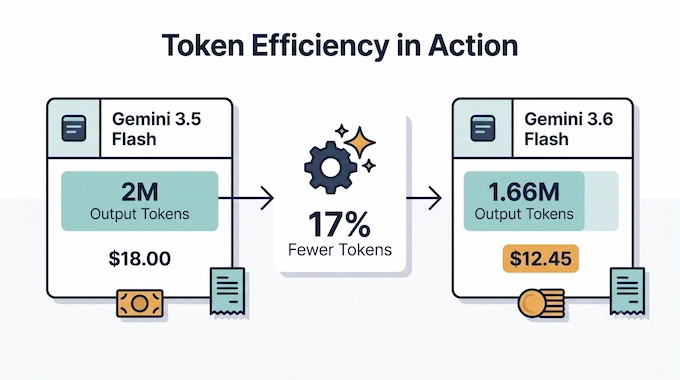
Compared against GPT-5.6 Luna, the sticker price actually favors Luna, which charges $1.00 for input and $6.00 for output. On paper, that makes Luna the cheaper model per token. But per-token price isn’t the same as per-task price, and this is where Google’s efficiency claim earns some scrutiny. Gemini 3.6 Flash uses 17% fewer output tokens than its own predecessor to complete comparable tasks, and needs fewer reasoning steps and tool calls along the way. A model that’s slightly more expensive per token but needs meaningfully fewer tokens to finish the job can still come out ahead on the actual invoice.
6.1 A Quick Cost Example
Picture an agent workflow that historically burns 2 million output tokens a month on Gemini 3.5 Flash. At $9.00 per million, that’s $18 in output costs alone. Move the same workload to Gemini 3.6 Flash, and the token reduction alone could shrink usage to roughly 1.66 million tokens, priced at $7.50 per million, for a total closer to $12.45. That’s before accounting for fewer failed tool calls or retry loops, which tend to compound the savings on longer agentic tasks. It’s a simplified example, but it illustrates why “cheapest per token” and “cheapest per task” aren’t always the same model.
7. The Missing Model: What Happened to Gemini 3.5 Pro?
Scroll through any Gemini 3.6 Flash thread and you’ll find some version of “where is 3.5 Pro?” Google’s official line is straightforward: Gemini 3.5 Pro is currently testing with partners, with a broader release planned once it’s ready. The company has also confirmed it’s already deep into pretraining for Gemini 4, which suggests the roadmap is very much alive, just not fully public yet.
Industry chatter fills the gap with a less flattering theory: that Gemini 3.5 Pro hit underwhelming results on internal coding benchmarks and got pulled back for another training pass. That’s speculation, not confirmed fact, and it’s worth treating it that way. What is fair to say is that Gemini 3.6 Flash conveniently functions as a capable stopgap either way, giving Google a strong release to point to while the higher tier model, whatever its actual status, continues cooking in the background.
8. The Knowledge Cutoff Controversy: Is It Really March 2026?
Google’s own model card lists a knowledge cutoff of March 2026 for Gemini 3.6 Flash. Some early users have reported the model stumbling on events from the first quarter of 2026, which has fed a bit of skepticism about whether that date is accurate.
The likely explanation is less dramatic than a mislabeled cutoff. There’s a meaningful difference between a model’s static training data and its ability to retrieve current information through grounding. Gemini 3.6 Flash supports search as a tool, and Google Search Grounding specifically, which pulls in live web results rather than relying purely on frozen training knowledge. If you’re building anything that touches current events, pricing, or recent releases, the fix isn’t to distrust the cutoff date, it’s to make sure grounding is actually switched on in your API calls.
9. Meet the Siblings: Gemini 3.5 Flash-Lite and Flash Cyber
Gemini 3.6 Flash wasn’t the only release. Google also shipped two more specialized models worth knowing about.
Gemini 3.5 Flash-Lite is built for speed and volume. It runs at 350 output tokens per second, according to the Artificial Analysis Index, and is priced at $0.30 per 1M input tokens and $2.50 per 1M output tokens, making it the cheapest model in the current lineup. Despite the low price, it isn’t a downgrade across the board: it beats the older Gemini 3 Flash on SWE-Bench Pro (54.2% versus 49.6%) and OSWorld-Verified (74.0% versus 65.1%), and shows large jumps over Gemini 3.1 Flash-Lite on Terminal-Bench 2.1 (54% versus 31%) and long context recall (72.2% versus 60.1%). For high-throughput jobs like agentic search or bulk document processing, it’s a solid low-cost option.
Gemini 3.5 Flash Cyber is a narrower release built specifically for CodeMender, Google’s automated vulnerability detection and patching system. Multiple Flash Cyber agents work together within CodeMender to produce combined security reports, and the model reportedly performs competitively at the frontier on the CyberGym benchmark. Given the dual-use risk of a model this good at finding software vulnerabilities, Google is restricting access to governments and trusted partners rather than opening it up broadly.
10. Conclusion: Should Developers Switch to Gemini 3.6 Flash?
The honest answer depends on what you’re actually building. If your workload is deep, iterative software engineering, where every percentage point on SWE-Bench Pro or MLE-Bench translates into real productivity, Claude Sonnet 5 or Grok 4.5 still hold the edge, and the benchmark table above backs that up clearly.
But if your work looks more like massive document retrieval, long-video analysis, chart-heavy research, or GUI-based agentic automation, Gemini 3.6 Flash is genuinely hard to argue against right now. The 1M context window finally performs like one, the computer use scores lead the field, and the Gemini API pricing structure rewards exactly the kind of high-volume, multi-step workflows that are becoming standard in production AI systems.
Nobody needs to pick one model forever. The more realistic setup for most teams is routing tasks by strength, coding-heavy work to Sonnet 5 or Grok 4.5, and long-context, vision, or agentic UI tasks to Gemini 3.6 Flash. For more breakdowns like this one, stick with Binary Verse AI. We’ll keep tracking every major model release with the same benchmark-first approach, so you don’t have to sort through the hype yourself.
How much does Gemini 3.6 Flash cost compared to ChatGPT and Claude?
Gemini 3.6 Flash costs $1.50 per 1 million input tokens and $7.50 per 1 million output tokens, making it notably cheaper than Claude Sonnet 5 ($3.00 / $15.00) and Gemini 3.1 Pro ($2.00 / $12.00). It’s slightly pricier than GPT-5.6 Luna ($1.00 / $6.00) on a per-token basis, but Google reports a 17% cut in output token usage, which lowers the real cost per completed task.
Is Gemini 3.6 Flash better than Claude Sonnet 5 and GPT-5.6 Luna?
It depends on the task. Gemini 3.6 Flash trails Claude Sonnet 5 and GPT-5.6 Luna on raw coding benchmarks like SWE-Bench Pro (58.7%), but it leads both on agentic computer use (83.0% on OSWorld-Verified) and complex visual reasoning (CharXiv), making it a stronger choice for general-purpose agentic work.
Does Gemini 3.6 Flash really support a 1 million token context window?
Yes, and with a major accuracy jump. On the GDM-MRCR v2 1M-token pointwise recall test, Gemini 3.6 Flash scores 54.0%, roughly double Gemini 3.5 Flash’s 26.6%. That makes large-scale document and codebase workflows far more dependable than in prior Flash generations.
When will Gemini 3.5 Pro be released?
Gemini 3.5 Pro hasn’t launched yet. Google says it’s currently testing with partners ahead of a broader release. Some in the AI community view Gemini 3.6 Flash as a capable stopgap release while the Pro model continues development.
What is the knowledge cutoff date for Gemini 3.6 Flash?
Gemini 3.6 Flash has an official knowledge cutoff of March 2026. Some early users report gaps on very recent events, so for time-sensitive queries, developers should enable Google Search Grounding rather than relying on the model’s training data alone.