Nonlinear Schrödinger Equation Blowup: OpenAI’s Proof of a Stable Defocusing Singularity
Copper spike rises from a torus in artwork for nonlinear Schrödinger equation blowup.

A wave can conserve positive energy and still grow without bound at one point. OpenAI’s September 2026 preprint proves this kind of nonlinear Schrödinger equation blowup for a scalar defocusing model on the twelve-dimensional torus. For a suitably chosen large odd power, every initial condition in a nonempty open set of a high Sobolev space … Read more
Finitely Presented Burnside Problem: OpenAI’s Proof of an Infinite Torsion Group

Receding glass loops illustrate the infinite torsion group in the Finitely Presented Burnside Problem.

Every element of OpenAI’s group has a positive power equal to the identity. Yet the group contains infinitely many elements, and a finite list of generators and relations defines it. That combination gives a negative answer to the Finitely Presented Burnside Problem. In An infinite finitely presented periodic group, dated September 23, 2026, OpenAI proves … Read more

Koebe Circle Domain Conjecture: How OpenAI’s Proof Tames Wild Boundaries

Irregular paper cutouts give way to circles and pinpoints in an illustration of the Koebe circle domain conjecture.

A round disk can survive every stage of a conformal approximation and still fail to fill its hole in the limit. That gap is the central difficulty of the Koebe circle domain conjecture. In a manuscript dated September 23, 2026, OpenAI proves that every domain on the Riemann sphere has a conformally equivalent model whose … Read more

Yang–Mills Existence Proof: How OpenAI Built a Four-Dimensional Quantum Field Theory

Jade lattice becoming continuous glass, illustrating the Yang–Mills existence proof.

OpenAI’s Yang–Mills existence proof starts with matrices on the edges of a four-dimensional grid and ends with local quantum fields on continuous spacetime. The Yang–Mills Working Group’s November 10 assessment concludes that the Lean submission constructs relativistic pure Yang–Mills theories satisfying the specified Wightman axioms for compact matrix gauge groups with a nonabelian simple Lie … Read more

One-Way Liveness: OpenAI’s Proof That Rereading Cannot Save Exponential States

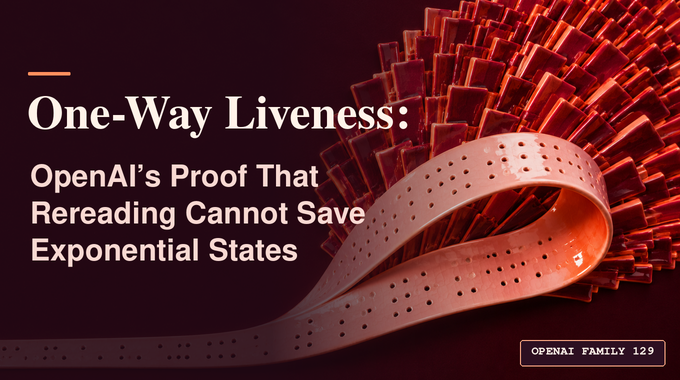
One-way liveness cover with looping punched tape and a fan of red ceramic tiles representing states.

Give a finite automaton permission to walk back and forth across its input, and it can revisit a choice point as often as it likes. Can that freedom make up for losing nondeterminism? OpenAI’s one-way liveness preprint gives a family for which the answer is no. A nondeterministic machine can recognize the language with h+3h+3 … Read more

Hawking–Page Transition: The Three-Loop Sign That Settled a 23-Year Black Hole Mystery

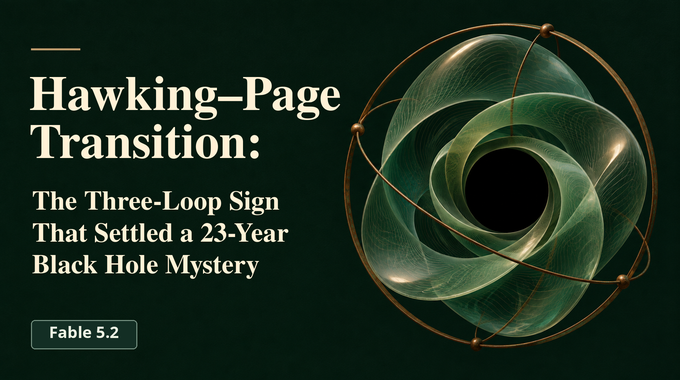
Three jade loops frame a black hole beside the Hawking–Page transition article title and Fable 5.2 label.

A gas of radiation can fill anti-de Sitter space at low temperature. Heat the system enough and a large black hole takes over. The Hawking Page transition is that abrupt switch. In 2003, physicists asked whether its gauge-theory counterpart still switches abruptly when the interactions are weak. A November 2026 preprint on the Hawking–Page transition … Read more