Fourier Series Convergence: How Did OpenAI Solve the L log L Problem?
Engraved waves resolve into one jade trace, illustrating Fourier series convergence.

A Fourier sum can approximate a function in mean square while still behaving erratically at individual points. OpenAI’s September 23, 2026 preprint settles a sharper question about Fourier series convergence. For every complex-valued function in Llog⁡LL\log L on the circle, the ordinary symmetric partial sums converge to the function almost everywhere along the full sequence … Read more
Dimension Reduction in Lp: How OpenAI’s Proof Escapes the Quadratic Trap

A copper lattice passes through a glass lens and emerges as a sparse network, illustrating dimension reduction in Lp.

An exact copy of the distances among a set of points can need quadratically many coordinates, even when the points themselves number only in the dozens. Allow a fixed amount of distortion, however small, and OpenAI’s preprint proves that the worst-case dimension drops below every positive power of the point count. This is dimension reduction … Read more

Weak vs Strong Normalization: How OpenAI Proved Every Reduction Path Must End

Three folded-paper paths end at separate platforms on the Weak vs Strong Normalization cover.

If every legal expression has a terminating reduction, must every reduction strategy terminate? For pure type systems, OpenAI’s September 2026 manuscript answers yes under a system-wide hypothesis. If every legal expression in every valid context can reach a β-normal form, then no infinite β-reduction sequence can start from any of them. Weak vs strong normalization … Read more

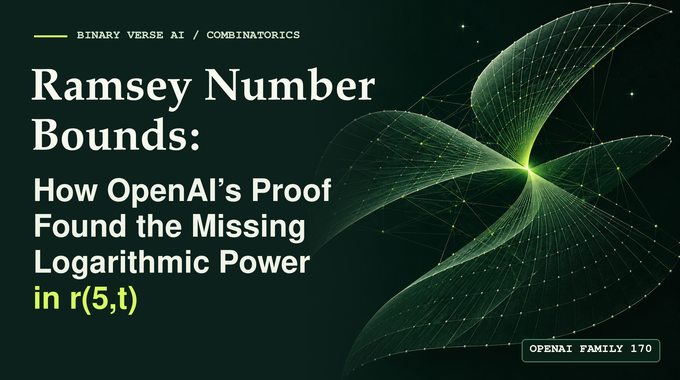
Ramsey Number Bounds: How OpenAI’s Proof Found the Missing Logarithmic Power in r(5,t)

Ramsey number bounds cover with a green wire network converging at a single point.

How long can a network avoid both five mutually connected vertices and a large group with no connections among them? For the Ramsey number r(5,t)r(5,t), the power of tt had been settled, but the best bounds still differed by three powers of a logarithm. OpenAI’s September 24, 2026 preprint pins the logarithmic exponent down to … Read more

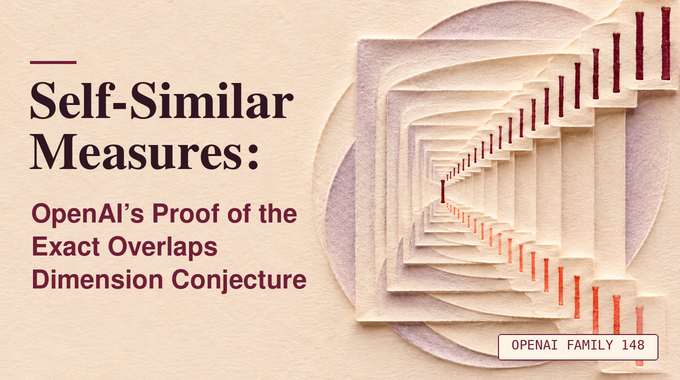
Self-Similar Measures: OpenAI’s Proof of the Exact Overlaps Dimension Conjecture

Embossed paths converge on one mark, illustrating exact overlaps in self-similar measures.

Two different instructions can draw precisely the same piece of a fractal. With the maps “divide by three,” “divide by three and add one,” and “divide by three and add four-thirds,” nine two-step paths produce only eight affine maps. Counting those paths as separate outcomes gives the construction more information than it actually carries. OpenAI’s … Read more

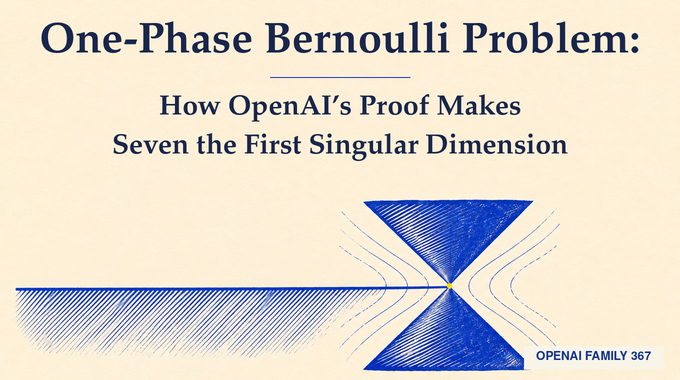
One-Phase Bernoulli Problem: How OpenAI’s Proof Makes Seven the First Singular Dimension

Linocut for the one-phase Bernoulli problem showing a flat interface beside a double cone with a singular tip.

A free boundary can look perfectly smooth in low dimensions yet develop a singular cone when enough coordinates are available. The one phase Bernoulli problem now has an exact threshold: the September 24, 2026 OpenAI mathematical manuscript proves that every nonzero one-homogeneous global minimizer is a half-space solution through dimension six. A nonflat minimizing cone … Read more

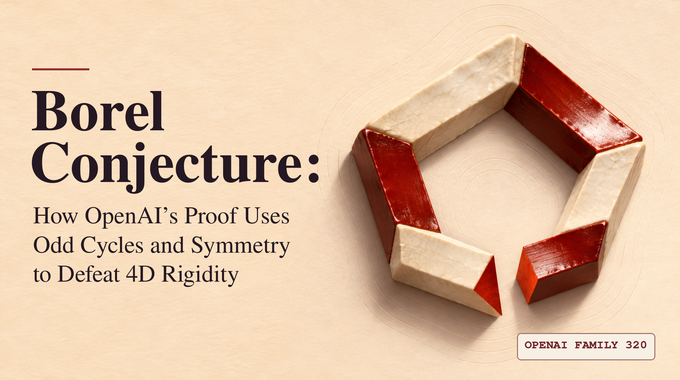
Borel Conjecture: How OpenAI’s Proof Uses Odd Cycles and Symmetry to Defeat 4D Rigidity

A broken ceramic loop with red ends evokes the odd-cycle obstruction in the Borel Conjecture proof.

In the double cover, every plumbing edge has one end where the right cap is selected. On an odd cycle, the same two colors cannot alternate all the way around. That difference drives OpenAI’s Borel Conjecture counterexample in dimension four. The preprint constructs two closed, connected, aspherical topological four-manifolds that are homotopy equivalent but not … Read more