
OpenAI and Onava tested 322 small proteins built on shapes proposed by a general-purpose language model. Thirty-five registered as binding hits, with at least one hit for each of five targets. That result gives AI protein design a new source of candidate structures: a model that can translate written requirements into molecular geometry using reasoning and code.
The November 24, 2026 preprint by Uehara and colleagues also reports binding after GPT-6.2 rewrote sequences for existing minibinders and antibodies. The division of labor matters. GPT generated the backbones in one experiment and the sequences in others. Specialist models supplied sequences for the backbone campaign and helped select laboratory candidates throughout. Global folding, the task of predicting an entire structure from its sequence, remained a weakness.
Table of Contents
1. AI Protein Design: The Scientific Barrier GPT-6 Is Challenging
A design brief can mix several kinds of requirements: a desired overall shape, a region where two molecules should meet, and a limit on how much a sequence can change. Each constraint describes a different feature of the molecule. The authors call a protein capability “intrinsic” when GPT handles the generation or prediction using reasoning and basic coding tools without calling a pretrained specialist model at that stage. The experiments test how far that capability extends and where outside models still add value.
| Campaign | Screening Hits | What Was Tested |
|---|---|---|
| De novo minibinders | 35/322 (10.9%) | GPT backbones, specialist sequences (Section 2.5) |
| Minibinder inverse folding | 123 hits | GPT sequences, nonpublic backbones (Section 3.3.1) |
| VHH inverse folding | 128/182 (70.3%) | Single-domain fragments with reported results (Section 3.3.2) |
| Therapeutic antibody redesign | 179/272 (65.8%) | Fragments from five parental families in the screen (Section 3.3.3) |
2. The Original Protein Design Problem and the Limits of Specialized Models
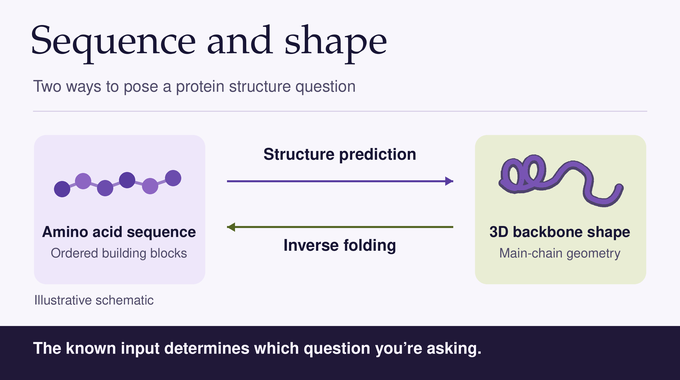
An amino acid sequence specifies the order of a protein’s building blocks. Their interactions shape how the chain folds, while the resulting surface, flexibility, and chemical properties help determine its function. Protein structure prediction starts with a sequence and estimates its shape. Protein inverse folding starts with a shape and asks which sequences might adopt it. De novo protein design starts with a goal, such as making a new binding protein, and has to account for both the structure and the sequence.
Established protein engineering workflows are built around that division of labor. RFdiffusion generates structures, ProteinMPNN proposes sequences for supplied backbones, and AlphaFold-based workflows predict structures from sequences and can provide a computational check. Each tool has ways to accept constraints, but a requirement outside its established inputs may need custom software or changes to the model. A language interface can express several requirements together. The scientific question is whether the resulting molecule satisfies them.
3. How GPT-6 Approaches Protein Biology: The Complete Research Roadmap
The study’s research strategy connects five decisions, from specifying a molecule to interpreting an assay. This roadmap reconstructs the logic across the campaigns. Section 6 and Appendix E provide selected examples of the model’s recorded reasoning and code.
- Define the requirement. A request such as “make a small protein that binds” leaves too much open. The researchers specify the desired property and provide structural information, giving the model a concrete object to reason about.
- Translate the request into geometry. Parts of a chain can fit locally yet fail to form a coherent whole. GPT interprets the supplied structure and turns written requirements into spatial relationships it can examine.
- Generate and check candidates. A plausible description can still yield inconsistent coordinates. The authors show examples in which GPT used code to evaluate proposals and revise them in response to geometric or chemical checks.
- Select candidates with specialist models. A design can look plausible in its submitted form while its sequence is predicted to adopt a different shape. Specialist predictions helped the team choose which candidates to test. In the de novo campaign, a specialist also assigned sequences to GPT’s backbones.
- Measure binding and interpret the result. Onava tested selected proteins and measured affinity for a subset. The results support binding under the assay conditions. The proposed structure and biological effect remain separate experimental questions.
4. From Language to Molecular Geometry: The Science Behind GPT-6 Protein Design
A backbone is the repeating main chain of a protein. Its geometry can be represented by three-dimensional coordinates for the backbone nitrogen, alpha carbon, carbonyl carbon, and oxygen of each residue. Side chains project from that framework and give different residues their chemical properties. A model can therefore describe a convincing overall shape and still make an implausible proposal if the chain fails to connect or if atoms overlap.
In OpenAI’s documented binder example, GPT considered how a helical structure might fit a target surface and used custom calculations to compare alternatives. The record illustrates why a single geometric cue can mislead. Two proposed polar contacts can have similar separations while their orientations differ enough for one to score much better. That score records a preference in the model’s calculation. Establishing a contact in the physical complex would require structural evidence.
The GPT-6 protein design approach let researchers change the task in words, such as requesting a different class of fold. Those changes altered the instructions without additional model training. Whether the request carried through depended on the task and the independent checks applied to the output.
5. De Novo Protein Design: Creating New Molecular Structures
A minibinder is a small protein intended to attach to a target. Designing one requires a plausible fold and a plausible placement against that target. Internal GPT models generally exceeded RFdiffusion on the paper’s computational protein-target tests. On selected tests spanning small molecules, RNA, and DNA, internal models performed comparably to RFdiffusion3. The checks used predicted refolds and measures of the proposed interface or pose. The wet-lab minibinder results came from a separate experiment on protein targets.
Two benchmarks probed different kinds of structural control. The CATH system groups protein domains by class, architecture, topology, and homologous superfamily. Class describes the broad mix of structural elements, architecture their arrangement, and topology how they connect. In topology-conditioned generation, 18.9% of the internal model’s designs met both the requested topology and the backbone similarity criterion, compared with 17.1% for Proteina. The paper also tested the reverse direction: identifying a CATH classification from supplied coordinates.
Motif scaffolding asks whether a model can build the rest of a backbone around a supplied geometric feature while preserving it. The internal model passed on 43.7% of evaluable scaffolds versus 27.8% for RFdiffusion on MotifBench, with different numbers of evaluable outputs. Its success rate was higher on 19 of 30 motifs. That per-motif result shows how much a pooled percentage can obscure.
6. Wet-Lab Validation: What 35 Successful Protein Binders Actually Prove
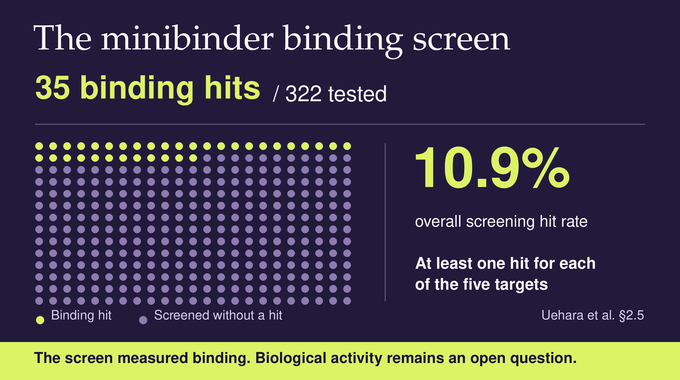
OpenAI used prerelease GPT-6.2 to propose backbones. SolubleMPNN supplied sequences, and specialist structure predictors helped select the candidates. Onava screened them with biolayer interferometry (BLI), which measures the optical change as molecules associate with or dissociate from a sensor surface. A follow-up series at multiple concentrations can estimate the equilibrium dissociation constant, . A lower value indicates tighter binding under comparable conditions. Figure 9 reports 1.21 nanomolar for one minibinder characterized this way.
The overall hit rate divides the number of hits by the total screened.
The equation pools all designs. Consequently, a target with 93 tests carries about twice the weight of one with 45. The individual screening rates ranged from 2.2% to 40.0%. These denominators describe candidates that reached the lab after computational selection. Differences in target choice, candidate selection, and assay definitions make comparisons across binder studies uncertain. A BLI hit establishes evidence of attachment under the assay conditions. Whether that attachment changes a cell’s behavior requires a different experiment.
7. Protein Inverse Folding: Redesigning Sequences Beyond Memorization
In inverse folding, the backbone is supplied and the sequence is the unknown. GPT-6.2 and the internal models generally recovered more native residues than ProteinMPNN on the paper’s public structure benchmarks. The specialist remained comparable on predicted structural self-consistency, which asks whether a sequence is predicted to fold back to the supplied shape. High sequence recovery can reflect prior exposure. The paper also raises the possibility that artifacts in predicted AlphaFold Database structures may give away residue identities.
A rotated or translated molecule retains all its internal distances. The researchers tested this by moving input structures as rigid bodies and found that mean sequence recovery was nearly unchanged. That supports approximate invariance to the coordinate frame. Supplying a protein binding partner raised mean sequence recovery at the interface from 75.7% to 80.6%, showing that surrounding molecular information affected the answers.
The wet-lab test used nonpublic target–binder backbones and withheld parental binder sequences. The team reported 123 screening hits across five targets. Of those hits, 38 shared only 30–50% sequence identity with their parent. These results are stronger evidence of generalization than high native recovery on public structures. The authors still used specialist models to select candidates, and the measured outcome was binding.
8. AI Antibody Design: GPT-6’s Experimental Redesign of Therapeutic Antibodies
Complementarity-determining regions (CDRs) are antibody loops that contribute much of the binding surface. The surrounding framework holds those loops in place. In computational antibody inverse folding, GPT-6.2 and the internal models recovered more original CDR residues than AbMPNN, with comparable structural self-consistency by the paper’s metrics.
The team evaluated two kinds of antibody fragments in the lab. A VHH contains a single antibody variable domain. GPT generated loop sequences with the parental loop sequences withheld, and 128 of 182 designs with reported results screened positive (70.3%). The therapeutic antibody experiment started with parental sequence information and deliberately changed the heavy-chain binding loops. It produced 179 screening hits among 272 fragments across five parental families (65.8%). The assays support binding to the tested targets. They leave open whether full-length antibodies would retain the same behavior, whether the changes alter specificity, and whether the resulting molecules could be developed as medicines.
9. GPT-6 vs Specialized Models: Protein Structure Prediction and Molecular Docking
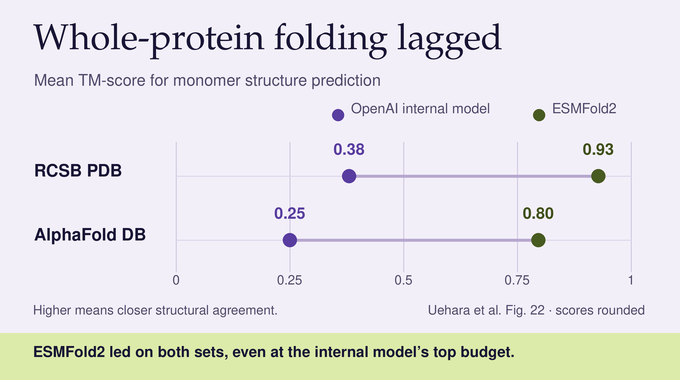
The strongest internal model in the global monomer tests reached mean TM-scores of 0.38 on the Protein Data Bank set and 0.25 on the AlphaFold Database set at its highest evaluated budget. ESMFold2 scored higher on both. TM-score compares a predicted and reference structure on a roughly zero-to-one scale, with higher values indicating closer global agreement. Root-mean-square deviation (RMSD) measures positional error over corresponding atoms after the alignment specified for the task. Lower values indicate closer agreement. For local antibody loop prediction, the internal model came closer to ESMFold2, which had lower median RMSD on five of six loops.
Docking supplies some of the geometry up front and asks how molecules fit together. For antibody–antigen reassembly, the internal model reached a mean DockQ of 0.96 with side chains supplied and 0.81 with backbone coordinates alone. Higher DockQ means a closer match to the known complex. Both settings started from components in their bound conformations. This tests reassembly and leaves the harder problem of how binding changes each partner’s shape open.
With receptor side chains supplied, GPT-6.2 and the internal model outperformed DiffDock-L at their highest tested budgets on the two small-molecule docking benchmarks. In a separate side-chain packing task, the internal model nearly matched FlowPacker-4 on median heavy-atom RMSD, while trailing it on torsion-angle accuracy. Those metrics capture different aspects of the same prediction.
10. Can GPT-6 Predict the Effects of Protein Mutations?
Section 5 asks how well models can rank sequence variants by experimentally measured properties. ProteinGym includes assays for properties such as expression and stability. BindingGYM evaluates how substitutions affect molecular interactions. On each task, the model ranked 50 variants using sequence and assay context, with experimental outcomes withheld and coding tools disabled.
Spearman rank correlation () compares the predicted and measured order. A value of 1 means the orders agree perfectly, and −1 means one is the reverse of the other. A good rank correlation can help prioritize experiments even if it gives no estimate of how large a stability or affinity difference will be. GPT-6.2 and the internal models ranked variants more accurately on average across the evaluated datasets than the ESM2-650M baseline. The authors acknowledge possible prior exposure to related sequences or assay results, which limits the strength of the zero-shot comparison.
11. What OpenAI’s Experimental Proof of Concept Establishes and Where It Stops
The case against simple memorization is strongest where nonpublic inputs and sequence divergence coincide with measured binding. Rigid-body tests address a narrower question about coordinate dependence. Public benchmarks can still reflect training exposure. Likewise, the paper compares models at their highest evaluated budgets in several figures, so reported differences do not establish relative performance under equal compute.
The experiments used a prerelease GPT-6.2 checkpoint. The authors report it separately from the advanced internal models that set many of the best computational scores. Model names, access, and evaluation settings matter when interpreting what a public deployment can reproduce. Independent replication on unseen targets, with comparable selection rules and assay definitions, would help establish how much of the performance generalizes. As biological design tools gain capability, evaluations of access controls and misuse safeguards also need to keep pace.
12. Programmable Molecular Design and What It Means for Pharmaceutical Research
Programmable molecular design would let researchers revise a design brief in ordinary language and inspect the resulting candidates using tools appropriate to the question. In AI drug discovery, that may shorten the loop between proposing an idea and deciding what to make. Where a project needs both whole-protein folding and targeted redesign, the paper’s results suggest a division of labor: generalist models can propose candidates, while specialist predictors and experiments check different parts of the claim.
For pharmaceutical research, promising binding leads still face tests of specificity, cellular activity, stability, and safety. Clinical trials would then ask whether a candidate offers a meaningful benefit for patients. The lasting contribution to AI protein design is evidence that a language model can generate molecular candidates worth testing, with clear experimental limits on what their binding proves.
Follow Binary Verse AI for independent analysis of AI research grounded in primary sources.
How does GPT-6 perform AI protein design?
GPT-6 combines biological knowledge with reasoning and code to generate and evaluate candidate structures and amino acid sequences. In the paper, natural-language instructions let researchers specify structural and sequence constraints without retraining the model.
Is GPT-6 better than AlphaFold for protein design?
The paper finds GPT-6 models competitive on several protein-design tasks. On monomer-folding tests, the benchmark’s specialist reference, ESMFold2, was substantially more accurate than the reported internal model.
Were GPT-6-designed proteins experimentally validated?
Yes. OpenAI and Onava reported 35 binding hits among 322 screened minibinders and found hits for all five tested targets. GPT-6.2 supplied the candidate backbones, SolubleMPNN supplied the sequences, and specialist predictions helped select candidates for testing.
Can GPT-6 design proteins without specialized AI models?
GPT-6 models generated candidate structures and sequences with reasoning and general-purpose code in designated tasks. Specialist models supplied sequences for the de novo backbone experiment and helped assess and select candidates for all laboratory campaigns.
Can GPT-6 redesign therapeutic antibodies?
In the reported experiments, 179 of 272 redesigned therapeutic antibody fragments screened positive for target binding after substantial changes to their heavy-chain binding loops. The experiment tested binding under assay conditions. Therapeutic performance would require additional experiments.
Is GPT-6 simply memorizing existing protein structures?
The paper found that sequence recovery changed little when researchers rotated or translated the input structures. It also reported binding for substantially redesigned sequences based on nonpublic structures. These results weigh against simple memorization, while prior exposure remains possible on public benchmarks.
Can GPT-6 accelerate pharmaceutical drug discovery?
The results show that GPT-6 can propose protein and antibody candidates worth testing. The time savings across drug development remain to be measured. Binding is an early result, and therapeutic candidates still require functional, safety, stability, and clinical evaluation.