De Giorgi Conjecture: How the OpenAI Proof Forces Flatness in Eight Dimensions
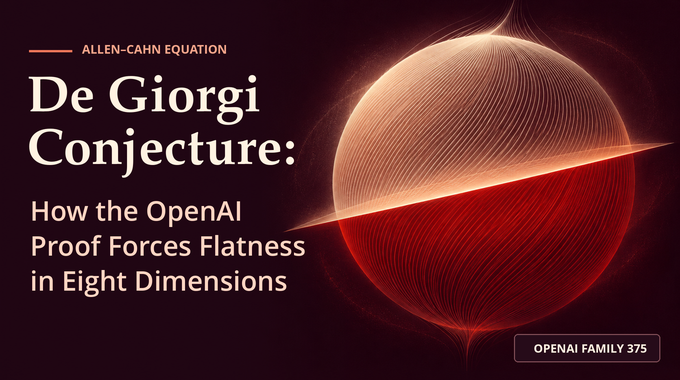
De Giorgi conjecture artwork with a luminous plane dividing a sphere into two phases.

The De Giorgi conjecture asks whether a phase boundary can bend when the field describing it rises in one fixed direction everywhere. In eight dimensions, OpenAI’s September 26, 2026 preprint proves that it cannot for the scalar cubic Allen–Cahn equation. Every entire solution in the open interval between the two wells with an everywhere positive … Read more
Graph Coloring NP-Hard: The OpenAI Proof Behind the Three-Color Paradox

Three porcelain ribbons rise from tangled threads, illustrating why graph coloring is NP-hard.

A graph can come with a guarantee that three colors suffice and still hide a solution that no polynomial-time algorithm can always find, unless P equals NP. Is graph coloring NP hard even if the algorithm gets a larger palette? Yes, for any fixed palette of three or more colors. OpenAI’s September 24, 2026 preprint … Read more

Grothendieck Homotopy Hypothesis: How the OpenAI Proof Reveals the Algebra of Spaces

A glass ribbon traces paths between two points, illustrating the Grothendieck homotopy hypothesis.

Take a path, add a second path with the same endpoints, and join them by a homotopy. In a free algebra of paths, however, it creates new composites, inverses, and higher coherence cells as well. The September 24, 2026 OpenAI preprint proves that the entire extension leaves the homotopy type unchanged for cellular models of … Read more

Mazur Conjecture: The Polynomial That Could Overturn a 30-Year Prediction and Go Beyond Hilbert’s Tenth Problem

Mazur Conjecture cover with a paper river passing through a comb and emerging as separated jade islands.

Give a polynomial the number 7 as its first input and ask whether rational numbers can fill the remaining slots so that it vanishes. Now try 72\frac{7}{2}. A November 6, 2026 manuscript claims to give one equation that separates those cases for every rational input. If its arithmetic proof holds, the equation would refute the … Read more

Aaronson Ambainis Conjecture: How One Bit Revealed the Limits of Quantum Speedups

A glowing edge on a glass hypercube represents an influential bit in the Aaronson Ambainis Conjecture.

Suppose a quantum algorithm can query a vast string of bits in superposition, while a classical algorithm has to inspect one bit at a time. How can the classical algorithm know where to look? The November 2026 proof of the Aaronson Ambainis Conjecture gives an answer. Every nonconstant bounded polynomial of low degree on the … Read more

Calderon Inverse Problem: The Hidden Geometry That One Boundary Patch Can Determine

Calderon Inverse Problem artwork reveals hidden geometry and paired transport ribbons through one boundary patch.

Imagine controlling a small accessible patch of an object while its remaining boundary stays out of reach. Can those measurements determine its entire hidden geometry, together with a rule for transporting two-component complex vectors? OpenAI’s October 5, 2026 manuscript answers this version of the Calderon Inverse Problem with a uniqueness theorem. For a smooth metric … Read more

Purely Cosmetic Surgery Conjecture: Inside OpenAI’s Two-Count Proof

Purely Cosmetic Surgery Conjecture artwork showing a porcelain knot and two contrasting portals.

Cut out a thickened knot, glue it back with a different slope, and ask whether the entire oriented universe around it can look unchanged. The Purely Cosmetic Surgery Conjecture says this cannot happen for a nontrivial smooth knot in the three-sphere. OpenAI’s September 23, 2026 manuscript presents a proof: earlier work reduces the problem to … Read more