Contingency Table Sampling: The Paradox of Getting Perfect Uniformity from Imperfect Randomness
Contingency table sampling shown as coral ribbons corrected into equal mint streams and table tiles.

Three tables can have identical row and column totals yet receive very different probabilities from a careless random generator. Contingency table sampling asks for something stricter: every feasible integer table must have the same chance. OpenAI’s September 24, 2026 manuscript establishes exact uniform sampling for arbitrary nonnegative margins, with polynomial expected bit complexity. Its route … Read more
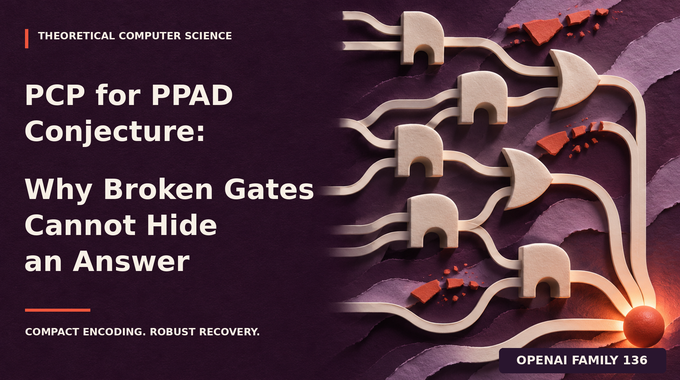

PCP for PPAD Conjecture: Why Broken Gates Cannot Hide an Answer

PCP for PPAD Conjecture illustrated by fractured ceramic gates and intact paths converging on an answer.

Imagine a circuit that can conceal its answer by breaking a few carefully chosen gates. The PCP for PPAD Conjecture asks whether that escape route can be closed with almost linear storage overhead. OpenAI’s September 25, 2026 manuscript presents a proof: even an adversarially placed constant fraction of failed constraints cannot prevent polynomial-time recovery of … Read more

Matroid Prophet Inequality: One Sample, No Secrets, Inside OpenAI’s Proof

Matroid prophet inequality depicted as a golden forest inside transparent blue glass.

Imagine choosing network connections while an opponent already knows every value, every sample and every coin you will flip. Your decisions remain irreversible. OpenAI’s September 23, 2026 paper proves that a matroid prophet inequality survives this information imbalance: one independent sample per element suffices for a universal expected reward fraction of 2−3102^{-310}. The detailed proof … Read more

Infinity Laplacian Regularity: How OpenAI’s Proof Turns Flatness into Hölder Gradients

Infinity Laplacian regularity illustrated by copper contours and nested tangent planes.

A function can have a derivative everywhere without that derivative varying continuously. That gap is the central issue in higher-dimensional infinity Laplacian regularity. OpenAI’s October 4, 2026 manuscript proves that bounded infinity-harmonic functions in dimensions d≥3d\ge3 have uniformly Hölder-continuous gradients on interior balls. The exponent is positive and dimension-dependent, but unspecified. The proof converts qualitative … Read more

Wall D2 Problem: How OpenAI’s Twisted-Homology Proof Found a 3D Counterexample

Wall D2 Problem artwork showing a twisted cellular sculpture and its two-dimensional shadow.

Can a space satisfy the algebraic tests for two dimensions yet still require three? The Wall D2 Problem asks exactly that question about finite cell complexes. OpenAI’s October 6, 2026 manuscript constructs a finite three-dimensional complex satisfying the D(2) conditions but admitting no finite two-dimensional homotopy model. Its fundamental group is infinite. The decisive obstruction … Read more

Hot Spots Conjecture: OpenAI’s Proof That Excludes Every Interior Critical Point

Hot Spots Conjecture artwork shows warm and cold boundary extremes on an irregular enamel plate.

An insulated plate can have an irregular outline, deep indentations and no symmetry. As temperature differences fade, must its slowest nonconstant heat pattern put its hottest and coldest values on the edge? OpenAI’s September 24, 2026 paper on the Hot Spots Conjecture proves a stronger statement for smooth, bounded, simply connected planar domains: every nonzero … Read more

Weisfeiler–Leman Time Complexity: OpenAI’s Proof of an Unavoidable \(n^{\Omega(k)}\) Time Cost

Weisfeiler Leman time complexity illustrated by a graph-printing press and growing stacks of graph plates.

Must a graph comparison become polynomially harder as its dimension grows, or could a clever algorithm bypass the expensive refinement? OpenAI’s September 25, 2026 paper on unconditional WL lower bounds answers this question about weisfeiler leman time complexity. For every sufficiently large fixed dimension, every correct deterministic sequential decider needs an exponent proportional to that … Read more