Logarithmic Brunn–Minkowski Conjecture: How OpenAI Proved the Symmetric Inequality in Every Dimension
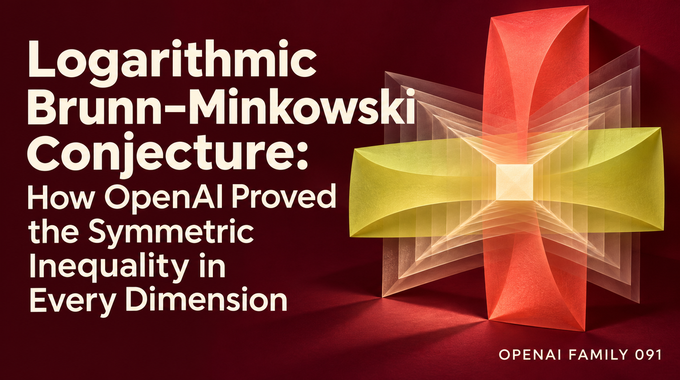
Logarithmic Brunn Minkowski conjecture artwork showing symmetric shapes and geometric interpolation.

A convex body can become smaller when you replace arithmetic averages with geometric ones. The logarithmic Brunn Minkowski conjecture asks whether its volume nevertheless stays above a precise lower bound. OpenAI’s paper proves that it does for any two origin-symmetric convex bodies, in every dimension. The result rests on a sharp variance inequality, a transport … Read more
Erdős Similarity Conjecture: OpenAI’s Proof of the Almost-Full Set Paradox

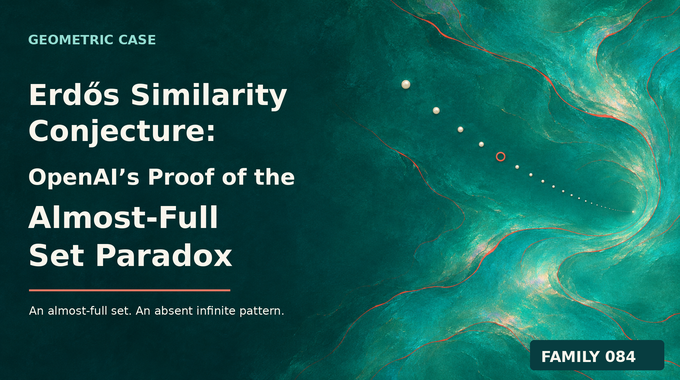
Erdős similarity conjecture artwork showing a nearly intact field and an interrupted geometric sequence.

Remove less than one percent of a unit interval. Can the remaining compact set exclude every translated, stretched, compressed, or reflected copy of an infinite geometric progression? OpenAI’s proof answers yes for every fixed ratio 0<q<10<q<1. Its October 5, 2026 paper establishes the geometric case of the Erdős similarity conjecture: however small the permitted loss … Read more

Phillips–Toms Conjecture: How OpenAI Proved the One-Half Formula

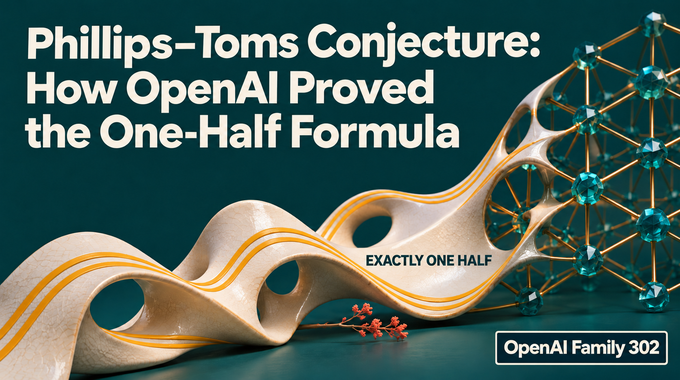
Phillips–Toms conjecture artwork links flowing orbit geometry to algebra and the one-half formula.

A dynamical system can require fresh geometric information at every step, even when its orbit lives inside one compact space. Can its associated algebra measure that same complexity exactly? The Phillips–Toms conjecture predicts that it can: the radius of comparison equals half the mean dimension. OpenAI’s September 25, 2026 paper proves this equality for every … Read more

Seymour Second Neighborhood Conjecture: The Graph That Cannot Exist

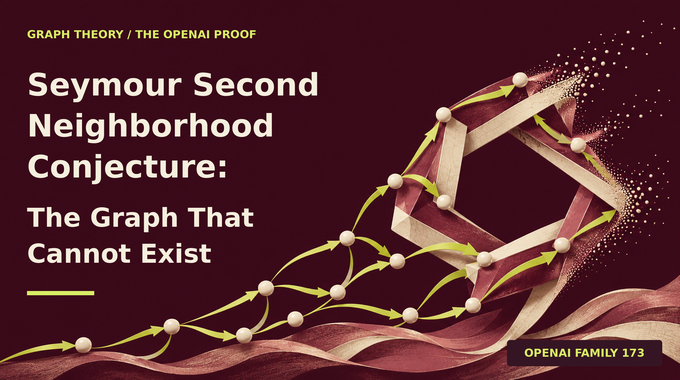
Seymour second neighborhood conjecture artwork showing a directed graph and a dissolving impossible frame.

Take any finite network of one-way arrows, forbid loops and opposing arrows, and look two steps ahead. Must somebody reach at least as many new vertices in two steps as in one? The Seymour second neighborhood conjecture says yes. OpenAI’s September 23, 2026 paper proves this for every nonempty finite oriented graph. Its argument assumes … Read more

Scalar Curvature and Urysohn Width: The Spectral Proof Behind Bounded Fibers

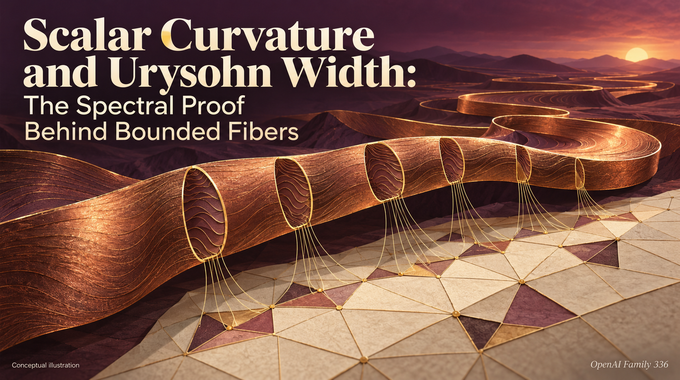
Scalar curvature and Urysohn width visualized as copper fibers projecting onto a triangulated map.

A manifold can extend forever while its geometry remains uniformly narrow in two directions. The new connection between scalar curvature and Urysohn width makes that intuition precise under a spectral condition that even permits negative scalar curvature locally. OpenAI’s October 5 paper proves that every complete, connected, smooth, boundaryless manifold of dimension n≥4n\ge4 satisfying −4Δ+Scal≥1-4\Delta+\mathrm{Scal}\ge1 … Read more

Nearby Lagrangian Conjecture: An Exact Twin Outside Hamiltonian Reach

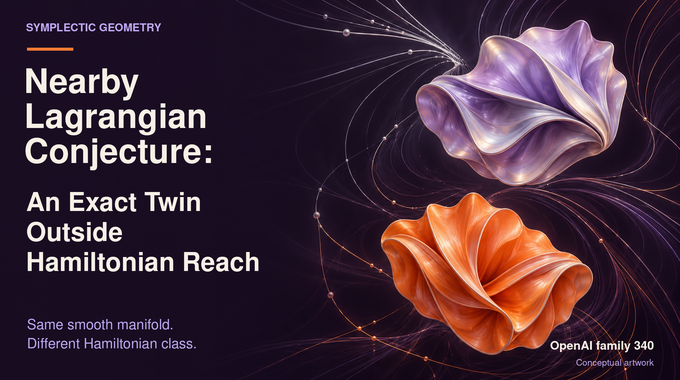
Nearby Lagrangian conjecture artwork showing smooth twins in different Hamiltonian isotopy classes.

Two manifolds can be exact smooth twins yet occupy different Hamiltonian isotopy classes. OpenAI’s September 23, 2026 manuscript gives a nearby Lagrangian conjecture counterexample: a closed exact smoothly embedded Lagrangian, diffeomorphic to the base of its cotangent bundle, that cannot be carried to the zero section by Hamiltonian isotopy. The base is a product of … Read more

Shub Entropy Conjecture: The Clock That Lets Homology Grow While Entropy Vanishes

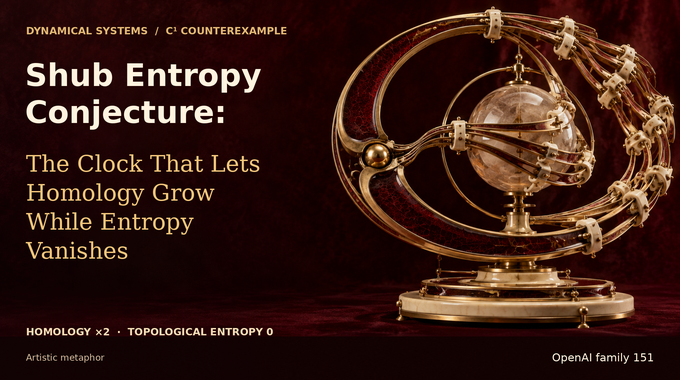
Shub entropy conjecture artwork showing a slowing clock and multiplying golden topology.

A sphere map can double aa topological feature every iteration while its observable orbit complexity grows slower than exponentially. OpenAI’s proof makes that mismatch explicit: the general C¹ self-map formulation of the Shub entropy conjecture is false. Its construction has zero topological entropy but an eigenvalue of 2 on second real homology. The mechanism combines … Read more