

Cut out a thickened knot, glue it back with a different slope, and ask whether the entire oriented universe around it can look unchanged. The Purely Cosmetic Surgery Conjecture says this cannot happen for a nontrivial smooth knot in the three-sphere. OpenAI’s September 23, 2026 manuscript presents a proof: earlier work reduces the problem to genus-two knots and opposite slopes of magnitude two, then two incompatible gauge-theoretic counts eliminate that case.
One count must be nonzero. A second construction forces a positive power of two times that count to vanish. Understanding why no hidden boundary can repair this contradiction is the central task. This article explains the manuscript’s argument while distinguishing its theorem claims from independent verification.
Table of Contents
01. What Does the Purely Cosmetic Surgery Conjecture State?
Let be a smooth nontrivial knot in the oriented three-sphere . Theorem 1.1 of Purely cosmetic surgery on knots in the three-sphere says that an orientation-preserving homeomorphism between fillings implies equal slopes:
Here and range over . Crucially, the homeomorphism need not preserve the surgery core or identify the original knot exteriors. It compares the whole filled manifolds. “Purely” requires preserved orientation; allowing reversal asks a different question.
| Item | Precise Scope |
|---|---|
| Result | Distinct slopes cannot give the same oriented filling. |
| Hypotheses | A smooth nontrivial knot in . |
| Remaining case | , with slopes and . |
| Mechanism | Nonzero instanton count versus vanishing weighted boundary count. |
| Source status | September 23, 2026 preprint; family 306. Review and Lean scope are discussed below. |
02. How Dehn Surgery Changes a Knot’s Three-Manifold
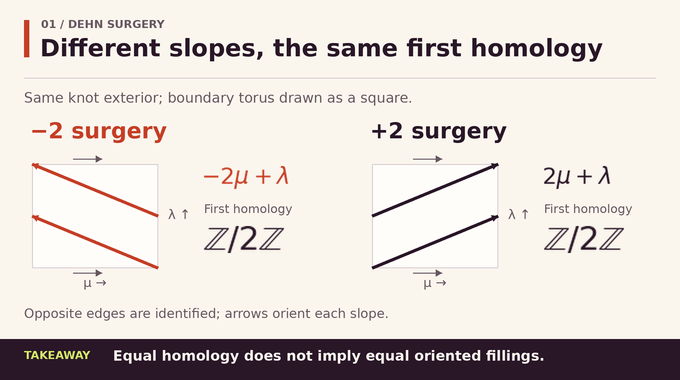
Dehn surgery on knots removes the interior of a tubular neighborhood, a solid torus. Its complement has a torus boundary. A replacement solid torus is attached so that its meridian, the circle bounding a disk inside it, becomes a chosen boundary curve.
The knot’s meridian circles the removed knot. Its preferred longitude follows the knot with zero linking number. A slope represents the primitive class , with coprime integer coefficients considered up to simultaneous sign. Thus means , while means . These are distinct slopes, not two orientations of one curve.
Both fillings have first homology , so that elementary invariant cannot separate them. This is a useful worked example of the obstacle: identical homology does not establish a homeomorphism. As in our Poincaré conjecture explainer, recognizing a three-manifold requires more than counting holes informally.
03. Why Earlier Proofs Left Only Genus-Two Knots and ±2 Surgery
Earlier work progressively restricted possible coincidences. Heegaard Floer surgery formulas supplied obstructions. Ni and Wu forced any hypothetical purely cosmetic pair into opposite slopes. Hanselman narrowed those pairs to or , with positive integer denominator, and showed that the magnitude-two case requires genus two.
Daemi, Lidman, and Miller Eismeier’s filtered instanton homology argument excludes the reciprocal pairs. Proposition 1.2 packages the consequence used here: a counterexample must satisfy and have slopes and . The genus is the minimum genus of an orientable surface spanning the knot.
This reduction is imported, not reproved. The earlier results impose additional polynomial conditions, but the new argument uses only the genus and slope restriction. Genus-two knot surgery is therefore the final universal obstruction problem, rather than a convenient selection of examples.
The first homology calculation also explains why zero cannot hide among these surviving pairs. For a nonzero numerator, the filling has finite cyclic first homology of order equal to the numerator’s absolute value. At zero numerator the group is infinite cyclic. Equal absolute numerators are only a necessary condition for matching fillings. The successive Floer restrictions extract information that this coarse algebraic test cannot see.
04. The Contradiction Setup: Assuming −2 and +2 Surgeries Agree
Write and suppose there is an orientation-preserving identification . Three-dimensional smoothing lets the manuscript use a diffeomorphism. No peripheral condition is imposed on .
A surgery trace is a four-dimensional cobordism joining the original three-manifold to a filling. Joining traces gives maps between instanton Floer complexes. The hypothetical identification lets the proof repeatedly return to the same boundary convention, assembling a finite stack between two fixed caps.
This is where a three-dimensional recognition question becomes a four-dimensional counting problem. The stack is built to support both counts with the same determinant data, metric families, incidence tests, and orientation conventions. Without that compatibility, two separately valid constructions would not yield a contradiction.
05. Instanton Floer Theory, Handle Maps and the Negative Interval Unit
Instanton Floer homology organizes special gauge connections on a three-manifold and trajectories between them. The handle maps count solutions of the anti-self-dual connection equations on cobordisms. Gauge transformations have determinant one, with determinant connections and transition identifications fixed. At zero surgery , an odd determinant evaluation on the capped Seifert surface excludes reducible projectively flat connections.
Sections 2–3 distinguish parity information from signed integer counts. A “unit” means an isomorphism on Floer homology over , the two-element field. It does not mean an arbitrary chain-level matrix is invertible over the integers.
The negative interval map combines a metric interval, a degree-two sphere test, and two determinant lifts. Theorem 3.1 makes it an integral chain map whose mod-two reduction is a homology isomorphism. Proposition 3.3 fixes the lifts’ relative signs locally, so minimal lens-cap contributions cancel. Modulo two, opposite signs coincide; the final oriented count needs their integer distinction.
06. Constructing the Nonzero Instanton Count Ω
Sections 4–5 supply the first count. Symplectic caps close the geometry, and Donaldson nonvanishing gives a nonzero rational pairing of cap states. These states arise from fixed point and surface probes supported away from the variable blocks. Clearing denominators produces an integral pairing , where this is unrelated to a surgery denominator.
A mod-two unit alone does not guarantee that every repeated integer pairing stays nonzero. The manuscript passes to the free integral Floer lattice and reduces modulo a sufficiently large . The relevant operators become invertible on this finite module, so suitable repeated blocks act as the identity there. The resulting count obeys
This proves nonvanishing without computing the integer’s numerical value. Repetition also makes the complex coupled Dirac index positive while respecting integral bundle-degree congruences. Theorem 5.11 establishes both properties simultaneously, with topology chosen before the later metric and perturbation choices.
There is a concrete algebraic reason repetition works. After removing torsion, the homology groups form a finite-rank free lattice. An induced square matrix with odd determinant becomes invertible modulo every power of two. The invertible matrices over that finite coefficient ring form a finite group, so each has finite order. Choosing a common repetition exponent restores the cap pairing modulo the selected power. Separately, increasing the allowed repetition raises the Dirac index. Neither step asserts that the original integral map is an isomorphism.
07. Why PU(2) Monopoles Produce a One-Dimensional Boundary Count
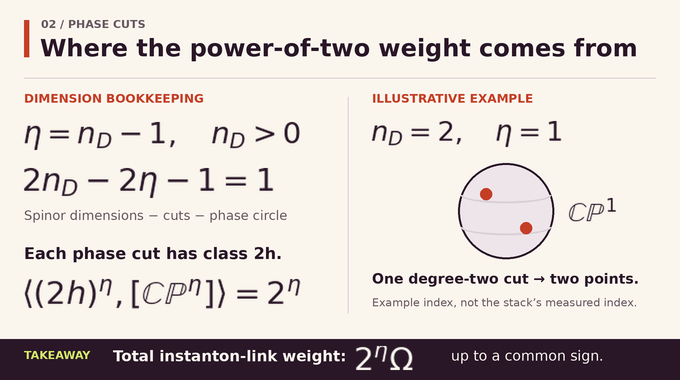
PU(2) monopoles couple a gauge connection to a spinor through nonlinear curvature and Dirac equations. At zero spinor, the ordinary instanton solutions reappear. Multiplication of the spinor by a phase gives a circle action.
Starting with the zero-dimensional ordinary count, the spinor directions add twice the complex index in real dimensions. Choose complex phase cuts, each imposing two real conditions, and quotient by the effective phase circle:
Near a regular instanton, the quotient of the normal link is , a complex projective space. Each phase cut represents , twice its hyperplane class , rather than a single hyperplane. Consequently,
These links contribute with the ordinary instanton signs, up to one common orientation convention. For illustration, if , then and a degree-two cut on counts two points with complex orientation. This illustrates the multiplier, not a measured index for the constructed stack.
At the smallest positive index, , no phase cuts are needed. The link is , a single point, so the multiplier is one. The same intersection formula therefore covers this endpoint without an additional convention.
08. Toric Metric Families and the Abelian Clamp
A reducible connection preserves a splitting into line bundles. Such fields could produce extra boundary terms, so the metric family must constrain their possible line classes. Sections 6–7 construct toric regions whose periods, integrals of geometric forms over surfaces, feed into quadratic and index inequalities.
The construction combines toric Kähler geometry, curvature estimates, long tubes, and isolated-cap bounds. Theorem 7.1 calls the resulting simultaneous restrictions the Abelian clamp. They apply at genuine corners of the parameter family as well as individual faces. Positive scalar curvature is required on specified limiting pieces, not on every knot-surgery cross-section.
Long auxiliary collars and surgery seams remain finite. Only designated spherical and lens cuts become genuine infinite ends. That distinction controls which broken configurations require analysis. Our scalar curvature explainer gives broader geometric context, but the clamp’s specific inequalities belong to this manuscript.
The order of choices matters. The finite stack, bundle lifts, and charge bounds are fixed first. The construction then chooses isolation sizes, background line connections, small perturbations, and sufficiently long finite surgery collars. Bounds are uniform over the required parameter faces for that finite problem. Arbitrarily stretching a collar afterward without checking those quantifiers could change the limiting problem and introduce configurations that the argument never claimed to control.
09. Eliminating Reducible, Broken and Bubbled Solutions
The second count would prove nothing if an overlooked degeneration could cancel the instanton contribution. Sections 8–9 address reducible fields, broken trajectories, and bubbling, where curvature concentrates into pointlike ideal particles. Compactness must account for all lost charge and all surviving constraints.
Lemma 9.10 uses exact-support incidence tests. A test persists unless a particle hits its actual support. If it does, dropping the test retains that incidence condition. Particle positions and released test degrees together have a bounded dimension budget, preventing the same loss from paying for unrelated constraints.
Index inequalities first rule out fixed-type candidates under stated regularity hypotheses. Mixed configurations need another step: Lemma 9.14 projects away zero-spinor Abelian fields while retaining their parameters. The retained equations must be independent of those discarded fields. Finite, equivariant branch perturbations then provide the transversality that turns negative projected dimensions into exclusions.
The outcome is a finite weighted branched problem. It is not enough simply to invoke a compact smooth one-manifold. Proposition 9.15 protects legitimate instanton neighborhoods and preserves paired lens-exterior data while excluding forbidden candidates. Those compatibility requirements allow a rational, oriented boundary formula later.
| Candidate | Treatment in the Argument |
|---|---|
| Instanton links | Retained; total , up to a common sign. |
| Single minimal lens cap | Retained; paired determinant sectors cancel. |
| Other reducible or mixed limits | Excluded by clamp, index and projected regularization arguments. |
| Other broken or bubbled limits | Excluded using charge, incidence and dimension budgets. |
This analysis also separates numerical exclusion from analytic justification. A formal negative expected dimension does not, by itself, imply that a nonlinear solution space is empty. One must establish enough independent local variations to make the retained equations transverse, and compactness must reduce the candidate images to finitely many choices. The manuscript constructs those variations near the candidates that actually arise. It does not claim compactness for every solution of the larger, unconstrained projected equations.
10. The Final Contradiction: Why the Boundary Count Must Vanish
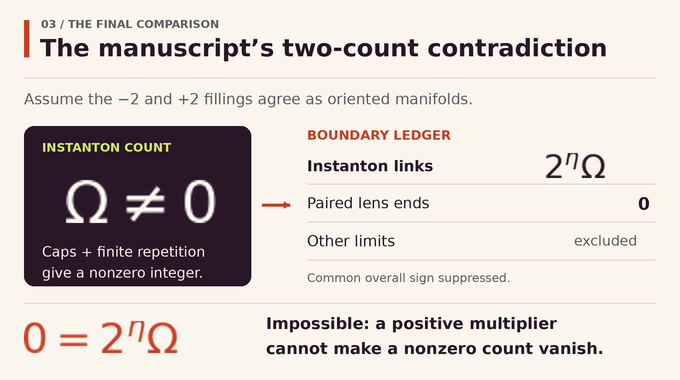
At each surviving lens face, one minimal trace cap separates from one free main component. These limits have no particles. Section 10 proves regular cylindrical gluing for precisely these surviving ends, rather than assuming gluing at arbitrary positive particle levels.
The two determinant sectors have matched exterior data and equal branch weights. Their orientations are opposite by the same local comparison used for the negative interval unit. Their lens contributions therefore cancel, including multiplicities and signs.
Remove small instanton neighborhoods and truncate the regular lens collars. The remaining weighted one-dimensional space is compact, and its total oriented boundary is zero. Theorem 10.6 leaves only the instanton links. Discarding their irrelevant common sign gives
Since and the multiplier is a positive integer, this is impossible, even over the rationals. The assumed identification cannot exist. Together with Proposition 1.2, the contradiction yields the manuscript’s full theorem.
The cancellation is local but must survive insertion into the entire stack. Tensoring the cap changes the determinant lift while leaving the exterior relative degree unchanged. The orientation comparison includes the cap deformation operator, framing, incidence mark, and cut factors. The proof carries that comparison through gluing instead of choosing a fresh sign at the end. This is why the negative interval construction and the final lens calculation must use the same convention.
11. What OpenAI’s Proof Establishes and What It Does Not
The stated theorem covers all rational slopes and the meridional slope for nontrivial smooth knots in . Zero surgery is distinguished by infinite cyclic first homology, and primitivity makes the unique zero-numerator slope. The meridian is handled by the absence of a second sphere filling. The unknot is excluded. Chirally cosmetic surgeries, links, and knots in other ambient manifolds remain outside the statement.
OpenAI’s mathematics release announcement supplies provenance, not independent certification. As checked on November 6, 2026, no complete Lean proof for family 306 was located in the published formalization catalogue. Our Lean proof explainer describes why formalization scope must be checked separately.
OSVerify’s report lists three minor findings and no released major findings: a parameter-count misstatement, an index equality requiring an upper bound, and a boundary-flux sign error. Its proposed repairs preserve the downstream conclusions. That review does not certify the entire proof.
The Purely Cosmetic Surgery Conjecture paper offers a precise route from a hypothetical manifold coincidence to incompatible counts. Its lasting mathematical value depends on scrutiny of that route, especially the boundary exclusions. Continue with Binary Verse AI’s Wall D(2), Hilbert–Smith and nearby Lagrangian explainers, and subscribe for research-first coverage that keeps theorem scope and verification visible.
What is the purely cosmetic surgery conjecture?
It states that two distinct Dehn surgery slopes on a nontrivial smooth knot in the three-sphere cannot produce orientation-preservingly homeomorphic three-manifolds. OpenAI’s September 23, 2026 manuscript presents a proof of this statement.
Why does the proof focus on genus-two knots with slopes −2 and +2?
Earlier results eliminate the other possible pairs. Combining Hanselman’s restrictions with Daemi, Lidman, and Miller Eismeier’s filtered instanton argument leaves only slopes and on a genus-two knot. Proposition 1.2 records the reduction used by the manuscript.
How does instanton Floer homology contribute to the proof?
Instanton Floer theory supplies the handle maps and cobordism structure. Together with Donaldson nonvanishing, symplectic caps, and integral repetition, these constructions produce a nonzero integer instanton count , which supports the contradiction.
Why are PU(2) monopoles necessary for the final contradiction?
In this argument, they provide a one-dimensional parameterized, weighted branched space whose instanton-link boundaries contribute , up to a common orientation sign. After other boundaries are excluded and lens-end contributions cancel, the total oriented boundary count forces this nonzero quantity to vanish.
Does the theorem also rule out chirally cosmetic surgery?
No. Purely cosmetic surgery requires an orientation-preserving homeomorphism. Chirally cosmetic surgery permits orientation reversal, so the manuscript’s theorem does not eliminate those possibilities.
Does the result apply to the unknot and all Dehn surgery slopes?
The theorem covers every slope in , including zero and meridional slopes, but only for nontrivial smooth knots in . The unknot is excluded because distinct slopes can yield orientation-preservingly homeomorphic fillings.
Has OpenAI’s purely cosmetic surgery proof been independently verified or formalized in Lean?
As checked on November 6, 2026, no published complete Lean formalization was located for family 306. OSVerify reports three minor findings and no released major findings, with proposed repairs that preserve the downstream conclusions. That review does not certify the correctness of the entire proof; the argument still warrants careful specialist scrutiny.