Zariski Cancellation Problem: OpenAI’s Proof That One Extra Dimension Erases a Difference
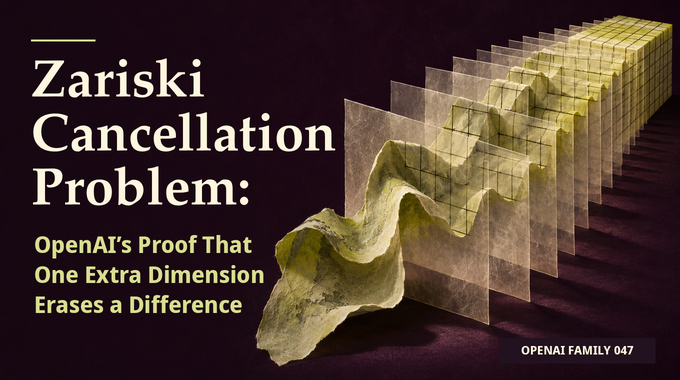
Zariski cancellation problem illustrated by folded paper becoming a regular lattice through translucent planes.

The Zariski cancellation problem asks whether one extra dimension can hide the difference between an affine variety and ordinary affine space. OpenAI’s September 2026 preprint gives an explicit example over the complex numbers. Its hypersurface has dimension four and cannot be described by four freely generating polynomial coordinates. Attach an affine line, however, and the … Read more


Memory Sample Tradeoff: Why Perfect Gaussian Measurements Still Demand More Samples

Paper records curl into a narrow slot, illustrating the memory sample tradeoff in noiseless Gaussian regression.

A stack of exact Gaussian equations can pin down an unknown vector after just as many measurements as it has coordinates. Put those same equations through a learner that can read each pair only once and retain at most a fixed multiple of the dimension squared in bits, and the precision changes what it needs. … Read more

Polynomial Identity Testing with Division: How OpenAI’s Proof Constructs Universal Matrix Hitting Lists

Light passes through one set of matrix tiles, illustrating a hit in polynomial identity testing with division.

Imagine a sealed box that accepts a tuple of matrices and returns the value of a hidden formula. Some queries fail because an intermediate matrix has no inverse. Which queries can you choose in advance so that every nonzero formula of a given size gives you a decisive answer? OpenAI’s September 24, 2026 preprint gives … Read more

Yau’s Nodal Conjecture: The Almost-Round Sphere That Defies the Upper Bound

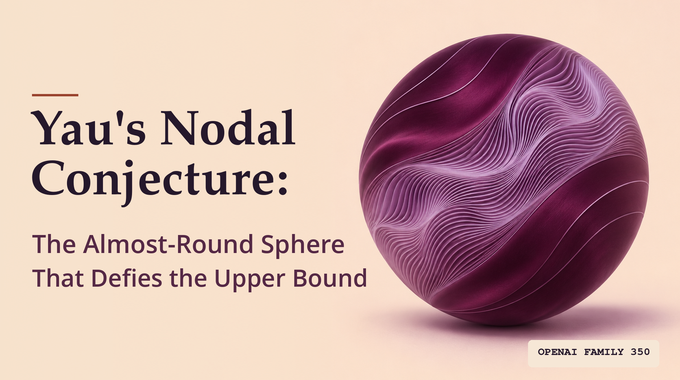
Yau nodal conjecture artwork showing a near-round sphere with densely folded contour lines.

A sphere can be changed by an arbitrarily small smooth deformation and yet support Laplace eigenfunctions with far more nodal area than Yau nodal conjecture permits. In a September 2026 manuscript, OpenAI constructs one fixed metric on the three-sphere and another on S2×T2S^2\times T^2 whose exact eigenfunctions have nodal measures growing faster than any constant … Read more

Critical Percolation: OpenAI’s Proof of a Tipping Point Without an Infinite Cluster

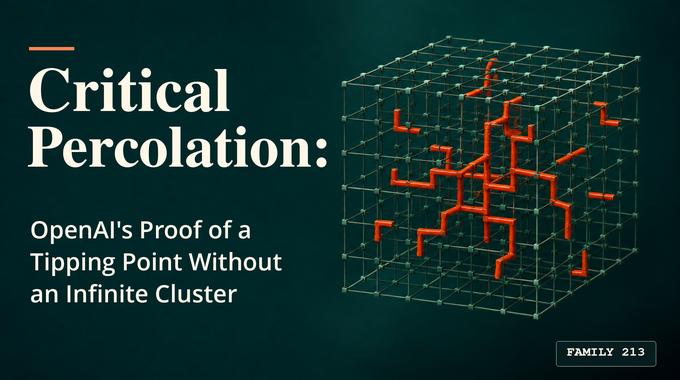
Orange finite clusters branch through a cubic lattice in this critical percolation illustration.

At the critical percolation threshold, a random network on the cubic lattice can still contain clusters that stretch across any prescribed finite distance. Yet an infinite open cluster has probability zero. That is Theorem 1.1 of OpenAI’s September 24, 2026 preprint, which proves the statement for nearest-neighbor Bernoulli bond and site percolation on ℤ3\mathbb{Z}^3, each … Read more