Grad’s Conjecture: How AI Helped Crack a 59-Year Fusion Physics Puzzle
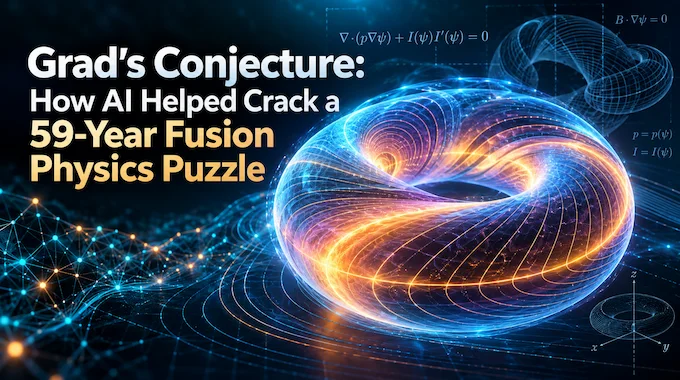
Nested glowing torus breaking through a symmetric shell, illustrating Grad's Conjecture and AI-assisted fusion physics

For nearly six decades, Grad’s Conjecture hung over one of the strangest questions in plasma physics: can a smooth, fully three-dimensional plasma sit in equilibrium inside nested toroidal surfaces without being forced into a strong symmetry? The intuition said probably not. Stellarator researchers, meanwhile, work precisely with complicated three-dimensional magnetic fields. Then September 2026 produced … Read more

Claude Sonnet 5.5 vs Opus 5.5: When Cheaper Costs More

Claude Sonnet 5.5 and Opus 5.5 shown as two receipt printers, one printing a much longer cost receipt

The cheaper model just complicated the buying decision. Claude Sonnet 5.5 beats Opus 5.5 on Anthropic’s Terminal-Bench evaluation, nearly matches it on professional knowledge work, and charges half as much for standard input and output tokens. Yet running Sonnet at maximum effort can cost more per benchmark task than running Opus. That’s the central question … Read more

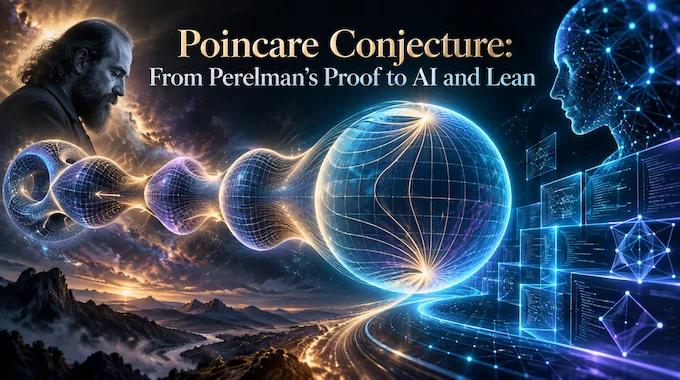
Poincare Conjecture: From Perelman’s Proof to AI and Lean

Poincare Conjecture concept art: a loop shrinking on a glowing three-sphere beside a digital proof grid

Every closed, simply connected three-dimensional manifold is homeomorphic to the three-sphere. That is the Poincare Conjecture, a statement whose vocabulary takes some unpacking and whose proof took nearly a century. The question is whether a certain test involving loops can identify the overall shape of a three-dimensional space. Grigori Perelman solved it in 2002–2003, building … Read more

OpenAI MentalHealthBench: The Story Behind AI’s 57.3% Score

OpenAI MentalHealthBench cover image showing an AI being measured against a glowing score dial

By Hajra, Clinical Psychology Research Scholar A chatbot can sound caring before it understands what’s wrong. It can also interrupt an ordinary conversation with crisis language that feels wildly out of place. Measuring the difference requires more than counting reassuring sentences. OpenAI MentalHealthBench, released on September 23, 2026, tackles that problem. It evaluates how AI … Read more

Claude Nine Loops: What the $2,000 Physics Result Actually Proved

Claude Nine Loops feature cover showing AI-generated glowing rings representing a nine-loop physics calculation

A nine-loop scattering amplitude sounds like the kind of phrase designed to make everyone except theoretical physicists close the tab. This one is worth staying for. Anthropic says Claude Fable 5.1, working through its Claude Science research harness, completed a nine-loop calculation for a six-particle amplitude in planar N=4 super Yang-Mills. The model pursued the … Read more

MiMo-V2.6: Xiaomi Scales Agentic RL Toward Self-Improving AI

MiMo-V2.6 self-improving AI concept image with a glowing reinforcement learning feedback loop

Most frontier model launches make the model itself the headline. MiMo-V2.6 is more interesting because Xiaomi wants the training loop to be the headline. The new family combines a large mixture of experts architecture with multimodal pre-training, agent-focused mid-training, and an unusually large reinforcement learning run. Xiaomi says MiMo-V2.6-Pro used 1,568 prompts and 16 rollouts … Read more

Claude Enzyme Discovery: What ART Is, How Claude Found It, and What Isn’t Proven Yet

Cover image illustrating the Claude enzyme discovery of a phage-based reverse transcriptase system

The headline is irresistible: Claude discovers enzyme. The biology is more precise, and more interesting. Anthropic’s Claude enzyme discovery centers on a previously uncharacterized biological system called array-associated reverse transcriptases, or ART. Claude did not pull a brand-new enzyme out of nowhere. The reverse transcriptase itself had relatives that researchers had already encountered. What Claude … Read more