Claude Opus 5.5: Huge Scores, but Cost per Task Matters More
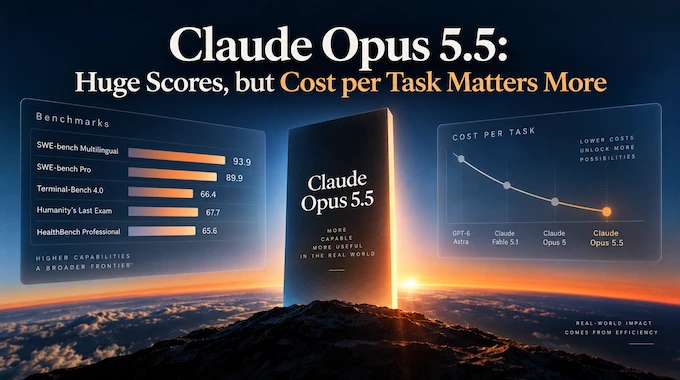
Claude Opus 5.5 feature graphic comparing high benchmark scores against real cost per task

Claude Opus 5.5 arrives with the kind of benchmark table designed to dominate launch-day discussion. It posts large gains over Opus 5, leads several coding and professional-work evaluations, and lands surprisingly close to or above newer rivals. But the headline scores are not the most interesting part of this release. The bigger change is economic. … Read more

Courtade Kumar Conjecture Solved? Two AI-Assisted Proofs End a 13-Year Wait

Cover image illustrating the Courtade Kumar conjecture, a single glowing bit outshining a complex network under noise.

A one-bit summary can combine thousands of inputs, compute parity, take a threshold, or apply some elaborate Boolean rule. The Courtade Kumar conjecture says that for preserving information about a noisy copy of the input, this cleverness buys you nothing. The best one-bit summary is simply one original bit. Mathematically, let Xbe uniform on {-ⓜ,11}^n, … Read more

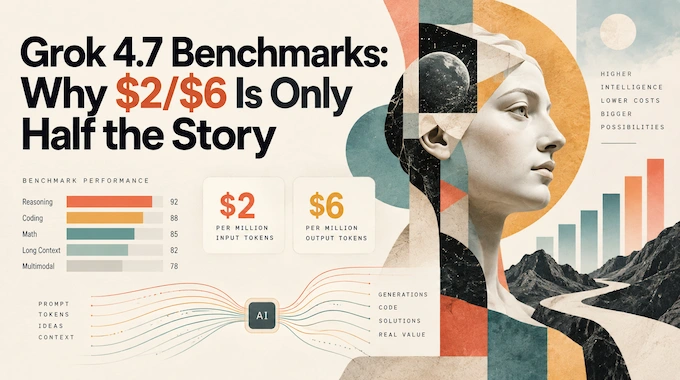
Grok 4.7 Benchmarks: Why $2/$6 Is Only Half The Story

Grok 4.7 benchmarks feature image showing a price tag above a hidden iceberg of compute costs.

Grok 4.7 arrives with an unusually attractive headline: $2 per million input tokens, $6 per million output tokens, and stronger results than Grok 4.6 across several long-horizon coding and professional-work tests. The Grok 4.7 benchmarks make the upgrade look substantial in places. DeepSWE rises to 71.0% at High effort, Terminal-Bench reaches 38.0% at xHigh, and … Read more

Can AI Feel Pain? Inside the “Pain Axis” That Made LLMs Seek Relief

Cover image exploring can AI feel pain, showing a glowing red pain axis inside a neural network silhouette

Can AI feel pain? A new preprint offers a more interesting answer than either “obviously yes” or “obviously no.” Researchers found a repeatable internal direction associated with pain across 25 open-weight large language models. When they experimentally increased that direction, models shifted toward distress, worthlessness, failure, and relief-seeking behavior. In some tests, larger Qwen models … Read more

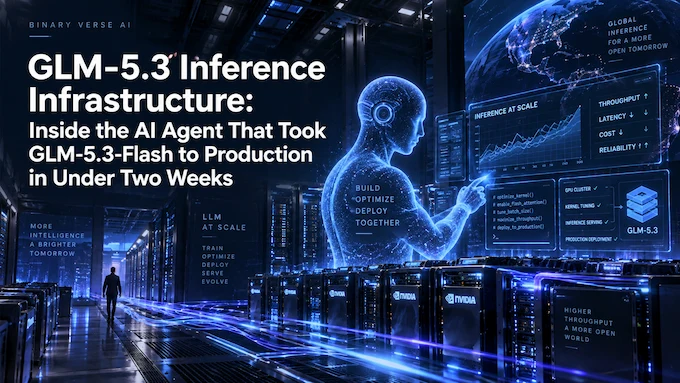
GLM-5.3 Inference Infrastructure: Inside the AI Agent That Took GLM-5.3-Flash to Production in Under Two Weeks

GLM-5.3 inference infrastructure agent optimizing AI data center servers

Z.ai’s latest infrastructure story sounds almost circular: GLM-5.3 helped optimize the system that serves GLM-5.3-Flash. The headline invites a bigger claim, that the model somehow built its own infrastructure. The engineering reality is more interesting, and more useful. The GLM-5.3 inference infrastructure was a production serving stack built on more than 100,000 Chinese-made AI accelerators. … Read more

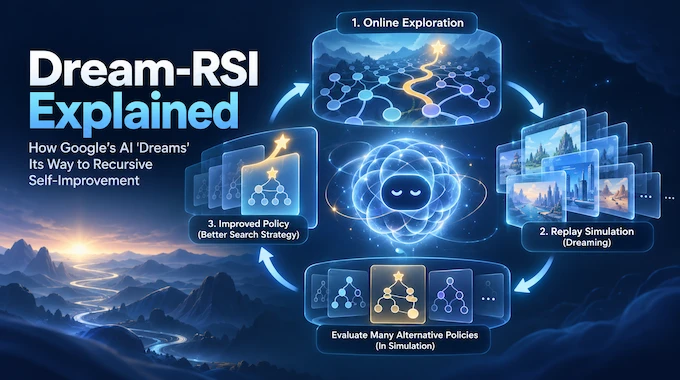
Dream-RSI Explained: How Google’s AI “Dreams” Its Way to Recursive Self-Improvement

Dream-RSI shown as a glowing search tree reflecting into a dream loop, symbolizing recursive AI self-improvement.

Dream-RSI sounds like the kind of system that rewrites itself into a smarter model. That is not what the paper shows. The key idea is narrower, and more interesting. The system leaves the underlying coding model, evaluator, and execution interface fixed. What changes is the exploration policy, the layer that decides where an AI discovery … Read more

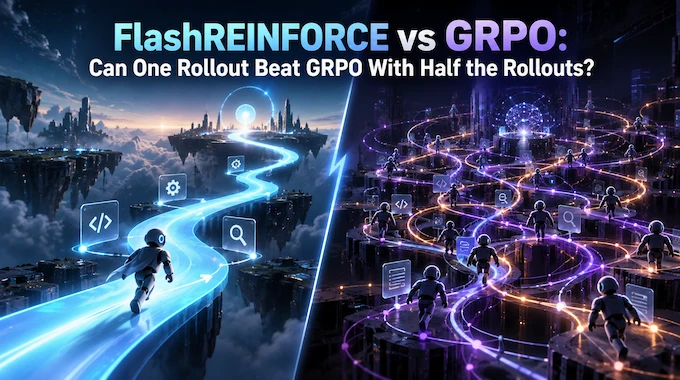
FlashREINFORCE vs GRPO: Can One Rollout per Prompt Really Beat GRPO With Half the Rollouts?

FlashREINFORCE cover image showing one clean rollout path outracing GRPO's tangled sibling rollouts

The headline result is hard to ignore: 256K rollouts versus 512K, with a five-benchmark mean of 38.0 versus 36.3. In NVIDIA researchers’ experiments on Qwen2.5-Math-1.5B, FlashREINFORCE beat the reported GRPO baseline by 1.7 percentage points while using half as many training trajectories. That does not mean it used half the GPUs, half the wall-clock time, … Read more