
Z.ai’s latest infrastructure story sounds almost circular: GLM-5.3 helped optimize the system that serves GLM-5.3-Flash. The headline invites a bigger claim, that the model somehow built its own infrastructure. The engineering reality is more interesting, and more useful.
The GLM-5.3 inference infrastructure was a production serving stack built on more than 100,000 Chinese-made AI accelerators. Z.ai says a GLM-5.3-powered Infra Agent handled much of the analysis, hypothesis generation, code modification, debugging, and experimentation needed to move the system from its first successful run to production readiness in under two weeks. End-to-end throughput rose to roughly three times the initial baseline. Humans still set goals, boundaries, acceptance criteria, and reviewed risky changes.
That distinction matters. This is not a story about an AI spontaneously building a data center. It is a case study in what happens when a capable coding model is placed inside a tightly instrumented engineering loop and given feedback that is specific enough to act on.
Table of Contents
1. GLM-5.3 Inference Infrastructure: What Z.ai Actually Built
The system serves GLM-5.3-Flash in production. Z.ai describes the deployment as unusually difficult because the hardware ecosystem had limited memory capacity and bandwidth, incomplete kernel support, immature software tooling, and sparse documentation. At the same time, the serving stack had to support a new model architecture, multimodal requests, and a context window of up to one million tokens.
GLM-5.3 Inference Infrastructure: Key Deployment Facts and What They Mean
| Key Fact | What Z.ai Reports | Why It Matters |
|---|---|---|
| Deployment scale | More than 100,000 Chinese-made AI accelerators | This was a large production serving problem, not a lab microbenchmark. |
| Time to production | Less than two weeks from initial adaptation | The claim is about engineering-cycle compression as much as raw speed. |
| Throughput result | Roughly 3× the initial end-to-end baseline | It measures cumulative serving improvement, not a 3× lead over another vendor. |
| Agent role | Analysis, hypotheses, code changes, debugging, experiments | The agent worked inside a human-defined engineering process. |
| Human role | Goals, system boundaries, acceptance, high-risk review | The loop was not autonomous recursive self-improvement. |
The phrase “built its own infrastructure” is therefore shorthand. The model participated in building and optimizing the serving software that runs GLM-5.3-Flash. Engineers remained responsible for the surrounding system and for deciding what counted as safe and successful.
2. What Is Inference Infrastructure, And Why Was This Deployment Difficult?
Training creates the model. Inference is what happens when that trained model receives a prompt and produces an answer. Inference infrastructure is the machinery that turns model weights into a reliable service: kernels, runtimes, parallelism, scheduling, KV-cache handling, quantization, communication, memory management, monitoring, and request orchestration.
For GLM inference, the hard part was not one slow function. The bottlenecks crossed layers. A faster kernel could hurt another task by consuming resources it needed. A transfer engine could support asynchronous work yet still sit idle because a Python thread could not submit jobs. A mathematically valid-looking optimization could accumulate numerical error at long context lengths.
The optimization stack gives a useful map of the work:
GLM-5.3 Inference Infrastructure: Optimization Techniques Behind the Serving Stack
| Technique or Milestone | Role in the Serving Stack | Practical Meaning |
|---|---|---|
| W8A8 | Baseline quantized execution | Cuts memory and bandwidth pressure using 8-bit weights and activations. |
| Layer Split | Early major throughput step | One of the largest early gains in the reported optimization trajectory. |
| Context Parallelism | Scales long-context work across devices | Useful for the 1M-token target, but adds correctness and communication complexity. |
| Mixed INT8/FP8/BF16 Cache Quantization | Reduces cache cost | Trades precision and representation complexity for memory efficiency. |
| KV Transfer Overlap | Hides communication behind computation | Helps only when scheduling actually allows transfer and compute to overlap. |
| EPD Disaggregation | Separates encode, prefill, and decode stages | Lets serving stages be optimized and scaled more independently. |
| Linear-Attention and Kernel Work | Final-stage tuning | Pushes local execution closer to the target hardware’s practical limits. |
Z.ai also lists intra-node tensor parallelism for linear attention and the LM Head, ReplaySSM, W8A8, mixed-precision cache quantization, Layer Split, and an Encode-Prefill-Decode architecture as core parts of the final stack.
3. What Did The GLM Infra Agent Actually Do?
The GLM Infra Agent was not merely autocomplete with access to a repository. Z.ai describes a loop in which engineers defined the objective and system boundaries, while the agent performed analysis, formed hypotheses, changed code, and used an experimental environment to test whether those changes were correct and useful.
That included several kinds of work normally associated with experienced infrastructure engineers: mapping high-level parallelism choices to kernel behavior, comparing numerical outputs across execution paths, reading runtime traces, following Python-to-C++ call chains, profiling kernels, testing alternative tiling strategies, and running incremental or ablation experiments.
The important point is not that GLM-5.3 “knew infrastructure.” It had tools and an environment that could turn a vague problem such as “throughput is too low” into smaller questions it could answer experimentally.
4. How GLM-5.3-Flash Reached 3× Throughput In Under Two Weeks
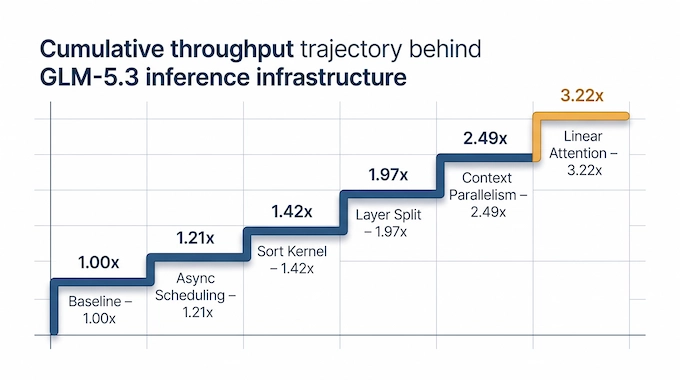
The throughput chart on page 3 of Z.ai’s report shows a cumulative LLM inference optimization trajectory rather than one magic change. The deployment starts at 1.00× with a W8A8 baseline. Async scheduling lifts it to 1.21×. A sort-kernel optimization reaches 1.42×, followed by a small regression to 1.41× around hierarchical caching. Layer Split raises the curve to 1.97×, and context parallelism to 2.49×.
Later work pushes the system through roughly 2.67× with KV-transfer overlap, mixed-precision cache quantization, and chunked MQA, then 2.85× with a prefill dequantization kernel, 3.01× with fused activation plus quantization, and 3.22× around linear-attention work at launch.
This is where many summaries get sloppy. Z.ai does not provide a clean ablation that assigns the full threefold gain to ReplaySSM, EPD, quantization, or the Infra Agent alone. The graph is a cumulative engineering history. Some changes barely move the headline metric, and one representative ReplaySSM kernel step actually made local execution slower before later work recovered the cost.
That is normal systems engineering. The best LLM inference optimization techniques are often interdependent. You trade memory for compute, communication for device memory, or local kernel speed for better overlap elsewhere in the pipeline.
5. Dense Feedback Was The Real Breakthrough
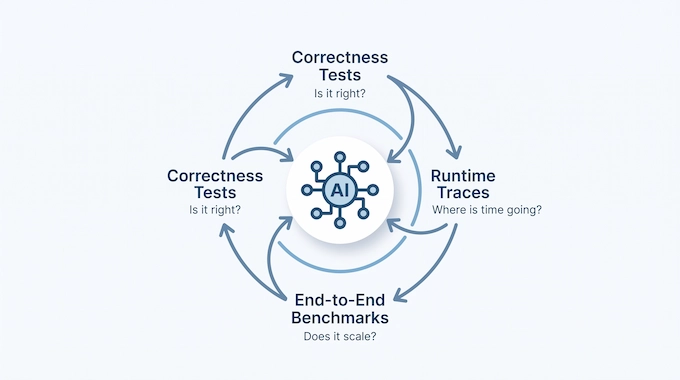
The most transferable idea in the GLM-5.3 inference infrastructure story is not W8A8 or a particular kernel trick. It is Z.ai’s “dense feedback” design.
A weak agent loop looks like this: change code, deploy everything, run a load test, discover that throughput fell, then guess why. The feedback is technically correct but strategically useless. It says the result is bad without identifying the responsible layer.
Z.ai instead connected correctness tests, runtime logs, execution traces, runtime events, microbenchmarks, and end-to-end measurements into repeatable workflows. Local kernel comparisons answered “is the computation correct?” Traces answered “where is the time going?” Microbenchmarks answered “which option is faster under this input shape?” End-to-end tests then checked whether a local gain survived contact with the real service.
The company defines good feedback by three properties: it should be local enough to narrow the problem, cheap and fast enough to run repeatedly, and objective enough to verify with controlled tests rather than correlation.
That is a useful recipe for any AI inference infrastructure team using coding agents. Better models help, but better feedback makes their reasoning testable.
6. Case Study One: The Long-Context KDA Precision Bug
One of the clearest examples involved the KDA kernel’s Context Parallelism path. The agent compared partitioned and non-partitioned execution using the same inputs and found numerical discrepancies. The trail led to state-merging operations where tl.dot defaulted to TF32 even with FP32 inputs.
The lower precision accumulated error as context length grew. Z.ai’s fix explicitly used input_precision=”tf32x3″, combining three TF32 Tensor Core operations for a higher-precision result while keeping much of the hardware advantage. The candidate then returned to model-level accuracy and serving tests. Z.ai says the numerical fix was merged upstream into Flash Linear Attention.
This case matters because “optimization” first meant proving the system was computing the right thing. Faster wrong answers are still wrong.
7. Case Study Two: A Python GIL Bottleneck Blocked KV Transfer
The next failure looked like a transfer problem. Engineers had defined a target: Prefill plus KV Transfer should stay within 5% of Prefill alone. In some scenarios the gap exceeded 20%.
The Infra Agent examined the timeline and noticed that Python-side Mooncake Transfer work never overlapped with DeepEP dispatch and combine calls. Following the call chain showed that the intra-node C++ functions in the deployed DeepEP version did not explicitly release Python’s Global Interpreter Lock. Entering C++ did not automatically free the GIL, so the Python thread responsible for transfer submission could be delayed even though the lower-level transfer engine was asynchronous.
After the relevant C++ intervals released the GIL, Z.ai reports that the gap between Prefill plus KV Transfer and Prefill alone fell below 1% under the same test conditions.
That is a useful reminder: production bottlenecks often live between abstractions, not inside the component everyone first blames.
8. Case Study Three: A 1.71× Decode-Kernel Speedup
For kernel tuning, the Infra Agent did not invent every technique from scratch. Z.ai says it learned patterns from expert implementations in projects such as SGLang, Flash Linear Attention, and DeepGEMM, then distilled them into reusable “optimization skeletons” containing applicability conditions, transformations, resource constraints, and validation evidence.
On a representative KDA decode kernel, profiling showed repeated FP32 normalization and gating work because the implementation tiled along the V dimension. The agent merged tiles into a single thread block, kept shared intermediates in registers, and replaced repeated work with a warp-level reduction. Z.ai reports a 1.71× speedup over the preceding v2 kernel.
The more important pattern is experimental reuse. Existing kernels supplied ideas. Profiling supplied context. Controlled tests decided which ideas survived.
9. What Does “3× Throughput” Actually Mean?
The threefold number needs a guardrail. Z.ai says GLM-5.3-Flash tripled end-to-end throughput relative to its own initial baseline during the production optimization cycle. It does not say GLM-5.3-Flash is three times faster than NVIDIA hardware. The separate vendor claim is that hardware utilization efficiency and per-token cost reached levels comparable to mainstream NVIDIA GPUs. Those are different measurements.
Throughput is usually an aggregate serving metric: how much useful work the system completes over time. It does not automatically tell you tokens per second for one user, time to first token (TTFT), queueing delay, or p95 and p99 latency.
So the correct reading of the GLM-5.3 inference infrastructure result is narrower and stronger: Z.ai reports that a cumulative set of software and serving optimizations made its own deployment roughly three times as productive as the starting point. That is impressive without turning it into a benchmark it never ran.
10. Why Can GLM Still Feel Slow After A 3× Throughput Gain?
Because cluster throughput and individual experience are not the same thing.
A serving system can process far more total tokens while a particular user still sees slow decode speed, a long queue, rate limits, or poor peak-hour latency. Disaggregation and batching may increase total utilization while changing how latency is distributed across requests. A quota can also cap a user’s effective speed even when the backend has spare capacity.
This is why questions such as “does GLM now sustain 200 tokens per second per user?” cannot be answered from Z.ai’s post. The company does not publish the user-level throughput distribution, TTFT distribution, or p95/p99 production latency needed to establish that claim.
11. Is GLM-5.3 Really Recursive Self Improvement?
Not by Z.ai’s own description. The company explicitly says it has not reached recursive self-improvement and that choosing objectives, setting boundaries, and assessing risk remain human responsibilities. Earlier in the post, it calls the infrastructure project an early form pointing toward that direction, not the finished thing.
A recent RSI research paper helps sharpen the distinction. It defines recursive self-improvement as a closed loop in which an AI system identifies its limitations, develops and validates improvements, and eventually improves the process by which future improvements are produced. Its roadmap moves from execution autonomy to strategy autonomy, experience acquisition, environment adaptation, and finally recursive inheritance or meta-improvement.
Viewed through that framework, the GLM Infra Agent looks closer to strategy-level autonomy than full recursive inheritance. Humans fixed the objective and boundaries, while the agent diagnosed problems and chose engineering actions inside them. The reusable optimization skeletons do add persistence, but the agent did not redesign the overall mechanism that governs its own future improvement.
That makes recursive self improvement a useful research direction here, not a literal description of what happened in this deployment.
12. What Is Verified, What Is Still Unknown, And Why It Matters
The GLM-5.3 inference infrastructure story is strongest when its evidence is separated by type.
What Z.ai documents in its first-party report is a detailed optimization trajectory, concrete bug investigations, a representative 1.71× kernel speedup, and a dense-feedback workflow linking hypotheses to tests. At least one numerical fix is tied to an upstream Flash Linear Attention pull request, making that part of the work more inspectable than the aggregate serving claim.
What Z.ai reports, but the provided material does not independently reproduce, includes the more-than-100,000-accelerator deployment, the roughly 3× end-to-end throughput gain, the sub-two-week production cycle, and NVIDIA-comparable hardware efficiency and per-token cost. The post does not disclose the exact accelerator model, detailed p99 latency, user-level tokens-per-second distributions, a full agent architecture or “swarm” design, or a clean ablation assigning each part of the 3× gain to one technique.
That does not make the result unimportant. It tells us exactly where the significance lies.
The durable lesson from the GLM-5.3 inference infrastructure case is that capable coding models become much more useful when the engineering environment gives them local, cheap, objective feedback. The model proposes. The system measures. Experiments decide. Humans still define the lines that matter.
For builders, that is more actionable than the headline. If you are designing an LLM inference optimization workflow, the next step is not simply to give an agent more code. Give it a way to observe the system, isolate causes, run controlled tests, and prove that a local win improves the service that users actually touch.
Binary Verse AI will keep separating impressive AI infrastructure claims from the engineering details underneath them. If you want more evidence-first breakdowns of new models, systems, benchmarks, and the research behind them, follow Binary Verse AI and explore our latest technical explainers.
1. What is the GLM-5.3 inference infrastructure?
It is the production serving system built for GLM-5.3-Flash. Z.ai says it runs on more than 100,000 Chinese-made AI accelerators and was jointly optimized by human engineers and an Infra Agent powered by GLM-5.3. The stack incorporates memory, parallelism, quantization, kernel and scheduling optimizations designed for large-scale inference.
2. Did GLM-5.3 really build its own inference infrastructure?
Not entirely by itself. GLM-5.3 powered the Infra Agent that performed much of the analysis, hypothesis generation, coding and optimization, while human engineers defined goals, system boundaries, acceptance criteria and reviewed risky changes. Also, the infrastructure serves GLM-5.3-Flash, so “built its own infrastructure” is a convenient shorthand rather than a literal description.
3. How did GLM-5.3 triple inference throughput?
Z.ai attributes the roughly 3× end-to-end improvement to a combination of intra-node tensor parallelism, ReplaySSM, W8A8 quantization, mixed-precision cache quantization, Layer Split, Encode-Prefill-Decode disaggregation, kernel optimizations and debugging aided by dense feedback. The company does not publish a controlled ablation showing how much of the total 3× came from each individual technique.
4. Does 3× throughput mean GLM-5.3-Flash is three times faster for users?
No. The figure describes end-to-end serving throughput relative to Z.ai’s initial same-hardware baseline. Aggregate throughput is different from per-user output speed, time to first token, queueing delay and p99 latency. That distinction also explains why some users can report slow responses or rate limits despite higher total system throughput.
5. Is GLM-5.3 an example of recursive self-improvement?
It is better described as an early step toward it rather than full recursive self-improvement. Z.ai explicitly says RSI has not yet been reached because humans still choose objectives, set boundaries and assess risk. Genuine higher-level RSI would require the system to take increasing control over the mechanisms that determine and retain future improvements.