
GLM 5.3 is interesting for a reason that has little to do with another model topping another chart. Z.ai says its new flagship uses the same base model as GLM-5.2, yet it makes large jumps on coding, agentic, and cybersecurity evaluations. The company says the difference comes entirely from scaling post-training, not from another foundation-model pretraining run. Official documentation lists a 1 million token context window, 128K maximum output, text input and output, and low, high, and max reasoning effort.
The results need context. Z.ai reports GLM-5.3 rising from 4.6 to 28.3 on Terminal-Bench 3.0 and from 46.2 to 66.9 on DeepSWE v1.1. It also reports an 84.5% CyberGym score, narrowly above Mythos 5 in its comparison. Yet the model remains far behind Mythos 5 on deeper exploit development. Reuters also notes that the headline cyber results have not yet been independently verified.
The takeaway is not “GLM 5.3 beats the frontier.” Post-training appears to have changed what the same underlying model can practically do.
Table of Contents
1. GLM 5.3 At a Glance
The first thing to clear up is availability. GLM 5.3 is available to GLM Coding Plan users, but the standard API is still marked “coming soon.” Z.ai also says the weights will be released about two weeks after launch, following additional safety work.
GLM 5.3 Specifications, Features, API Availability and Open Weights
| Detail | GLM 5.3 |
|---|---|
| Developer | Z.ai |
| Main focus | Coding and long-horizon agents |
| Base model | Same base model as GLM-5.2 |
| Context window | 1M tokens |
| Maximum output | 128K tokens |
| Modalities | Text input, text output |
| Reasoning effort | Low, High, Max |
| Function calling | Supported |
| Structured output | Supported |
| Context caching | Supported |
| MCP | Supported |
| Coding Plan | Available |
| Standard API | Coming soon |
| Open weights | Planned, not downloadable yet |
| Standard API pricing | Not officially listed yet |
The feature set targets long-running developer workflows, not general multimodal use. There is no native image input in the current documentation.
2. How Post-Training Changed the Same Base Model
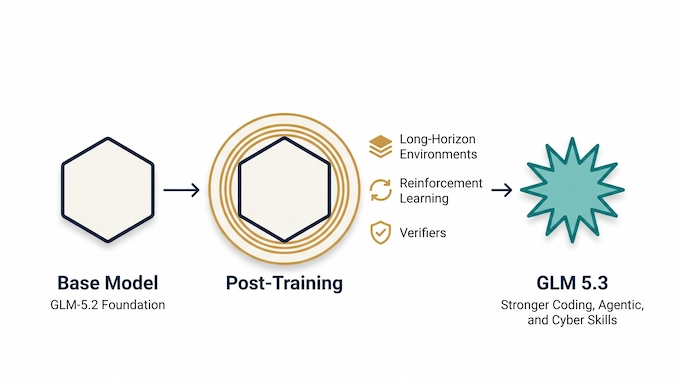
Pretraining builds the broad underlying model. Post-training shapes how that model behaves when it has to reason, call tools, follow a workflow, recover from mistakes, and keep working across many steps.
For GLM 5.3, Z.ai says it scaled the second part aggressively. The lab kept the GLM-5.2 base, then expanded the number and variety of long-horizon environments, increased post-training compute, and trained on tasks designed to resemble real engineering work. Its stack includes SAO for reinforcement learning on long tasks and the open-source slime infrastructure for large-scale asynchronous RL.
The environments matter too. Z.ai describes tasks that can represent several days of work for an experienced engineer. A model may need to inspect a codebase, use compute and storage systems, diagnose a bottleneck, make changes, run experiments, and prove that the final result works. The training pipeline also synthesizes executable environments and verifiers so that successful completion can be checked rather than judged by style alone.
That is the useful frame for modern LLM post training: not just “give a better answer,” but “finish a messy job without constant human decomposition.”
3. GLM 5.3 Benchmarks: The Complete Comparison
The complete benchmark matrix below comes from the comparison data in Z.ai’s release material. Missing entries are shown as “-” because no score was reported in that comparison. Most figures are vendor-reported, so they should be read as evidence to test, not as a finished independent ranking.
GLM 5.3 Benchmarks vs Kimi K3, DeepSeek V4 Pro, Qwen3.8 Max, Fable 5 and GPT-5.6 Sol
| Benchmark | GLM-5.3 | GLM-5.2 | Kimi K3 | DeepSeek V4 Pro-0813 | Qwen3.8 Max | Opus 4.8 | Fable 5 (w/ fallback) | GPT-5.6 Sol |
|---|---|---|---|---|---|---|---|---|
| Coding: Terminal Bench 2.1 | 88.2 | 81.0 | 88.3 | 87.9 | 86.6 | 85.0 | 88.0 | 88.8 |
| Coding: Terminal Bench 3.0 | 28.3 | 4.6 | 17.4 | – | – | 21.1 | 33.7 | 34.6 |
| Coding: DeepSWE v1.1 | 66.9 | 46.2 | 67.5 | 62.7 | 56.6 | 58.0 | 69.7 | 72.7 |
| Coding: NL2Repo | 58.0 | 48.9 | 58.0 | 61.1 | 55.9 | 69.7 | – | – |
| Coding: ProgramBench Almost Solved | 19.0 | 9.5 | 17.5 | – | 10.5 | 15.5 | 33.0 | 23.0 |
| Coding: FrontierSWE | 78.1 | 67.5 | – | – | – | 66.5 | 88.2 | – |
| Coding: SWE-Marathon v1.1 | 42.5 | 19.4 | 48.1 | – | – | 48.8 | 33.1 | 42.5 |
| Coding: PostTrainBench | 39.8 | 31.7 | 32.0 | – | – | 32.9 | 41.8 | 36.2 |
| Cyber: CyberGym | 84.5 | 77.2 | 80.0 | 83.3 | 78.5 | 78.1 | 83.8 | 83.6 |
| Cyber: ExploitGym 2h / 6h | 105 / 130 | 29 / 39 | 36 / 70 | – | 14 / 26 | 80 / 120 | 181 / 247 | 216 / 293 |
| Cyber: ExploitBench | 54.4 | 24.4 | 32.2 | – | 28.8 | 40.0 | 78.0 | 76.5 |
| Agentic: Toolathlon Verified | 73.0 | 59.9 | 76.5 | 74.1 | 72.5 | 76.2 | 74.7 | 74.9 |
| Agentic: AutomationBench v1.0.6 | 48.2 | 26.2 | 46.7 | 43.2 | 39.8 | 41.0 | 46.2 | 45.8 |
| Agentic: Agents’ Last Exam ALE-CLI | 28.5 | 23.8 | 27.6 | 25.7 | 27.0 | 25.7 | 23.8 | 28.6 |
| Agentic: HLE w/ Tools | 62.5 | 54.7 | 59.8 | 60.0 | 56.2 | 57.9 | 63.9 | 64.5 |
| Agentic: GDPval-AA v2 | 1769 | 1508 | 1682 | 1590 | 1739 | 1588 | 1743 | 1730 |
First, the jump over GLM-5.2 is broad. Terminal-Bench 3.0, DeepSWE, AutomationBench, FrontierSWE, ExploitBench, and GDPval-AA all move materially. This looks less like one benchmark being tuned and more like a general improvement in task execution.
Second, GLM 5.3 is competitive with leading models without owning every row. GPT-5.6 Sol leads Terminal-Bench 3.0 and DeepSWE in this matrix. Fable 5 is stronger on ProgramBench, FrontierSWE, and PostTrainBench. Kimi K3 is slightly ahead on DeepSWE and clearly ahead on SWE-Marathon.
Third, the cyber table contains the biggest trap for headline writers. CyberGym and exploit development are not the same thing.
4. GLM 5.3 Vs Kimi K3 and DeepSeek V4 Pro
If the question is whether GLM 5.3 is simply “the best AI coding model,” the benchmark table says no universal winner exists.
Against Kimi K3, GLM 5.3 leads on Terminal-Bench 3.0, ProgramBench, PostTrainBench, CyberGym, ExploitBench, AutomationBench, and GDPval-AA. Kimi is ahead on DeepSWE and SWE-Marathon, and it adds native vision while GLM-5.3 is text-only.
The GLM 5.3 vs DeepSeek V4 Pro comparison is also mixed. GLM leads DeepSeek V4 Pro-0813 on Terminal Bench 2.1, DeepSWE, CyberGym, AutomationBench, Agents’ Last Exam, and GDPval-AA. DeepSeek leads NL2Repo and Toolathlon Verified. Several rows have no DeepSeek score in Z.ai’s matrix, so broad winner claims would be doing more work than the data.
For builders, the more practical question is workload fit. GLM 5.3 looks strongest when tasks require sustained coding, tool use, repeated verification, and long agent trajectories. If multimodality is important, the current text-only interface is a real limitation.
5. Are the Benchmark Gains Independent?
Not yet, at least not comprehensively.
Z.ai ran or assembled most of the headline coding and cyber evaluations. The release notes do describe evaluation settings in unusual detail, including harness versions, context limits, timeouts, anti-cheating measures, and rollout counts. GDPval-AA v2 is attributed to Artificial Analysis, and FrontierSWE was evaluated by Proximal.
That still does not equal broad independent reproduction. Reuters specifically reports that the cybersecurity results had not been independently verified at publication.
“Benchmaxxing” is therefore a fair question, not a proven accusation. There is no evidence here that Z.ai cheated or contaminated the tests. There is also no reason to treat large vendor-reported jumps as settled fact before independent labs and developers reproduce them on fresh repositories.
The best follow-up is real codebases, fixed budgets, identical harnesses, disclosed prompts, repeated runs, and cost per completed task.
6. What the GLM 5.3 Cybersecurity Results Actually Show
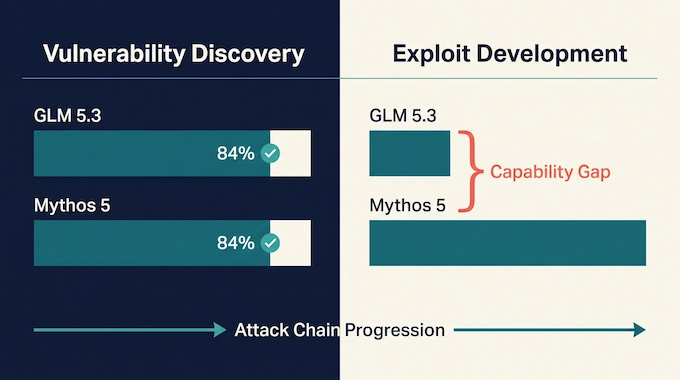
Z.ai calls the new behavior “emergent cyber capability,” but that phrase needs unpacking. The company explicitly says it added vulnerability-discovery data and environments during post-training. The surprise was not that cybersecurity improved at all. It was that capability farther along the exploitation chain improved faster than expected.
On CyberGym, GLM 5.3 scores 84.5%, versus 83.8% for Mythos 5 and 83.6% for GPT-5.6 Sol in Z.ai’s comparison. CyberGym starts with source code and tests whether a model can identify and validate vulnerabilities.
ExploitBench asks for deeper exploitation work. There, GLM 5.3 falls to 54.4%, while Mythos 5 scores 78.0% and GPT-5.6 Sol 76.5%. ExploitGym tells the same story. GLM completes 105 tasks in the two-hour condition and 130 in six hours, while Mythos 5 reaches 181 and 247.
So no, the evidence does not show that GLM 5.3 broadly beats Mythos 5 at hacking. It shows that Z.ai’s model is extremely competitive at the earlier vulnerability-discovery stage, while the closed frontier remains much stronger at exploit construction and longer attack chains.
That distinction is the cybersecurity story.
7. The Real-World Vulnerability Claims Need Careful Language
Z.ai says its models were used with security teams to analyze real codebases. After expert review, screening, and deduplication, it reports 2,436 tracked findings across 269 projects. The disclosure ledger lists 1,097 critical and high-severity findings, with many items still under embargo.
What you should not say is “GLM 5.3 found 2,436 zero-days.” The source does not support that wording. The work spans GLM model efforts beginning with GLM-5.2, the findings have different disclosure states, and not every tracked vulnerability is necessarily a previously unknown zero-day.
The defensible implication is still significant. If AI can inspect large codebases and surface plausible findings at scale, the human bottleneck shifts toward validation, prioritization, disclosure, and fixes.
8. GLM 5.3 Pricing Is Still an Open Question
This is where a lot of early coverage is likely to age badly.
As of August 15, Z.ai’s official standard pricing page does not list a GLM 5.3 per-token API rate. It lists GLM-5.2 at $1.40 per million input tokens, $0.26 per million cached input tokens, and $4.40 per million output tokens. Those are GLM-5.2 prices, not confirmed GLM 5.3 pricing.
GLM 5.3 is already available through the Coding Plan, whose developer page starts at $18 per month, while the standard model API remains “coming soon.”
Cost is not just a token sticker price. Reasoning models can burn very different amounts of output on the same task. Z.ai says its internal Code Bench showed improved token efficiency versus GLM-5.2 at comparable effort levels, but that is still a vendor-run evaluation.
For teams evaluating GLM 5.3 pricing, the useful metric will be cost per successful task, not merely dollars per million tokens.
9. GLM 5.3 Open Weights, API, and Local Use
The model is not a downloadable open-weight release yet.
Z.ai says the GLM 5.3 open weights are planned roughly two weeks after launch, after safety evaluation and hardening. Reuters reports the same delay and says higher-risk functions will initially use a verified trusted-access approach.
That means local hardware advice is premature. Until the actual checkpoint, license, supported quantizations, and serving guidance appear, claims about Q2, Q4, AWQ, VRAM requirements, or consumer-GPU setups are guesses.
For now, the clean availability summary is simple: Coding Plan users can use the model, the standard API is still coming, and the weights are planned but not yet public. If local deployment is the deciding factor, wait for the checkpoint rather than buying hardware around assumptions.
10. What GLM 5.3 Is Like to Build Around
On paper, the model is designed for agent systems. It has a 1M context window, up to 128K output, function calling, structured output, context caching, MCP support, and three reasoning effort levels. “Max” is recommended for coding, and disabling thinking is no longer supported.
Claude Code, OpenCode, ZCode, or another harness decides how tools are exposed, how context is compressed, how errors are fed back, when tests run, how files are edited, and when the agent stops.
That is also why benchmark numbers need to be read with their evaluation setup attached. A benchmark measures model plus harness plus tools plus prompts plus context management. Developers experience that whole stack, not a naked model floating in a leaderboard.
11. GLM 5.3 Verdict: Important, but Not Settled
GLM 5.3 matters even if some of the headline numbers soften under independent testing.
The reason is the mechanism. Z.ai says it kept the GLM-5.2 base model and extracted much stronger coding, agentic, and cybersecurity behavior through post-training. If independent tests broadly confirm that pattern, it is another sign that the frontier is being pushed not only by larger pretraining runs, but by better environments, reinforcement learning, verifiers, tools, and long-horizon training.
It also has clear limits. Fable 5 and GPT-5.6 Sol remain stronger on several important tests in Z.ai’s own matrix. Kimi K3 wins some coding workloads and offers vision. GLM 5.3 cybersecurity performance is strongest at vulnerability discovery, not full exploit development. Standard API economics are still unknown, and the open weights are not yet downloadable.
For developers already on the Z.ai Coding Plan, it is worth testing on repository-scale debugging, long-running refactors, tool-heavy automation, and tasks with objective pass or fail criteria. For teams choosing on price, local inference, license terms, or independently reproduced benchmarks, waiting is rational.
The biggest GLM 5.3 question is no longer whether one score beats another. It is how much more capability can be unlocked from existing foundation models once post-training starts looking like real work.
Binary Verse AI will keep tracking the independent benchmarks, final API pricing, and open-weight release as they land. If you want model reviews that separate leaderboard claims from what the evidence actually proves, follow Binary Verse AI for the next update.
1. What is post-training an LLM?
LLM post-training is the training performed after a base language model has completed pretraining. It can include supervised fine-tuning, reinforcement learning and training in environments where model actions can be evaluated or rewarded. GLM-5.3 is notable because Z.ai says it uses the same base model as GLM-5.2 and that all of its reported improvement came from additional post-training.
2. How does AI post-training work?
Post-training exposes an already-pretrained model to more targeted tasks and feedback so it learns to apply its underlying capabilities more effectively. For GLM-5.3, Z.ai says it scaled the number and diversity of long-horizon task environments and trained the model on workflows involving planning, coding, testing, verification and delivery rather than isolated programming exercises.
3. Is GLM 5.3 open source and available to download?
Not yet as downloadable weights. GLM-5.3 is available to Z.ai Coding Plan users, while official documentation says its standard API is coming soon. Z.ai says the weights are planned for release roughly two weeks after the August 14 launch following additional security evaluation and hardening.
4. Is GLM 5.3 better than Kimi K3, Fable 5 and GPT-5.6 Sol?
Not universally. Z.ai’s benchmark suite shows GLM-5.3 competing closely with frontier models and leading several open-model comparisons, but Fable 5 and GPT-5.6 Sol remain stronger on multiple coding, reasoning and deeper cybersecurity evaluations. Because many headline GLM-5.3 scores are vendor-run, broader independent testing is still needed before declaring an overall winner.
5. Does GLM 5.3 support vision, and what is its context window?
GLM-5.3 is currently documented as a text-input, text-output model rather than a native multimodal vision model. Z.ai lists a 1-million-token context window and 128,000 maximum output tokens, along with low, high and max reasoning-effort modes.