Inverse Goldbach Conjecture: How OpenAI’s Proof Rules Out Primes as A + B
Inverse Goldbach Conjecture visualized as a two-input press producing unavoidable unwanted outputs.

Two sets of integers, one addition sign, and every sufficiently large prime: that is the deceptively simple target of the Inverse Goldbach Conjecture. OpenAI’s September 24, 2026 manuscript, The Additive Indecomposability of the Primes, presents a proof that this construction is impossible when each set contains at least two nonnegative integers. Even allowing finitely many … Read more
Birch and Swinnerton Dyer Conjecture: How OpenAI’s Proposed Proof Closes the Prime-Factor Gap

Birch and Swinnerton Dyer Conjecture artwork shows a final prime-factor wedge closing a silver seal.

A proof can identify an elliptic curve’s rank and still miss the exact arithmetic hiding in its first nonzero L-value. That missing precision is the subject of OpenAI’s October 7 manuscript on the Birch and Swinnerton Dyer Conjecture. It presents the full leading-term formula for elliptic curves over the rationals whose full Selmer group has … Read more

Short Egyptian Fractions: How OpenAI’s Proof Solved Erdős’s 76-Year-Old Conjecture and Established the Optimal Double-Logarithmic Bound

Short Egyptian Fractions artwork: many fragments become a few distinct pieces.

How many fractions does a fraction really need? For 76 years, a conjecture of Paul Erdős asked whether every rational number below one could be assembled from remarkably few distinct reciprocals. OpenAI’s September 25, 2026 manuscript, Short Egyptian Fractions, presents a proof that the worst-case minimum length grows like the logarithm of the logarithm of … Read more

Gaussian Moat Conjecture: How OpenAI’s Proof Solves the 64-Year Walk-to-Infinity Mystery

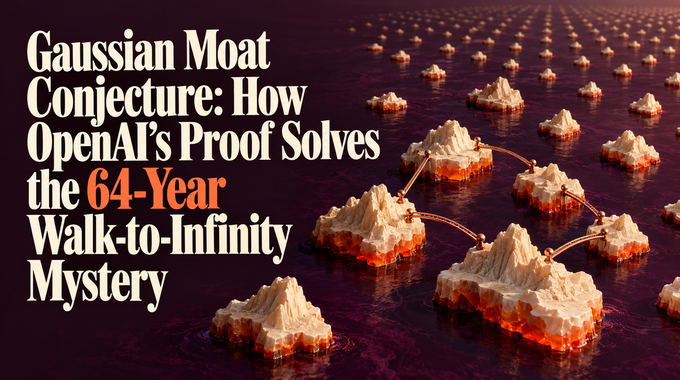
Gaussian moat conjecture illustrated by finite islands linked with copper bridges beneath the full article title.

Imagine stepping from prime to prime across the complex plane, always keeping the next jump below the same fixed limit. OpenAI’s September 26, 2026 manuscript answers that challenge negatively: the Gaussian moat conjecture admits no infinite walk through distinct Gaussian primes with bounded steps. Its stronger conclusion caps every connected component, wherever the walk starts. … Read more

Artin’s Primitive Root Conjecture: How OpenAI’s Proof Breaks the 99-Year Infinitude Barrier

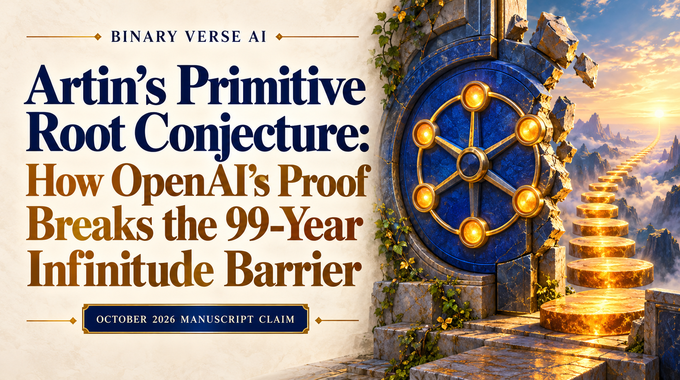
Artin’s primitive root conjecture shown as an opened wheel leading to an endless prime horizon.

Choose the integer 2. Can its powers generate every nonzero residue modulo infinitely many primes? Artin’s primitive root conjecture predicts yes. OpenAI’s October 4, 2026 manuscript Primitive roots for every admissible integer base claims an unconditional proof, covering every integer except −1 and perfect squares. Its quantitative guarantee is a lower bound of order x/(logx)2x/(\log … Read more

Two-Point Chowla Conjecture: OpenAI’s Proof Breaks a 61-Year Averaging Deadlock

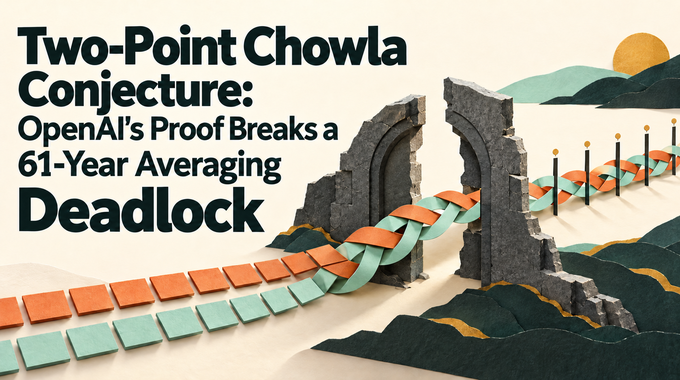
Two-point Chowla conjecture artwork showing paired parity streams crossing a broken 61-year averaging barrier.

Prime factors can be counted, but their parity has resisted a deceptively simple prediction for decades. The two-point Chowla conjecture asks whether the even-or-odd factor counts of two integers a fixed distance apart become uncorrelated. OpenAI’s September 24, 2026 manuscript claims a proof for ordinary averages at every cutoff, with a power-of-logarithm saving. It also … Read more

Erdős–Turán Conjecture: How OpenAI Tackled the Arithmetic Progression Barrier

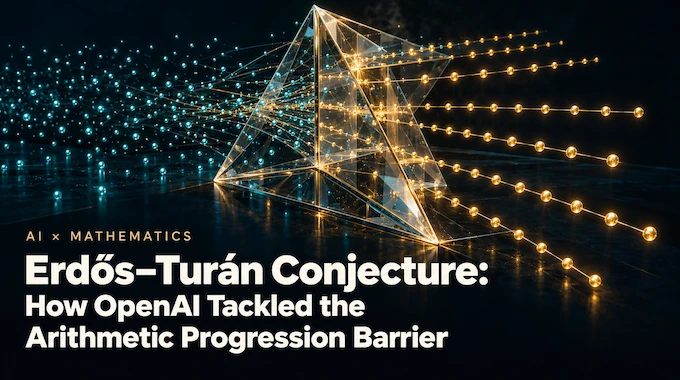
Erdős–Turán conjecture feature image: sparse glowing integers forming an evenly spaced chain through a barrier

A set of numbers can become vanishingly sparse and still carry enough arithmetic weight to force patterns. That’s the striking promise of the Erdős–Turán conjecture: if the reciprocals of a set’s positive integers add up without bound, the set must contain equally spaced sequences of every finite length. OpenAI’s Quasipolynomial Bounds for Arithmetic Progressions, dated … Read more