
A proof can identify an elliptic curve’s rank and still miss the exact arithmetic hiding in its first nonzero L-value. That missing precision is the subject of OpenAI’s October 7 manuscript on the Birch and Swinnerton Dyer Conjecture. It presents the full leading-term formula for elliptic curves over the rationals whose full Selmer group has corank zero or one at some prime. Its new contribution is the proposed equality at every odd prime, combined with companion rank, finiteness, and two-primary results.
This is a low-corank claim, not a solution for every elliptic curve. The research manuscript deserves a mathematical explanation, while its announced proof remains under scrutiny. The central question is how to recover every prime factor that rank equality alone leaves undetermined.
Table of Contents
01. What Is the Birch and Swinnerton Dyer Conjecture?
An elliptic curve is a nonsingular cubic equation with a distinguished point at infinity. Its rational points, whose coordinates are fractions, form a group. The Mordell–Weil theorem says this group has finitely many generators: a finite torsion part and a free part whose number of independent generators is its rank.
Rank zero therefore means finitely many rational points, including the point at infinity. Positive rank means infinitely many: multiples of one infinite-order point already provide an endless supply. Several visible points need not be independent generators.
The Hasse–Weil L-function encodes arithmetic information from the curve, including point counts modulo primes. BSD predicts that its order of vanishing at equals the rational-point rank. The Clay Mathematics Institute still lists the conjecture as unsolved.
| Question | Answer |
|---|---|
| Manuscript date | October 7, 2026. |
| Curves covered | Elliptic curves over the rationals with full Selmer corank zero or one at some prime. |
| New assertion | Exact leading-term valuations at every odd prime. |
| Companion inputs | Rank equality, Sha finiteness, and the two-primary leading-term equality. |
| General conjecture | Still unsolved, including the unrestricted higher-rank problem. |
| Verification status | Announced proof under specialist scrutiny, not independently established as correct. |
02. The BSD Equation: Rank and the Leading-Term Formula
Write for Mordell–Weil rank and for analytic rank. The first prediction is:
The refined prediction gives the first nonzero Taylor coefficient, using the paper’s normalizations:
Here is the rth derivative. In rank zero this is the value itself, and the regulator is one. In rank one it is the first derivative, weighted by the height of a generator.
The real period integrates the absolute Néron differential over all real points, including both components when present. The regulator is the determinant of the paper’s height pairing on a basis of the entire free point group. Its diagonal is the height limit specified in Section 1.1, so conventions matter.
The Tate–Shafarevich group, written Sha, measures failures of a local-to-global principle for torsors associated with the curve. Its conjecturally finite order enters the numerator. Tamagawa numbers count finite local components. Torsion contributes its squared order downstairs. Changing one normalization can alter the exact identity.
03. The Previous Barrier: Why Rank Equality Was Not Enough
Gross–Zagier relates derivatives to heights of Heegner points. Kolyvagin’s Euler-system methods, together with modularity, establish rank equality and finiteness of Sha when analytic rank is zero or one. Modularity is also central to the mathematics behind Fermat’s Last Theorem.
But knowing that a finite group exists does not tell you its order. Nor does locating a non-torsion point tell you whether it generates the full free lattice. A point three times a generator has a height nine times larger.
Subsequent Iwasawa-theoretic work established important leading-term formulas under particular local, residual-representation, and reduction assumptions. The manuscript discusses Skinner–Urban and Jetchev–Skinner–Wan among these advances. Their results cannot simply be read as unrestricted equalities at every prime.
The remaining problem is integral: retain finite indices and prime powers throughout the comparison. Passing to rational vector spaces can erase exactly the information the refined formula needs. Two lattices can span the same space while having different covolumes.
04. OpenAI’s Proof: The Exact Theorem for Low Selmer Corank
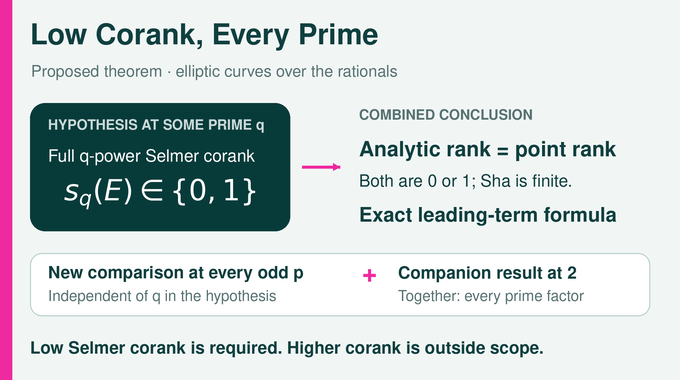
For a prime , the full q-power Selmer group uses local Kummer conditions at every place. Its corank is the rank of its Pontryagin dual over the q-adic integers, measuring its divisible size rather than a finite cardinality.
Theorem 1.1 asserts that, for every elliptic curve over the rationals, if this corank is zero or one at some prime, then:
It also asserts the complete leading-term formula above, with no extra restrictions on reduction, torsion, isogenies, complex multiplication, or residual Galois representations.
The prime in the hypothesis is not a restriction on which prime factors the conclusion covers. The argument later fixes an arbitrary odd prime , independently of .
The Kummer exact sequence places the rational-point contribution inside the full Selmer group, with the p-primary part of Sha as quotient. A finite p-Selmer group from a single descent is a different object from the full p-power Selmer group used here. Once the whole Sha group is finite, its divisible corank disappears, and the full Selmer corank agrees with the point rank at every prime. That explains why the input at two becomes applicable.
Two companion manuscripts supply the unrestricted Selmer converse and the two-primary formula. Another announced density result supplies auxiliary twists, connecting this paper to Goldfeld’s conjecture. These are substantive dependencies. The present manuscript identifies the new task as the odd-primary leading-term comparison, rather than presenting every ingredient as newly proved here.
05. The Arithmetic Discrepancy: A Prime-by-Prime Problem
The paper packages the analytic coefficient and known arithmetic factors into:
Then it measures the missing factor at each prime:
The valuation records the exponent of a prime in a nonzero rational number, normalized by . For example, , while . A discrepancy of one means one excess factor of that prime, not a small numerical rounding error.
Exact BSD requires every discrepancy to vanish. Positivity and rationality are essential: only then can prime factorization recover the complete ratio. The manuscript obtains both through the two-primary companion after rank equality and finiteness are available.
This is also why a decimal approximation cannot finish the proof. Numbers can be extremely close while differing arithmetically. Here the target is equality of exact valuations, including troublesome small primes, not numerical agreement to many digits.
06. Kato’s Classes, Selmer Complexes, and the One-Sided Inequality
Sections 3–5 organize the arithmetic through Galois cohomology, which studies how field symmetries act on the curve’s torsion. The Tate lattice retains integral information across all p-power torsion levels.
Selmer complexes combine global cochains with their local conditions. Determinant lines summarize their arithmetic volumes, including contributions from finite cohomology groups. Replacing these complexes by rational vector spaces would lose torsion lengths and lattice indices.
The construction introduces auxiliary primes and tame character variables. Residual specialization means examining the system after reduction modulo the prime. Carefully selected auxiliary directions test whether unwanted cohomology classes can lift through the deformations. Switching lemmas compare complementary local conditions while tracking determinant factors.
The auxiliary variables are mathematical probes, not numerical optimization parameters. They let the argument vary local arithmetic while preserving a distinguished central specialization. Keeping the maps and pairings as well as the groups is crucial: specialization can otherwise introduce extra cohomology, and a determinant computed before specialization need not retain the desired arithmetic meaning afterward.
Kato’s classes supply the bridge from cohomology to analytic values. Modular-symbol normalization calibrates that bridge, rather than allowing an unspecified scalar to absorb the discrepancy. Rank one additionally requires the manuscript’s tame height comparison.
Its stated output for non-CM curves of analytic rank at most one is:
This is deliberately one-sided. It bounds the discrepancy but allows it to be positive. The second comparison must eliminate that remaining possibility.
07. Quadratic Twists and Heegner Points: Forcing Equality
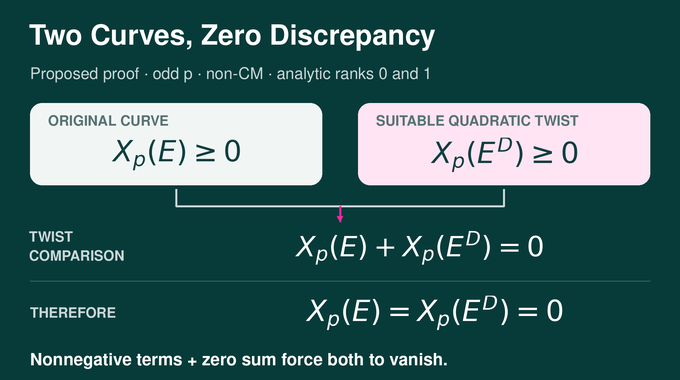
A quadratic twist becomes isomorphic to the original curve after adjoining a square root of , yet can have different rational arithmetic. The manuscript chooses an imaginary quadratic field satisfying splitting conditions and giving complementary analytic ranks.
Their ranks add to one. Over the quadratic field, the base-change L-function factors into the two rational L-functions. Gross–Zagier then connects its first derivative with the height of a Heegner point, constructed from complex multiplication points on a modular curve.
A nonzero height alone is insufficient. The exact comparison must recover the point’s index in the full lattice, together with torsion and local factors. After the later unit calculation, the paper obtains:
Now apply the single-curve inequality to both curves. Twisting preserves the non-CM condition, and both analytic ranks lie in its permitted range. Both discrepancies are nonnegative. If either were positive, their sum would be positive. Therefore:
The logical deduction is elementary. Establishing the zero-sum identity with exact integral normalizations is the demanding part. It cannot be assumed merely because the L-functions factor.
08. The Two p-Adic Series: Why Divisibility Falls Short
At the chosen odd prime, the quadratic field has two places, and . The paper forms two determinant series by imposing a strict, zero local condition at one place and a full, unrestricted condition at the other, then reversing them.
Call these and . Analytic series and come from bounded CM measures, objects that interpolate suitable arithmetic data p-adically. The quotients initially live in a fraction field:
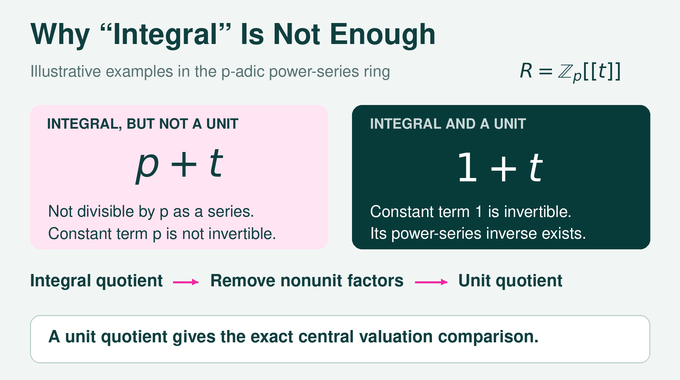
| Level | What It Guarantees |
|---|---|
| Integral quotient | : the determinant divides the analytic series without introducing denominators. |
| No Factor of | : excludes this particular divisor, while other nonunit factors can remain. |
| Unit quotient | : excludes all nonunit factors, enabling the exact central valuation comparison. |
The ambient ring is , a power-series ring. Its genuine character variable is ; the others encode auxiliary tame directions. An integral quotient can still contain a nonunit factor. In this local ring, for example, is a unit, whereas is not.
Residual tests and sufficiently ramified finite characters establish divisibility, using integral Weierstrass division. Analytic primitivity excludes a factor of . Neither step automatically excludes every other irreducible factor. Those require another argument.
09. Theta Congruences and Tame Primes: Removing Divisors
Sections 7–9 address those remaining factors through characteristic-zero tests. A potential divisor is tested where a suitable undepleted CM period vanishes. Theta-to-cusp comparisons turn that vanishing into a nonzero cohomology class satisfying a strict local condition, for the curve or a companion twist.
The estimates must work at nontrivial test characters, not only at the trivial character. The manuscript controls denominators while increasing p-level, using uniform bounds for position-cut moments and a product-character argument. These details prevent precision losses from silently destroying primitivity.
A primitive class survives reduction in the relevant integral lattice. Extracting such a class makes the vanishing test constrain the Selmer complex, rather than merely producing a rational relation.
Character division then identifies the two quotient ideals with multiplicities. Additional tame directions constrain simultaneous jumps in the two strict complexes to codimension at least two. A divisor has codimension one, so it cannot fit there.
Codimension here measures how many independent conditions define a locus in the parameter space. A single irreducible equation describes a divisor. Requiring at least two independent conditions makes the simultaneous-jump locus too small to support that divisor. The proof must establish this dimension bound with its actual local conditions, including possible factors invisible to the earlier finite-character tests.
That is the proposed exclusion mechanism. Theorem 9.6 concludes that both quotients are units. Setting the artificial variables to zero preserves a unit, allowing exact integral specialization at the central point. This conclusion is stronger than a comparison obtained only after denominators are inverted.
10. Completing the Exact BSD Formula at Every Prime
Section 10 computes the central determinant on the full Tate lattice. The calculation retains the Heegner-point index, global torsion, finite local Kummer contributions, elliptic logarithms, and component numbers. Point indices enter twice because heights scale quadratically.
Matching this volume to the analytic series produces the zero-sum twist identity. For non-CM curves, the two nonnegativity inequalities now force equality at the chosen odd prime.
CM curves require a different route. Complex multiplication means extra algebraic endomorphisms, the same structural idea introduced in our CM abelian varieties explainer, although the theorem here concerns elliptic curves. The manuscript invokes Burungale–Flach’s rank-zero CM theorem, with isogeny and descent arguments handling its application. A rank-one CM curve is paired with a rank-zero CM twist. The non-CM inequality is not applied to them.
The construction treats arbitrary odd primes, including three. The companion two-primary result supplies equality at two. Thus the positive rational ratio has zero valuation everywhere. Its numerator and denominator have no remaining prime factors after cancellation, so the ratio is one. This completes the manuscript’s claimed formula.
11. Why the Proof Does Not Settle Higher-Rank BSD
The hypothesis is full Selmer corank zero or one at some prime. Merely knowing Mordell–Weil rank one does not substitute for that hypothesis before finiteness is established. Higher corank lies outside the theorem, and the complementary-rank-one Heegner-point argument does not supply a general higher-rank formula.
As of October 17, 2026, independent correctness remains unresolved in the sources checked. In his October 15 specialist review, Ashay Burungale says the announced proofs are still being analyzed. His post explains the companion converse strategy, not a completed verification of this entire leading-term manuscript.
OpenAI’s release announcement reports Lean formalizations for many results. That release-wide statement does not certify this theorem. Mathematical correctness, formal statement fidelity, and readable explanation require separate evidence, a distinction developed in our coverage of AI mathematical proofs and the Navier–Stokes claim.
For researchers evaluating the result, the decisive checks include compatibility of the companion theorems, denominator bounds in the theta comparisons, and preservation of the full lattice during central specialization. A successful check of the final elementary implication would not validate those earlier steps. The paper’s architecture helps identify where independent scrutiny has to concentrate.
For developers, the paper offers no measured software speedup or new cryptographic attack. Its practical value is a proposed exact arithmetic theorem and techniques researchers can inspect. As with the quasi-Riemann hypothesis, a restricted result deserves attention without expanding its scope.
The Birch and Swinnerton Dyer Conjecture remains open. Follow Binary Verse AI’s research coverage for explanations that track the theorem, its dependencies, and what independent checking establishes next. Readers can then judge both the mathematical advance and its evidential status.
12. Frequently Asked Questions
Is the Birch and Swinnerton-Dyer conjecture solved?
No. The full conjecture remains unsolved. OpenAI’s October 2026 manuscript presents the exact leading-term formula for elliptic curves over the rationals whose full q-power Selmer group has corank zero or one for some prime q. The announced proof has not been independently established as correct.
What mathematical problem does the Birch and Swinnerton-Dyer conjecture address?
It predicts that an elliptic curve’s rational-point rank equals the order of vanishing of its L-function at . Its refined formula relates the first nonzero Taylor coefficient to the regulator, real period, torsion, Tamagawa factors, and the order of the Tate–Shafarevich group, whose finiteness it also predicts.
What exactly does OpenAI’s Birch and Swinnerton-Dyer proof establish?
The manuscript claims the full leading-term formula, including every prime factor, under the low-Selmer-corank hypothesis. It incorporates companion results identifying the analytic and algebraic ranks and proving finiteness of the Tate–Shafarevich group. These remain announced results subject to verification.
Why is Selmer corank zero or one important?
The full Selmer group links rational points with Galois cohomology and local arithmetic conditions. Its low corank is the structural hypothesis used by the manuscript’s rank theorem and integral comparisons. Knowing the Mordell–Weil rank alone is not substituted for this hypothesis.
Why were previous rank-zero and rank-one results insufficient?
Gross–Zagier, Kolyvagin, and modularity establish rank equality and Tate–Shafarevich finiteness in analytic ranks zero and one. Those conclusions alone do not establish every prime valuation of the leading-term formula. Later exact formulas have their own stated hypotheses. The manuscript addresses the remaining unrestricted integral comparisons within its low-corank scope.
How does OpenAI’s proof handle every prime factor?
It combines a companion two-primary formula with new odd-primary comparisons. For non-CM curves, a one-sided inequality applied to both the curve and a suitable quadratic twist, together with a zero-sum discrepancy identity, forces each odd-prime discrepancy to vanish. CM cases use a separate rank-zero input and the twist comparison.
Does the proof cover elliptic curves of rank two or higher?
No. The theorem requires full Selmer corank zero or one at some prime, leading to Mordell–Weil rank zero or one. It does not establish the leading-term formula for arbitrary higher-rank elliptic curves.