An infinite hierarchy can have no movable parts. OpenAI’s September 24, 2026 paper, Rigidity of the Turing degrees, proves that every symmetry preserving relative computability fixes every degree. The ordering itself leaves no room to exchange computational powers while keeping every relationship intact.
That is the answer to the rigidity of the Turing degrees problem. The proof’s engine is more surprising: recover an irrational number from four oracle values by counting binary choices in a bounded recurrence. Baire category then removes the auxiliary information. The result concerns the foundations of computation, with a documented Lean formalization of its main theorem. It supplies no faster algorithm or new ability to solve undecidable problems.
Table of Contents
1. What Is the Rigidity of the Turing Degrees?
An oracle machine can ask whether a natural number belongs to a supplied set. Writing means a machine with oracle can compute membership in . The oracle acts like a perfect membership service, regardless of whether ordinary software could implement it.
If each set computes the other, they are Turing equivalent. Their equivalence class is a Turing degree. All computable sets occupy the least degree, while the ordinary halting set occupies a strictly higher one. Degrees compare computational information rather than execution speed. Some are incomparable, making the structure a partial order rather than a leaderboard.
| Feature | What the Paper Establishes |
|---|---|
| Object | The full partial order of Turing degrees of subsets of natural numbers. |
| Main theorem | Every order automorphism fixes every degree, without regularity assumptions. |
| Proof mechanism | Borel representation, four-value recovery, bounded averaging, and category avoidance. |
| Foundation and dependency | ZFC; an established all-input Slaman–Woodin representation theorem. |
| Verification scope | OpenAI reports a Lean formalization of the main theorem; additional representation corollaries are excluded. |
A structural symmetry must preserve every comparison across this whole hierarchy. That is stronger than preserving a few familiar examples. Our Hilbert’s tenth problem explainer provides a related setting where locating a problem’s computational degree matters.
2. The Original Turing Degree Automorphism Problem
An order automorphism is a bijection satisfying:
It preserves comparability, incomparability, and least upper bounds. Conceivably, the hierarchy could contain distinct degrees with structural roles compatible with a global exchange, as a graph can admit a relabeling that preserves every edge.
Theorem 1.1 rules this out: every automorphism of the full degree ordering is the identity. The paper works in ZFC, the standard set-theoretic foundation with choice, without assuming the automorphism is definable, continuous, or otherwise regular. Turing degree automorphisms are unrestricted at the outset.
The claim concerns degrees, not literal sets. Different sets within one degree can still encode the same information differently. Rigidity says their shared position in the hierarchy cannot move.
3. Why Earlier Results Could Not Establish Full Rigidity
The Turing jump sends a degree to the degree of its relative halting problem. Even with the original oracle, this new halting problem remains beyond its computational reach.
Jockusch and Solovay proved that jump-preserving automorphisms fix degrees above the fourth jump of the computable degree. Shore and Slaman established that the jump is definable from the order, so every order automorphism preserves it.
Slaman and Woodin obtained a common fixed cone: all degrees above , the second jump of the computable degree. A cone contains every degree computing its base. Degrees outside this cone need not sit neatly below it, because incomparability is possible.
The historical barrier was therefore precise: an automorphism could not disturb the known cone, but existing results did not eliminate movement elsewhere. The new proof closes that gap.
4. The Slaman–Woodin Representation: From Automorphisms to Borel Functions
Theorem 3.1 imports an established Slaman–Woodin representation theorem. Every arbitrary degree automorphism has a single arithmetic function on oracle sets whose output degree is the image of the input degree, for every input.
Arithmetic describes the function’s graph. It yields a Borel function, meaning its behavior is measurable in the descriptive-set-theoretic sense generated by open sets. This regularity comes from a theorem, not an added restriction on the automorphism.
After encoding real numbers by oracle sets, the paper obtains a Borel function with , countable fibers, and:
Here joins oracle information. A join can place one set’s answers at even positions and the other’s at odd positions, preserving access to both sets through one oracle. The inequality says two input values together compute the value at their sum. It guarantees some successful program for each pair, not one universal addition program. That distinction drives the construction.
5. Rational Cuts, Countable Fibers, and Baire Category
Fix an effective listing of the rationals. The cut records which listed rationals are smaller than , and denotes its Turing degree. These cuts encode real numbers without ambiguous decimal expansions.
A fiber consists of inputs sharing exactly the same output set under . Such inputs must have the same original degree, because the automorphism is injective. Each degree contains only countably many sets, since there are countably many oracle programs. Consequently, every fiber is countable.
A meager set is a countable union of nowhere-dense sets. A comeager set has meager complement. These express topological smallness and largeness, not probabilities. A comeager success set is therefore not a claim that randomly sampling auxiliaries succeeds with probability one. The proof consistently uses category, rather than translating between two different notions of typical behavior.
Borel maps become continuous on a suitable comeager restriction. This does not assert continuity at every ambient point. A second category lemma says generic auxiliary real pairs cannot add the ability to compute a fixed set that the base oracle cannot already compute.
6. The Four-Value Recovery Theorem: The Central Breakthrough
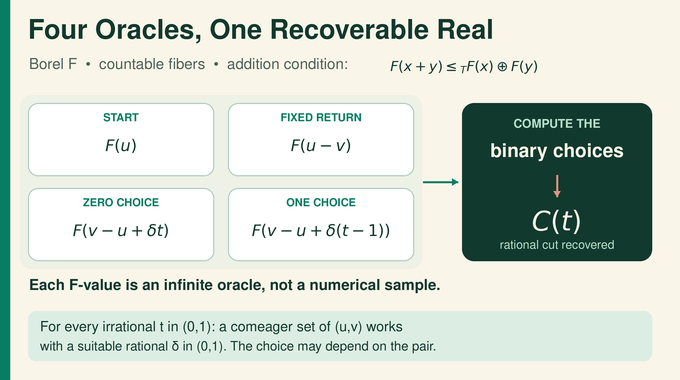
Proposition 4.1 applies to any Borel function with countable fibers satisfying the addition inequality. Fix an irrational . For a comeager collection of pairs , some rational makes the following four values compute :
| Oracle Value | Role in the Construction |
|---|---|
| Starts the computation at offset zero. | |
| Provides the fixed return step after each outward addition. | |
| Supplies the outward addition for a zero choice, giving a positive increment. | |
| Supplies the outward addition for a one choice, giving a negative increment. |
Four values here means four infinite oracle sets, not four finite measurements. The information resource is substantial. The breakthrough is that these particular affine arguments suffice without adding another real oracle for decoding.
The selected rational and program may depend on the parameter and auxiliary pair. This is an existence statement about Turing reductions, not an algorithm for finding the witnesses from arbitrary inputs. The later category argument accommodates exactly that nonuniformity.
The theorem also does not claim four values are optimal. It proves sufficiency under its stated hypotheses. Keeping those qualifications visible matters as much here as distinguishing computability from physical implementation in our fluid-computation analysis.
7. How Two Fixed Addition Programs Make Recovery Possible
Suppose the current oracle describes . To advance by an increment , the construction takes a detour:
The first addition moves to the neighborhood of . The second returns to the neighborhood of with the desired new offset. The return oracle remains fixed.
Why should the same two programs work repeatedly? Choose the least successful addition-program index for each input pair. This index-selection function is Borel. On a comeager restriction it is continuous, and its integer-valued outputs are therefore locally constant.
The proof restricts all relevant shifts to the countable group . Countably many translated conditions can then hold simultaneously on a comeager set of auxiliary pairs. Around a selected pair, two indices, and , stay valid whenever the offsets remain sufficiently small.
This converts pair-dependent reductions into a stable local mechanism. The recurrence’s task is now to keep every old offset, increment, and new offset inside that mechanism’s operating neighborhood.
For developers, the important distinction is between composing guaranteed oracle subroutines and executing a practical numerical simulation. The proof constructs new program indices by substituting earlier subroutines. Each requested output bit invokes only finitely many earlier subroutines. Induction guarantees termination on the actual oracles, even as the nesting grows. Establishing termination is enough for Turing reducibility. It gives no useful runtime bound, unlike a complexity result such as the integer-multiplication analysis.
8. The Bounded Recurrence That Encodes an Irrational Number
Choose a negative endpoint and positive endpoint inside the small operating neighborhood. Countable fibers ensure their translated outputs can be chosen different. Select a bit position where they differ, and call the upper endpoint’s bit .
Relative continuity makes that bit equal to near the upper endpoint and unequal near the lower endpoint. Choose a positive rational step scale small enough for these endpoint strips and the local addition programs.
Start at . Let when the tested bit of equals , and let otherwise. Then:
A zero chooses the positive step . A one chooses the negative step . Both magnitudes are smaller than .
Near the upper endpoint the bit forces a downward step. Near the lower endpoint it forces an upward step. Elsewhere either choice is allowed. Like a thermostat with protected boundary zones, the rule needs no monotonic behavior throughout the interior.
For example, a zero choice cannot occur in the upper strip. It therefore starts far enough below the upper endpoint that a positive step cannot escape. The matching argument handles a one choice near the lower endpoint. Induction confines every state between the endpoints.
Crucially, the oracle computation never calculates these real states. It reads the current output bit, chooses one of two fixed increment oracles, and uses programs to construct the next output oracle. Only the branch sequence must be computed. The endpoints justify confinement without becoming additional real inputs.
The fixed integers specifying the two programs, tested bit, and expected value can be built into a finite program, together with the rational step scale. They are not an infinite description of the unknown parameter. The four oracle sets supply the information that makes the entire infinite choice sequence accessible.
9. Recovering the Hidden Parameter From Binary Frequencies
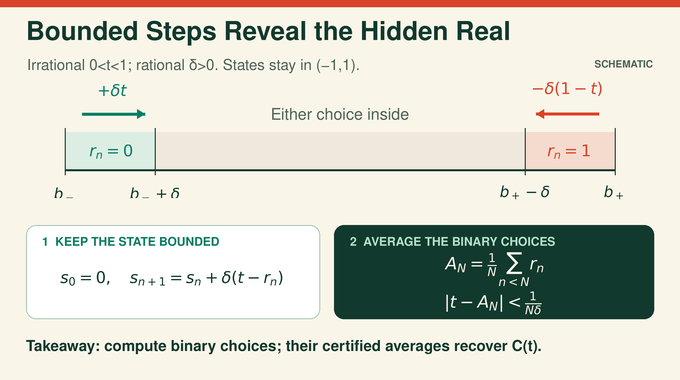
Summing the recurrence telescopes:
Define the average of its binary choices and rearrange:
The strict bound follows because every state lies inside a neighborhood of radius smaller than one. These are computable rational averages with an explicit shrinking error interval.
Imagine an irrational parameter a little above 0.7. Boundedness forces the long-run proportion of downward choices toward that value: too many downward steps would push the state down indefinitely, and too few would push it up. The telescoping identity makes this intuition quantitative, without assuming random or independent choices.
To answer whether a rational lies below the parameter, compute averages until the rational falls strictly outside the certified error interval. Its side determines the cut bit. Irrationality guarantees the queried rational never equals the parameter, so this search terminates.
For a numerical illustration of the bound, a step scale of one tenth and one thousand choices certify an error below one hundredth. That is a hypothetical substitution into the formula, not a measured benchmark. Greater accuracy requires more choices, and generating each choice can itself be computationally expensive.
Convergence alone would not suffice. The effective bound tells the computation when a comparison is certified. Nor is this a claim about exceptionally accurate rational approximation of a particular constant, the issue in our irrationality-exponent explainer. Here a known error schedule converts oracle-computable frequencies into the entire rational cut.
10. How Baire Category Removes the Auxiliary Degrees
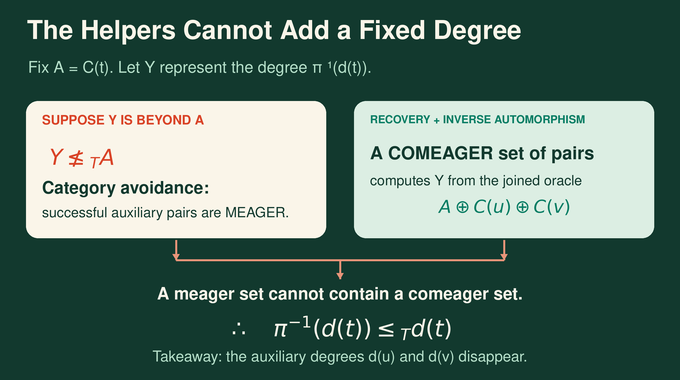
Recovery still appears to depend on and . Section 5 shows why those helpers cannot conceal a genuine increase in computational power.
Set , where is the least upper bound of degrees. Every argument among the four oracle values is a rational affine combination of these reals. Its degree is therefore at most . The representing function and preservation of joins bound the recovery oracle by .
Applying the inverse automorphism gives:
This holds for a comeager set of pairs. Now fix one set representing the left-hand degree. If it were not computable from alone, category avoidance would make the successful pairs meager. A comeager success set cannot fit inside that meager set in the Baire space of real pairs. The contradiction removes the auxiliary degrees:
The target set is fixed before the auxiliary pair varies. Reduction indices may vary between pairs, because the avoidance lemma already takes the countable union over possible programs. No hidden uniform decoding assumption enters the contradiction.
The avoidance lemma has a concrete computational explanation. A halting computation reads only finitely many cut bits. At irrational auxiliary coordinates, those answers remain unchanged on a small open rectangle. If successful pairs for one program were dense there, the base oracle could search finite transcripts and recover the supposedly inaccessible target itself. Taking the union over programs yields the meagerness result.
This is the decisive division of labor: local continuity makes four-oracle recovery possible, while global category avoidance forces its degree-theoretic consequence back onto the original parameter.
11. Why Every Automorphism Must Be the Identity
Every noncomputable degree is represented by an irrational parameter in the unit interval, and the least degree is automatically fixed. The inequality therefore holds for every degree. Apply the same result to the inverse automorphism to obtain . Applying to the original inequality gives . Antisymmetry forces equality.
The inverse used here is an inverse on degrees. The function need not be injective and requires no inverse.
Through an established Slaman–Woodin equivalence, the paper derives parameter-free biinterpretability with full second-order arithmetic. This relates degree-based codes for sets to their degrees through first-order definability. It is not a decision procedure for arithmetic, another distinction familiar from our discussion of decidable word problems.
OpenAI included the work in its October mathematics release. Its Turing degrees Lean proof scope note reports formalization of the main unrestricted rigidity theorem, excluding additional representation corollaries. This article does not independently rebuild that formalization. As our Lean verification explainer emphasizes, checking a formal argument and assessing its mathematical scope are distinct tasks.
Rigidity of the Turing Degrees gives the hierarchy a striking property: its full ordering determines every position uniquely. Follow Binary Verse AI for research explanations that carry the argument, assumptions, and verification scope into the same conversation.
What is a Turing degree?
A Turing degree is an equivalence class of sets of natural numbers that can compute one another using oracle Turing machines. Two sets share a degree when each is Turing reducible to the other. The ordering measures relative computational power, rather than execution speed.
What does rigidity mean for the Turing degrees?
Rigidity means that every automorphism preserving the entire ordering of Turing degrees is the identity. OpenAI’s paper proves that each degree must remain fixed, without imposing definability or regularity assumptions on the automorphism.
How many Turing degrees are there?
There are continuum many Turing degrees, with cardinality . Each individual degree contains only countably many sets, because there are only countably many oracle programs, while the full collection of subsets of natural numbers has continuum cardinality.
Why was rigidity difficult to prove before OpenAI’s result?
Earlier work established that every automorphism fixes all degrees above , the second Turing jump of the computable degree. The remaining difficulty was eliminating movement outside this fixed cone, including degrees incomparable with its base.
How does OpenAI’s proof recover an irrational number from four function values?
For a Borel function with countable fibers satisfying the paper’s addition condition, the proof constructs a bounded recurrence. Its binary choices are computable from four fixed oracle values, and their averages approximate the irrational parameter with error smaller than . The effective bound makes each rational-cut bit computable. The four values are infinite oracle sets, not finite numerical samples.
Why is Baire category essential to the rigidity proof?
Baire category supplies recovery on a comeager set of auxiliary pairs. Category avoidance says that pairs computing a fixed set beyond the base oracle’s power form a meager set. Combining those facts removes the auxiliary degrees, producing an inequality that, when applied to both an automorphism and its inverse, forces every degree to remain fixed.
Has the rigidity of the Turing degrees been formally verified in Lean?
OpenAI’s scope documentation reports a Lean formalization of the main theorem: every order automorphism of the full Turing degrees fixes every degree, with no definability or genericity assumption. The documented scope excludes additional representation corollaries. This article does not independently rebuild or audit the formalization.