Goldfeld’s Conjecture: Why OpenAI’s 50–50 Claim Could Change Number Theory
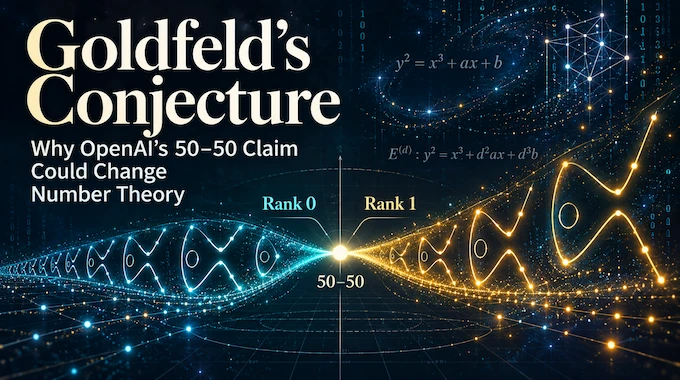
Goldfeld’s Conjecture visualized as a balanced teal and amber coin on a glowing elliptic curve

An infinite collection of equations, a coin-flip prediction, and a proof that has resisted mathematicians for decades. Goldfeld’s Conjecture sounds deceptively tidy: take one elliptic curve, build its quadratic twists, and analytic ranks zero and one should each appear half the time. The average should approach one-half. OpenAI now claims arguments establishing both conclusions for … Read more
Catalan’s Constant: Inside OpenAI’s New Proof and Why Irrationality Was So Hard

Catalan’s constant proof shown as two steel plates closing on a glowing matrix grid

A number can be easy to calculate and maddeningly difficult to understand. Catalan’s constant fits that description perfectly. Its defining series is simple enough to write on a napkin, yet deciding whether the result is a fraction resisted generations of mathematical work. OpenAI’s manuscript dated September 24, 2026, claims a proof of its irrationality. The … Read more

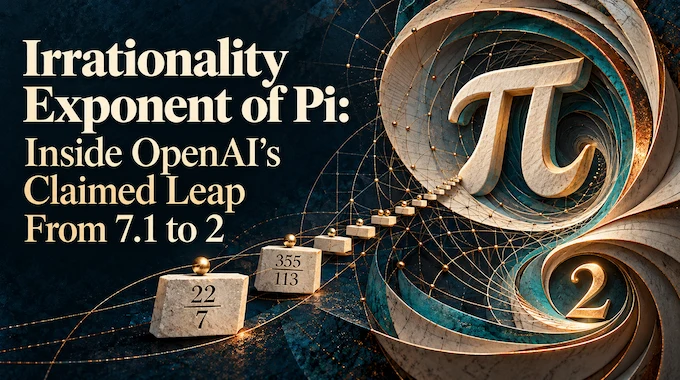
Irrationality Exponent of Pi: Inside OpenAI’s Claimed Leap From 7.1 to 2

Editorial cover showing the irrationality exponent of pi as a pi symbol squeezed between two glowing bounds, 7.1 to 2

The fraction 355/113 gets astonishingly close to π using just three digits in its denominator. It also points to a question mathematicians have struggled with for decades: how often can fractions achieve that kind of accuracy as their denominators grow? OpenAI’s manuscript The Irrationality Exponent of π Is 2, dated September 24, 2026, claims an … Read more

Quasi-Riemann Hypothesis: What OpenAI’s 7/8 Claim Means

Quasi-Riemann Hypothesis cover showing a glowing barrier wall holding back points of light at the 7/8 line

The Riemann hypothesis remains unsolved. Clay Mathematics Institute still lists it as an open Millennium Prize Problem. OpenAI’s new Quasi-Riemann Hypothesis manuscript addresses a weaker statement, but “weaker” hardly means small. If its argument holds, it establishes a fixed limit on where certain mathematical zeros can occur, tightening our understanding of prime numbers. Released on … Read more