Heilbronn Triangle Problem: A Tiny Exponent Overturns Decades of Geometric Belief
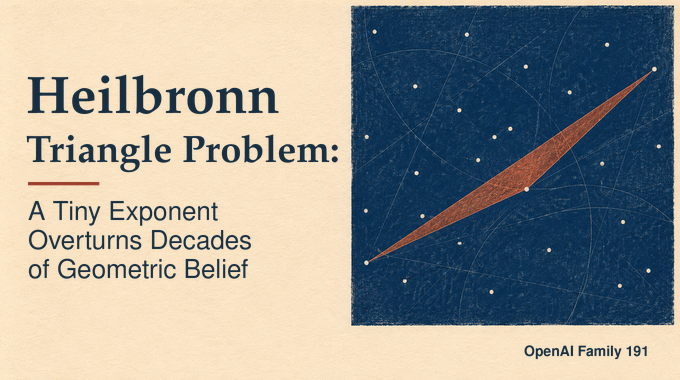
A thin copper triangle joins three points in an indigo square on the Heilbronn triangle problem cover.

Put four dots at the corners of a unit square. Whichever three you join, the triangle covers half the square. With a million dots, how much area can you guarantee for the skinniest triangle? The Heilbronn triangle problem asks how well the best arrangement can do as the number of dots grows. OpenAI’s September 2026 … Read more
BFSS Matrix Model: OpenAI’s Proof of Unexpected Quantum Bound States

A BFSS matrix model illustration of two D0-branes and a localized wave in an open channel.

Two D0-branes in the BFSS matrix model have a route to unlimited separation along configurations where the classical potential vanishes. Yet OpenAI’s October 2026 preprint proves that the relative SU(2)\mathrm{SU}(2) Hamiltonian has infinitely many normalizable states at strictly positive energies, including a sequence of energies that tends to infinity. The escape directions remain open. In … Read more

Ricci Flow: When Geometry Breaks but Scalar Curvature Stays Bounded

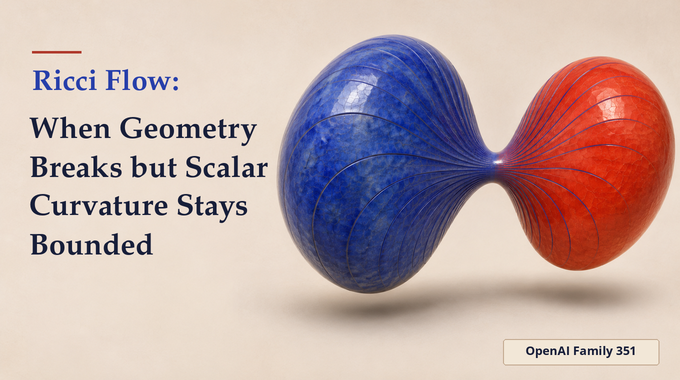
Ceramic lobes pinch at a narrow waist, illustrating Ricci flow blowup with bounded scalar curvature.

Ricci flow can reach a finite time when some sectional curvatures become arbitrarily large, even though scalar curvature stays uniformly bounded in space and time. OpenAI’s manuscript makes that split precise on a closed, sufficiently high-dimensional product of spheres. The key is a shrinking cap that sits inside a much larger region resembling a Ricci-flat … Read more

Geodesic on a Sphere: Why Infinite Closed Paths Survive Every Smooth Distortion

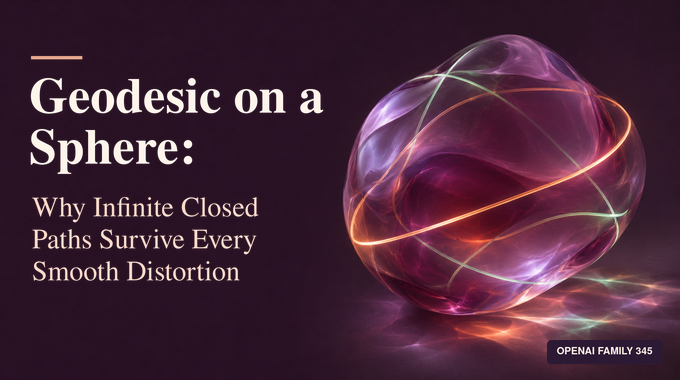
Geodesic on a Sphere article title beside a distorted glass sphere traced by luminous closed paths.

Every great circle on a round sphere closes. Stretch the sphere unevenly, and the same starting direction can send you along a path that never closes. Yet infinitely many periodic routes still exist. OpenAI’s September 2026 preprint proves that every smooth Riemannian metric on the standard sphere of dimension two or higher admits infinitely many … Read more

Random Matrix Singularity: OpenAI’s Proof Pins Down the Odds of a Missing Inverse

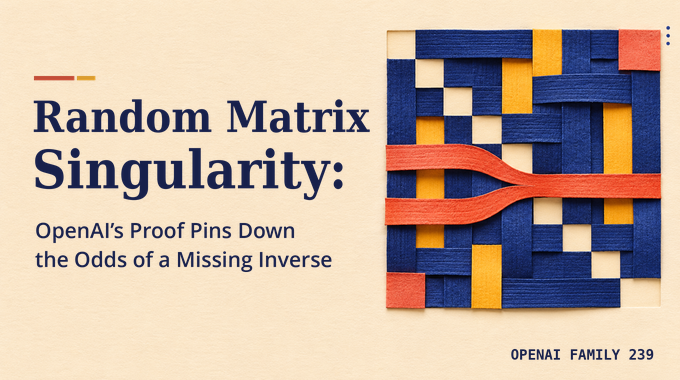
Two coral ribbons merge across a woven random matrix, illustrating how matching rows remove the inverse.

Two rows of a random matrix can match by accident. When they do, the matrix loses its inverse. But rows can also depend on one another in less obvious ways, and symmetry ties their entries together. Can all those other dependencies make singularity exponentially more likely than one matching pair? OpenAI’s October 3, 2026 preprint … Read more

Boltzmann Equation: OpenAI’s Proof for Gases Beyond Hard-Sphere Collisions

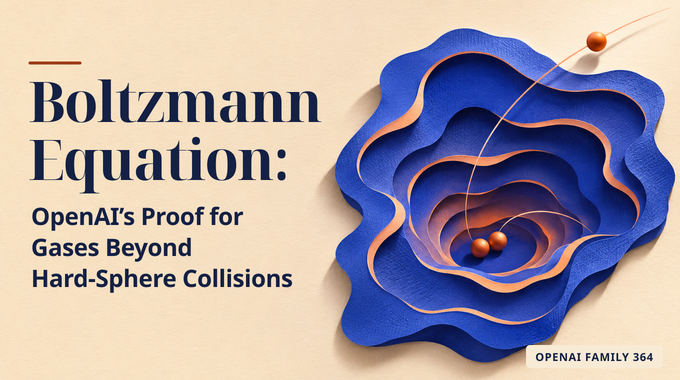
Boltzmann equation cover showing copper particles curving through a blue paper sculpture of an attractive potential well.

A pair of molecules drawn into an attractive well can keep interacting long enough for a third to arrive. The Boltzmann equation still describes the dilute-gas limit of that Newtonian system under the conditions proved in OpenAI’s September 2026 manuscript. The result covers stable, finite-range radial forces in three dimensions, including potentials with attractive wells. … Read more

Self-Avoiding Walk: OpenAI’s Proof of the Hidden 3/4 Law on the Honeycomb Lattice

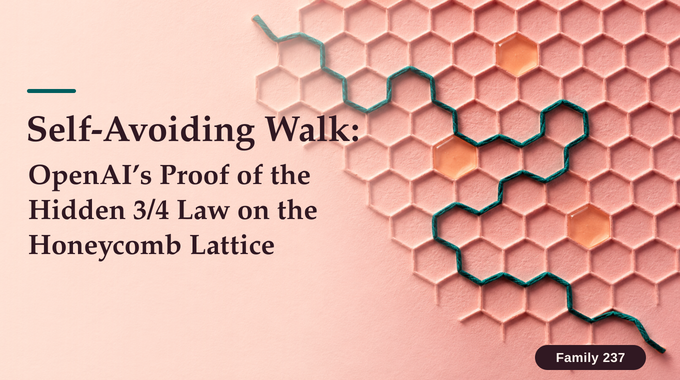
Teal self-avoiding walk stitched across a peach honeycomb lattice beside the article title.

Imagine two routes across a honeycomb grid, each exactly a thousand steps long and each forbidden to touch a vertex twice. One can curl back toward its start while the other reaches across the grid. How much space does a typical route occupy? OpenAI’s manuscript proves that a uniformly sampled nn-step self-avoiding walk on the … Read more