Ramanujan Graph Construction: OpenAI’s Proof of Exact Spectral Expansion in Every Fixed Degreev
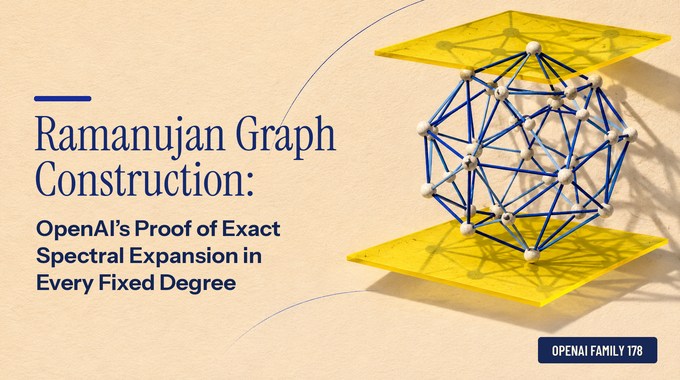
Blue Ramanujan graph sculpture between two yellow planes representing the spectral bounds.

Give every vertex exactly three neighbors and ask a random walk to forget where it started. Two densely connected regions joined by a handful of edges can trap the walk for a long time, even when every vertex has the same degree. A Ramanujan graph meets the sharp asymptotic spectral standard for avoiding that kind … Read more
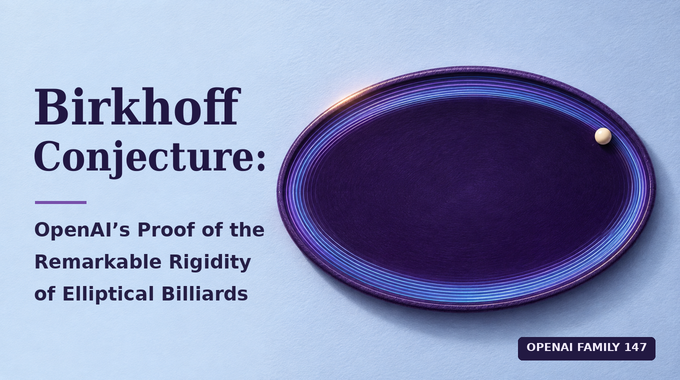
Birkhoff Conjecture: OpenAI’s Proof of the Remarkable Rigidity of Elliptical Billiards

Birkhoff conjecture feature art showing a violet elliptical billiard with a band of nested caustics.

Why are ellipses special billiard tables? Send a ball around an elliptical table at a shallow angle and every leg of its path can stay tangent to the same invisible inner ellipse. The Birkhoff conjecture asks whether that kind of order forces the table itself to be elliptical. OpenAI’s September 24, 2026 manuscript proves the … Read more

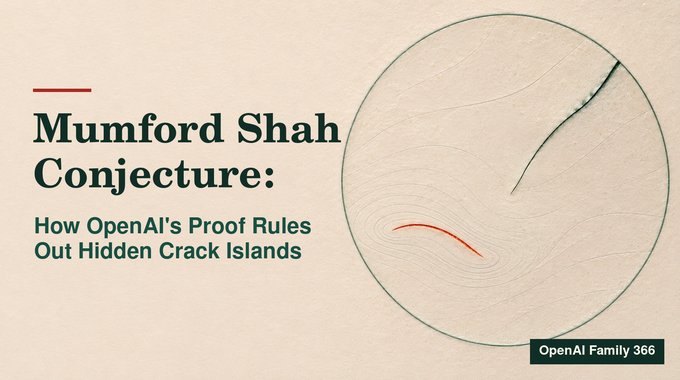
Mumford Shah Conjecture: How OpenAI’s Proof Rules Out Hidden Crack Islands

Mumford Shah conjecture cover showing an isolated red crack beside a separate green fissure.

An edge in a segmented image can run through a region, stop inside it, or meet two other edges. Could an energy minimizer hide a disconnected crack among other cracks, even as you zoom in? The planar Mumford Shah conjecture asks whether those three patterns describe every interior point of the discontinuity set. OpenAI’s September … Read more

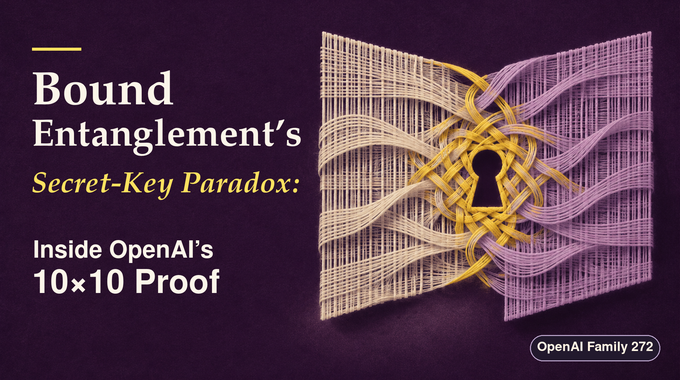
Bound Entanglement’s Secret-Key Paradox: Inside OpenAI’s 10×10 Proof

Two woven panels meet around a keyhole, illustrating bound entanglement with zero distillable secret key.

Can two quantum systems be entangled yet supply no usable secret key? OpenAI’s September 27, 2026 paper answers yes within its specified local-instrument protocol model. It constructs a state on two ten-dimensional systems for which unlimited copies and permitted two-way public discussion cannot produce even one arbitrarily accurate secret bit. Bound entanglement alone never established … Read more

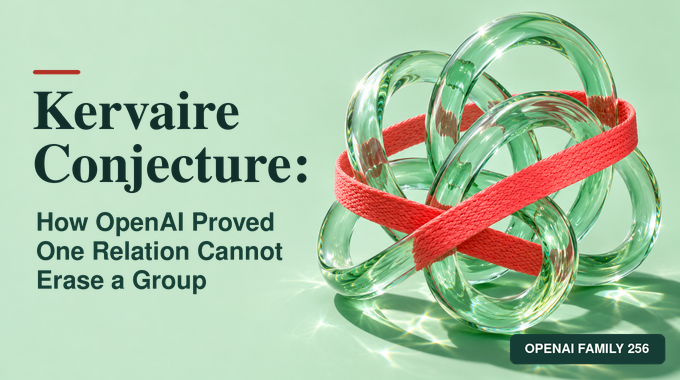
Kervaire Conjecture: How OpenAI Proved One Relation Cannot Erase a Group

Kervaire conjecture feature art with a red ribbon wrapped around an intact sculpture of interlocking mint glass loops.

“Can one new generator and one relation erase an entire group?” The Kervaire conjecture says no. Start with any nontrivial group, adjoin a generator, and impose one relation. The resulting group still has an element other than the identity. OpenAI’s September 24, 2026 manuscript proves something stronger in the difficult case. When the new generator … Read more

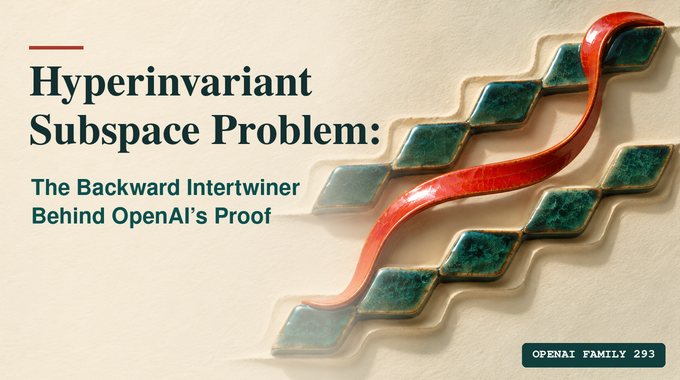
Hyperinvariant Subspace Problem: The Backward Intertwiner Behind OpenAI’s Proof

Hyperinvariant subspace problem cover with a red ribbon curling backward between two teal ceramic tracks.

Apply OpenAI’s operator to a vector supported at coordinates 0, 1, 2, and onward, and its support stays in that same tail. Now apply a second operator that commutes with the first. Even a vector concentrated at coordinate 0 can land at coordinate −1, in a different fiber. That backward move is the mechanism behind … Read more

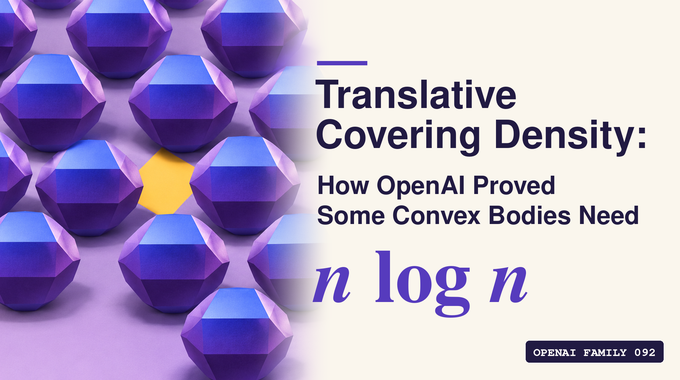
Translative Covering Density: How OpenAI Proved Some Convex Bodies Need n log n

Violet convex bodies leave a yellow gap beside the translative covering density article title.

A floor tiled with squares uses one square’s worth of material per square’s worth of space. In high dimensions, some convex shapes make that economy impossible even when you can place each copy wherever you like. OpenAI’s September 2026 preprint proves that, in every sufficiently large dimension, some centrally symmetric convex body has translative covering … Read more