Chiral Gauge Theory: How Nathaniel Craig Tackled a 50-Year-Old Lattice Problem with Astra
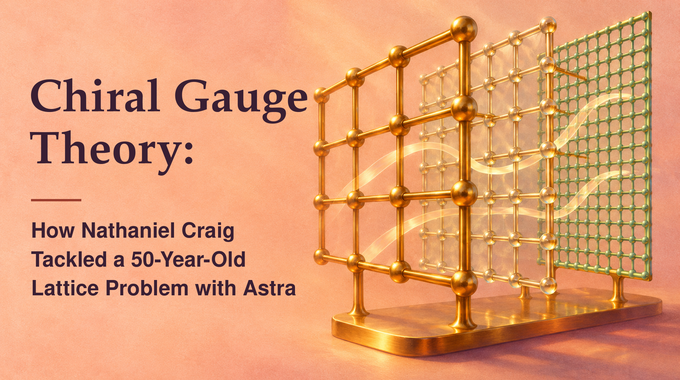
Brass and jade grids illustrate Nathaniel Craig’s lattice refinement in chiral gauge theory.

The Standard Model’s weak interactions distinguish left-handed particles from right-handed ones. Put those fermions on a spacetime grid, and that distinction becomes a problem for the path integral. In his preprint, physicist Nathaniel Craig constructs a gauge-invariant fermion measure for four-dimensional chiral gauge theory at finite lattice spacing, in a class that includes the Standard … Read more
Saxl Conjecture: One Staircase, Squared, Contains Every Symmetry Type

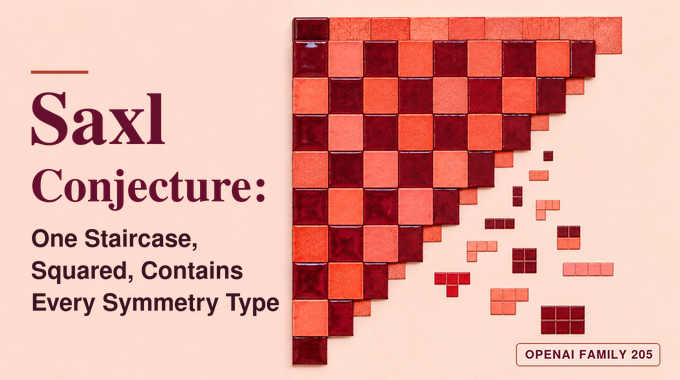
Saxl conjecture artwork with two overlapping red tile staircases and a fan of smaller shapes.

One staircase, squared, contains every symmetry type of its symmetric group. The staircase is a Young diagram, and the object being squared is the irreducible complex representation it labels. OpenAI’s September 2026 paper, publicly shared in October, proves the Saxl conjecture for staircases of every size: g(ρm,ρm,λ)>0g(\rho_m,\rho_m,\lambda)>0 for every partition λ\lambda of the staircase’s number … Read more

Cartan–Hadamard Conjecture: How OpenAI Proved Sharp Euclidean Fillings in CAT(0) Spaces

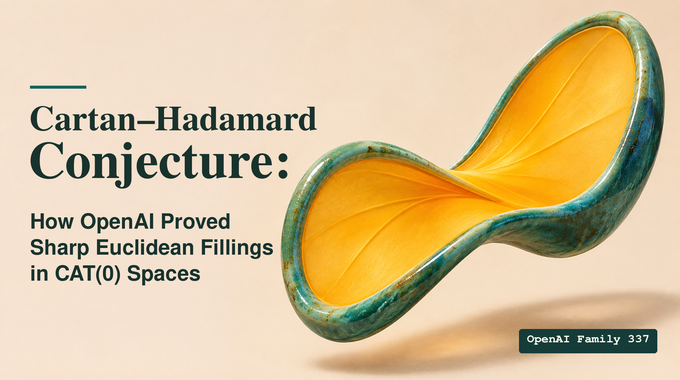
A gold membrane spans a warped ceramic rim in the feature art for the Cartan Hadamard conjecture.

How much volume can a boundary of fixed area enclose when the surrounding space has nonpositive curvature? The Cartan Hadamard conjecture says the Euclidean ball sets the limit. In Sharp integral fillings in CAT(0) spaces, OpenAI proves the corresponding domain inequality in manifold dimensions three and higher by establishing a broader result. Every compactly supported … Read more

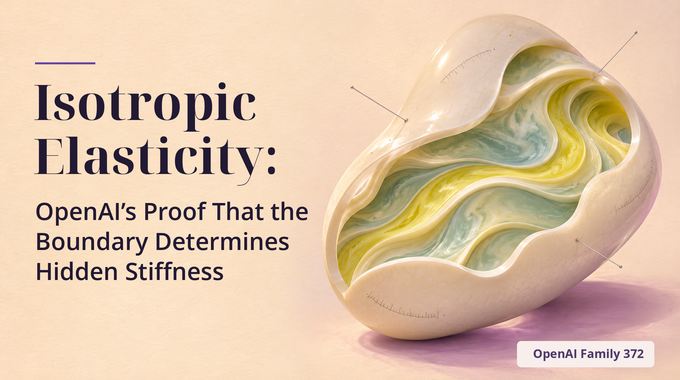
Isotropic Elasticity: OpenAI’s Proof That the Boundary Determines Hidden Stiffness

Porcelain cutaway illustrates how boundary data determine hidden stiffness in isotropic elasticity.

Prescribe every displacement pattern you can on the surface of a solid and record the force per unit area needed to hold each one. Could two bodies with the same shape but different interior stiffness give exactly the same responses? OpenAI’s preprint on isotropic elasticity proves they cannot under its smooth, three-dimensional, static model. The … Read more

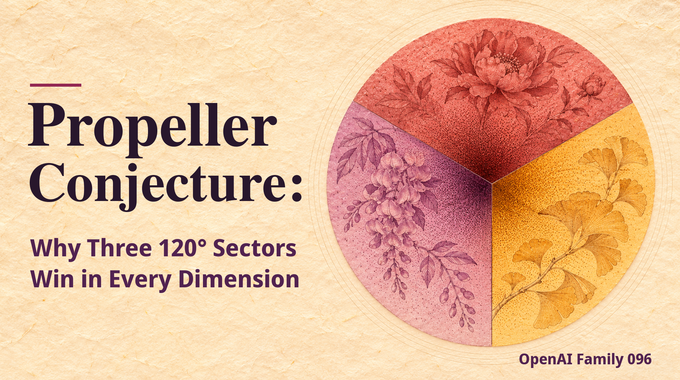
Propeller Conjecture: Why Three 120° Sectors Win in Every Dimension

Botanical print of three 120° sectors illustrating the propeller conjecture.

Give a standard Gaussian cloud as many labels as you like. For each label, add up the vectors assigned to it, weighted by Gaussian probability, and square the length of that sum. Can a fourth label, or a hundredth coordinate, improve the best total? OpenAI’s proof of the propeller conjecture gives a sharp answer. Every … Read more

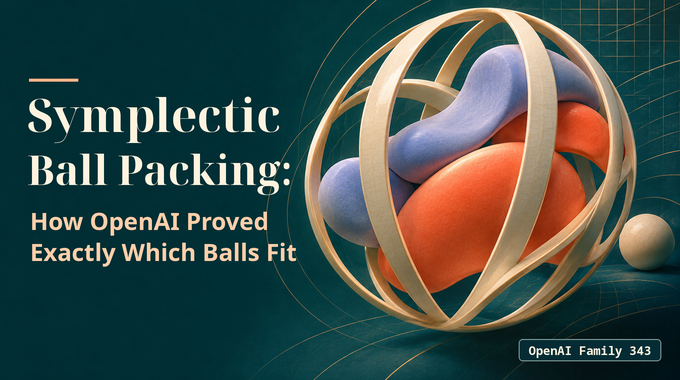
Symplectic Ball Packing: How OpenAI Proved Exactly Which Balls Fit

Ceramic shell and curved forms illustrate symplectic ball packing in higher dimensions.

Two balls in six dimensions can use just 43.2% of a target ball’s volume and still be impossible to pack inside it. Take two balls of capacity 0.6 and a target of capacity 1. Their capacities add to 1.2, which violates Gromov’s two-ball bound. OpenAI’s September 23, 2026 preprint proves that for symplectic ball packing … Read more

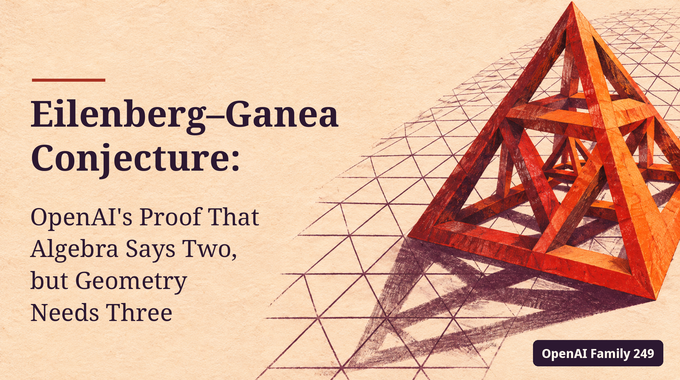
Eilenberg–Ganea Conjecture: OpenAI’s Proof That Algebra Says Two, but Geometry Needs Three

A tetrahedral lattice rises from a flat grid, illustrating the dimension gap in the Eilenberg Ganea conjecture.

A group can have a length-two free resolution and still need a three-dimensional classifying space. OpenAI’s September 2026 manuscript proves that this happens for a finitely generated, residually finite group, giving a counterexample to the Eilenberg Ganea conjecture. The proof turns on a test with unit quaternions. Assign each edge of an acyclic complex a … Read more