Brenier Map Stability: The Three-Atom Twist in OpenAI’s One-Third Proof
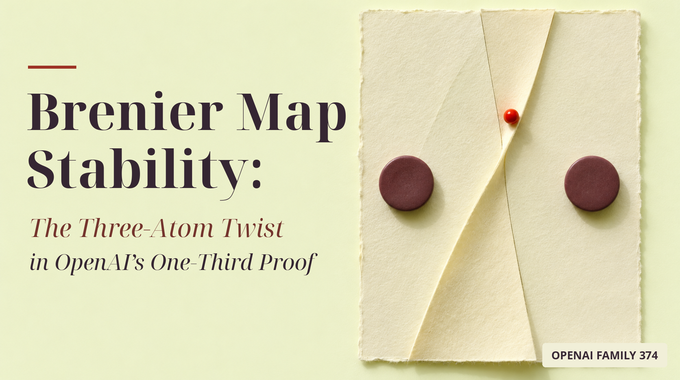
Brenier map stability cover with a small red bead pulling a folded paper strip between two fixed disks.

How can moving a tiny amount of probability mass cause a much larger change in the optimal transport map? OpenAI’s Brenier map paper answers with three target atoms. Keep two atoms fixed and move the lightest one sideways. The target distribution barely changes, yet a thin region of the source gets reassigned to destinations roughly … Read more
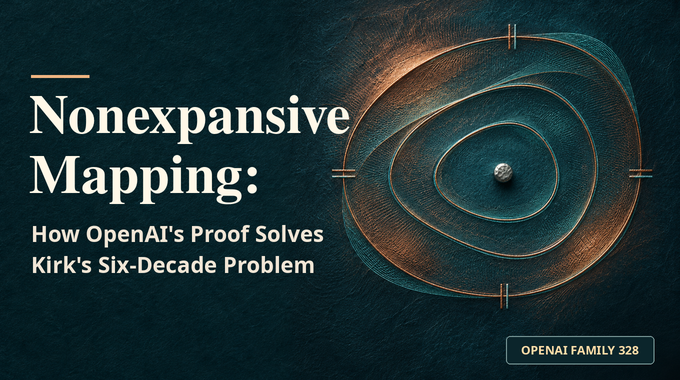
Nonexpansive Mapping: How OpenAI’s Proof Solves Kirk’s Six-Decade Problem

Etched copper contours surround a stationary silver pin, illustrating a fixed point of a nonexpansive mapping.

When must a distance-nonincreasing transformation leave some point unchanged? OpenAI’s September 2026 preprint proves that a nonexpansive mapping from a nonempty, norm-closed, bounded, convex subset of a real reflexive Banach space into itself always has a fixed point. That answers the question left by Kirk’s 1965 theorem for the space’s given norm. The proof begins … Read more

Hyperbolic Groups: OpenAI’s Proof of an Element No Finite Quotient Can Detect

Hyperbolic groups illustration with a green filament and three projections that miss it.

A group element can be nontrivial and still look exactly like the identity in every finite quotient. The longstanding question was whether the coarse negative curvature of hyperbolic groups prevented that from happening. In its September 23, 2026 preprint, OpenAI constructs a torsion-free word-hyperbolic group in which it does happen. Geometry certifies that finitely many … Read more

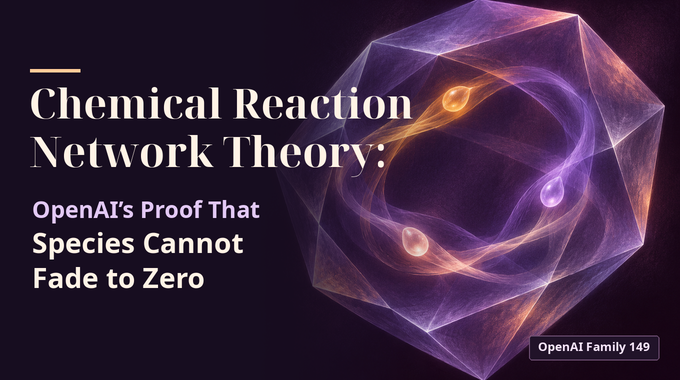
Chemical Reaction Network Theory: OpenAI’s Proof That Species Cannot Fade to Zero

Chemical reaction network theory artwork showing three glowing droplets confined inside a glass polytope.

Can a chemical species fade to zero even if every reaction has a directed return path? For a finite weakly reversible network governed by mass action kinetics, OpenAI’s September 25, 2026 preprint proves that it cannot, provided the reaction rates are positive constants and every species starts at a strictly positive concentration. Theorem 1.1 gives … Read more

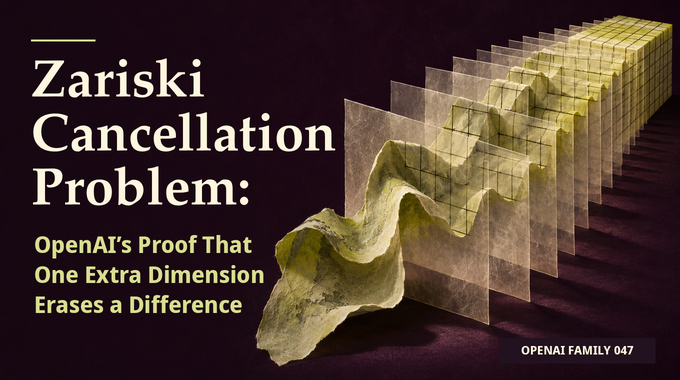
Zariski Cancellation Problem: OpenAI’s Proof That One Extra Dimension Erases a Difference

Zariski cancellation problem illustrated by folded paper becoming a regular lattice through translucent planes.

The Zariski cancellation problem asks whether one extra dimension can hide the difference between an affine variety and ordinary affine space. OpenAI’s September 2026 preprint gives an explicit example over the complex numbers. Its hypersurface has dimension four and cannot be described by four freely generating polynomial coordinates. Attach an affine line, however, and the … Read more

Memory Sample Tradeoff: Why Perfect Gaussian Measurements Still Demand More Samples

Paper records curl into a narrow slot, illustrating the memory sample tradeoff in noiseless Gaussian regression.

A stack of exact Gaussian equations can pin down an unknown vector after just as many measurements as it has coordinates. Put those same equations through a learner that can read each pair only once and retain at most a fixed multiple of the dimension squared in bits, and the precision changes what it needs. … Read more

Polynomial Identity Testing with Division: How OpenAI’s Proof Constructs Universal Matrix Hitting Lists

Light passes through one set of matrix tiles, illustrating a hit in polynomial identity testing with division.

Imagine a sealed box that accepts a tuple of matrices and returns the value of a hidden formula. Some queries fail because an intermediate matrix has no inverse. Which queries can you choose in advance so that every nonzero formula of a given size gives you a decisive answer? OpenAI’s September 24, 2026 preprint gives … Read more