Infinity Laplacian Regularity: How OpenAI’s Proof Turns Flatness into Hölder Gradients
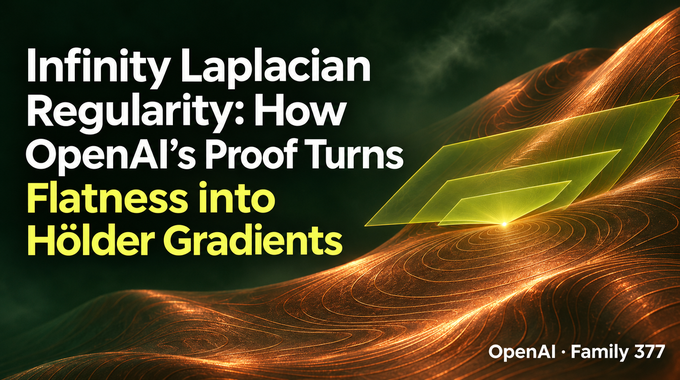
Infinity Laplacian regularity illustrated by copper contours and nested tangent planes.

A function can have a derivative everywhere without that derivative varying continuously. That gap is the central issue in higher-dimensional infinity Laplacian regularity. OpenAI’s October 4, 2026 manuscript proves that bounded infinity-harmonic functions in dimensions d≥3d\ge3 have uniformly Hölder-continuous gradients on interior balls. The exponent is positive and dimension-dependent, but unspecified. The proof converts qualitative … Read more
Wall D2 Problem: How OpenAI’s Twisted-Homology Proof Found a 3D Counterexample

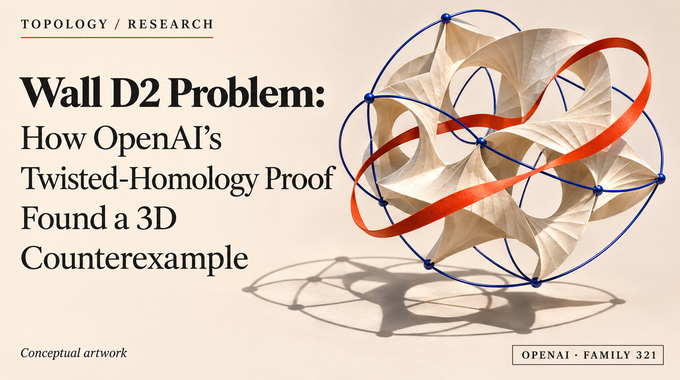
Wall D2 Problem artwork showing a twisted cellular sculpture and its two-dimensional shadow.

Can a space satisfy the algebraic tests for two dimensions yet still require three? The Wall D2 Problem asks exactly that question about finite cell complexes. OpenAI’s October 6, 2026 manuscript constructs a finite three-dimensional complex satisfying the D(2) conditions but admitting no finite two-dimensional homotopy model. Its fundamental group is infinite. The decisive obstruction … Read more

Hot Spots Conjecture: OpenAI’s Proof That Excludes Every Interior Critical Point

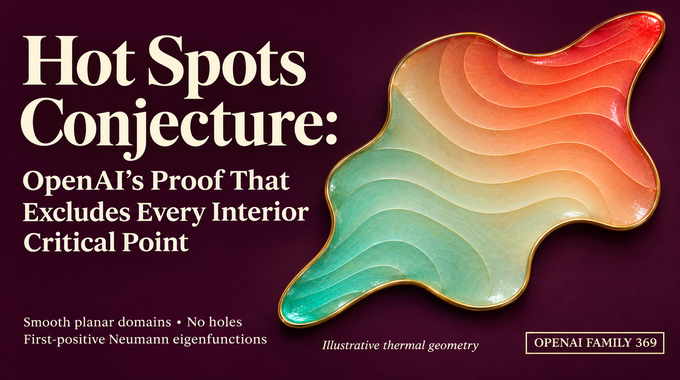
Hot Spots Conjecture artwork shows warm and cold boundary extremes on an irregular enamel plate.

An insulated plate can have an irregular outline, deep indentations and no symmetry. As temperature differences fade, must its slowest nonconstant heat pattern put its hottest and coldest values on the edge? OpenAI’s September 24, 2026 paper on the Hot Spots Conjecture proves a stronger statement for smooth, bounded, simply connected planar domains: every nonzero … Read more

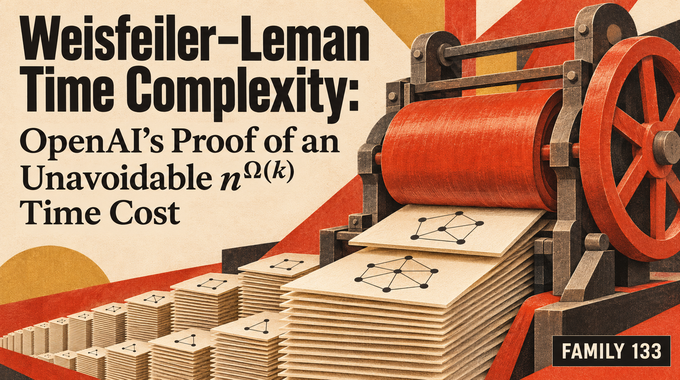
Weisfeiler–Leman Time Complexity: OpenAI’s Proof of an Unavoidable \(n^{\Omega(k)}\) Time Cost

Weisfeiler Leman time complexity illustrated by a graph-printing press and growing stacks of graph plates.

Must a graph comparison become polynomially harder as its dimension grows, or could a clever algorithm bypass the expensive refinement? OpenAI’s September 25, 2026 paper on unconditional WL lower bounds answers this question about weisfeiler leman time complexity. For every sufficiently large fixed dimension, every correct deterministic sequential decider needs an exponent proportional to that … Read more

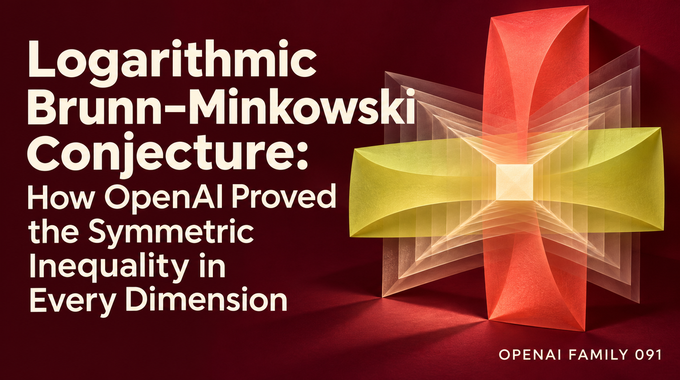
Logarithmic Brunn–Minkowski Conjecture: How OpenAI Proved the Symmetric Inequality in Every Dimension

Logarithmic Brunn Minkowski conjecture artwork showing symmetric shapes and geometric interpolation.

A convex body can become smaller when you replace arithmetic averages with geometric ones. The logarithmic Brunn Minkowski conjecture asks whether its volume nevertheless stays above a precise lower bound. OpenAI’s paper proves that it does for any two origin-symmetric convex bodies, in every dimension. The result rests on a sharp variance inequality, a transport … Read more

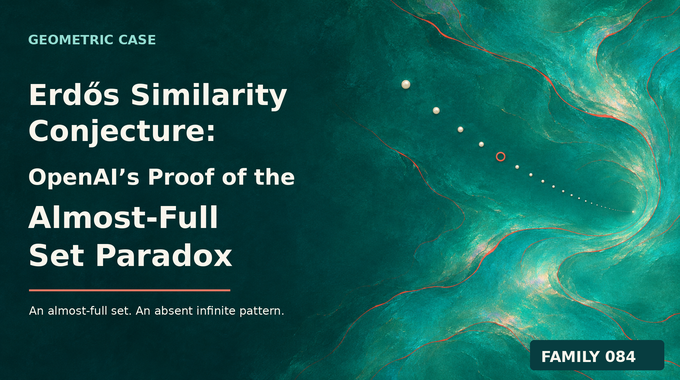
Erdős Similarity Conjecture: OpenAI’s Proof of the Almost-Full Set Paradox

Erdős similarity conjecture artwork showing a nearly intact field and an interrupted geometric sequence.

Remove less than one percent of a unit interval. Can the remaining compact set exclude every translated, stretched, compressed, or reflected copy of an infinite geometric progression? OpenAI’s proof answers yes for every fixed ratio 0<q<10<q<1. Its October 5, 2026 paper establishes the geometric case of the Erdős similarity conjecture: however small the permitted loss … Read more

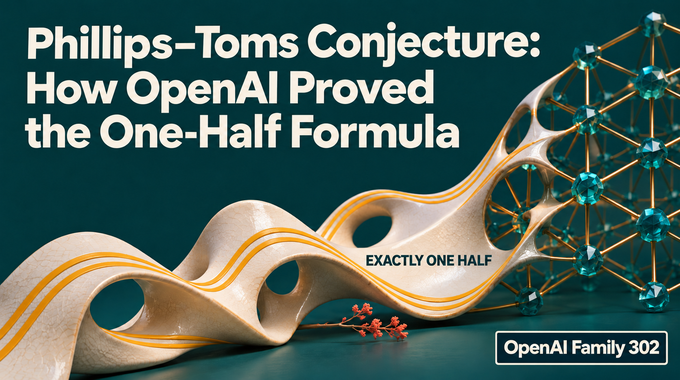
Phillips–Toms Conjecture: How OpenAI Proved the One-Half Formula

Phillips–Toms conjecture artwork links flowing orbit geometry to algebra and the one-half formula.

A dynamical system can require fresh geometric information at every step, even when its orbit lives inside one compact space. Can its associated algebra measure that same complexity exactly? The Phillips–Toms conjecture predicts that it can: the radius of comparison equals half the mean dimension. OpenAI’s September 25, 2026 paper proves this equality for every … Read more