Seymour Second Neighborhood Conjecture: The Graph That Cannot Exist
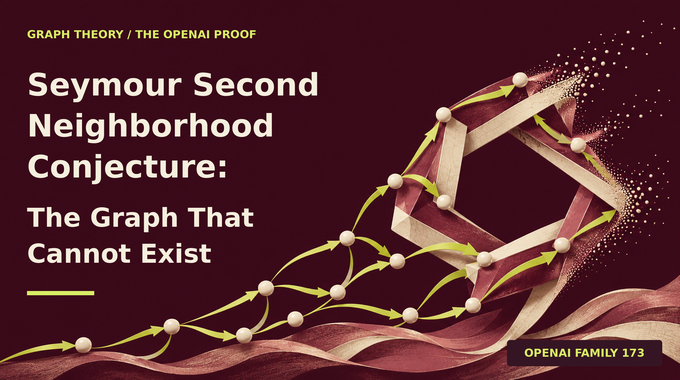
Seymour second neighborhood conjecture artwork showing a directed graph and a dissolving impossible frame.

Take any finite network of one-way arrows, forbid loops and opposing arrows, and look two steps ahead. Must somebody reach at least as many new vertices in two steps as in one? The Seymour second neighborhood conjecture says yes. OpenAI’s September 23, 2026 paper proves this for every nonempty finite oriented graph. Its argument assumes … Read more
Scalar Curvature and Urysohn Width: The Spectral Proof Behind Bounded Fibers

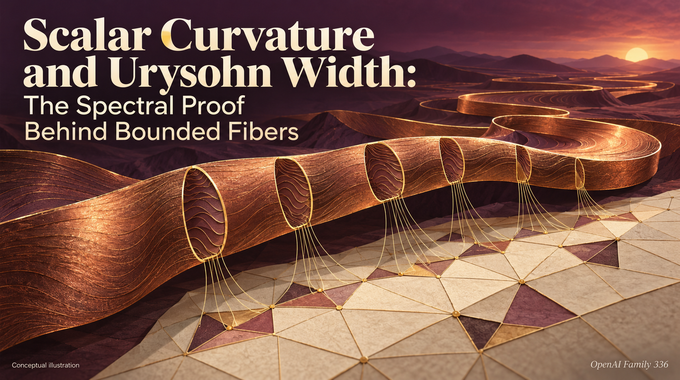
Scalar curvature and Urysohn width visualized as copper fibers projecting onto a triangulated map.

A manifold can extend forever while its geometry remains uniformly narrow in two directions. The new connection between scalar curvature and Urysohn width makes that intuition precise under a spectral condition that even permits negative scalar curvature locally. OpenAI’s October 5 paper proves that every complete, connected, smooth, boundaryless manifold of dimension n≥4n\ge4 satisfying −4Δ+Scal≥1-4\Delta+\mathrm{Scal}\ge1 … Read more

Nearby Lagrangian Conjecture: An Exact Twin Outside Hamiltonian Reach

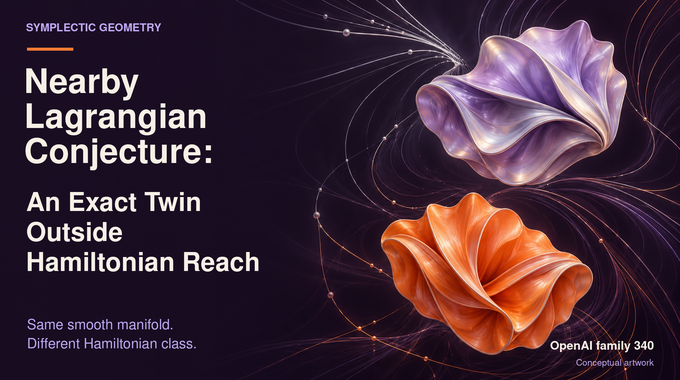
Nearby Lagrangian conjecture artwork showing smooth twins in different Hamiltonian isotopy classes.

Two manifolds can be exact smooth twins yet occupy different Hamiltonian isotopy classes. OpenAI’s September 23, 2026 manuscript gives a nearby Lagrangian conjecture counterexample: a closed exact smoothly embedded Lagrangian, diffeomorphic to the base of its cotangent bundle, that cannot be carried to the zero section by Hamiltonian isotopy. The base is a product of … Read more

Shub Entropy Conjecture: The Clock That Lets Homology Grow While Entropy Vanishes

Shub entropy conjecture artwork showing a slowing clock and multiplying golden topology.

A sphere map can double aa topological feature every iteration while its observable orbit complexity grows slower than exponentially. OpenAI’s proof makes that mismatch explicit: the general C¹ self-map formulation of the Shub entropy conjecture is false. Its construction has zero topological entropy but an eigenvalue of 2 on second real homology. The mechanism combines … Read more

Generalized Lax Conjecture: The 23-Variable Cone No Finite Matrix Pencil Can Define

Generalized Lax Conjecture: A 23-Variable Counterexample shown as a glass cone escaping rigid matrix frames.

A convex cone can pass every real-root test in its definition and still resist every finite matrix description in its original coordinates. OpenAI’s September 24, 2026 manuscript gives an explicit example: a hyperbolicity cone in 23 real variables, ultimately defined by a degree-16 polynomial, that is not spectrahedral. This disproves the geometric generalized Lax conjecture. … Read more

Trilinear Hilbert Transform: The Quadratic Symmetry OpenAI Had to Untangle

Trilinear Hilbert transform artwork with intertwined curved strips and the exact article title.

A quadratic wave can oscillate furiously while three shifted copies conceal its cancellation. That is the central difficulty behind the trilinear Hilbert transform. OpenAI’s October 5, 2026 manuscript proves the fixed-slope estimate L3×L3×L3→L1L^3\times L^3\times L^3\to L^1 for slopes 1, 2, 3. Its contribution is a method for controlling matched quadratic structure across arbitrarily many scales. … Read more

Kohn–Sham Representability: The Three-Electron Density That Defies Standard DFT Ensembles

Conceptual density artwork illustrating the Kohn–Sham representability counterexample.

A density can come from a real interacting Coulomb ground state yet have no exact Kohn–Sham stand-in within a familiar class of local potentials. OpenAI’s manuscript constructs precisely that situation with three electrons and two nuclei. Its Kohn–Sham representability result survives arbitrary mixtures of noninteracting ground states. The obstruction lies in a tiny density tail … Read more