Generalized Amplitude Damping Channel: Two States, One Exact Capacity, OpenAI’s Proof
Generalized amplitude damping channel shown as two copper signal ribbons passing through thermal noise.

A noisy qubit can lose an excitation, gain one from its surroundings, and still carry a precisely calculable amount of classical information. OpenAI’s September 24, 2026 paper proves that the generalized amplitude damping channel has classical capacity equal to its one-shot Holevo capacity for every allowed damping strength and thermal occupation. Two equally probable pure … Read more
Crouzeix’s Conjecture: How OpenAI Proved the Complete Matrix Inequality with the Sharp Constant 2

Artwork for Crouzeix's conjecture, with matrix tiles enclosed by jade and the sharp constant 2.

A matrix can have only zero eigenvalues and still amplify a vector by a factor of two. That small surprise explains why Crouzeix’s conjecture matters: eigenvalues do not tell the whole story of nonnormal matrices. The right geometric object is their numerical range. OpenAI’s September 26, 2026 direct proof establishes the sharp constant 2 for … Read more

Thorp Shuffle Mixing Time: How OpenAI Solved the Whole-Deck Randomness Puzzle

Thorp shuffle mixing time shown as ranked playing cards escaping a loom of hidden correlations.

After three Thorp shuffles, every card in an eight-card deck has exactly the right chance of occupying every position. Yet almost nine-tenths of all deck orders remain impossible. Each card looks innocent. The correlations give the game away. The Thorp shuffle mixing time asks how quickly the entire deck becomes approximately uniform. OpenAI’s September 26, … Read more

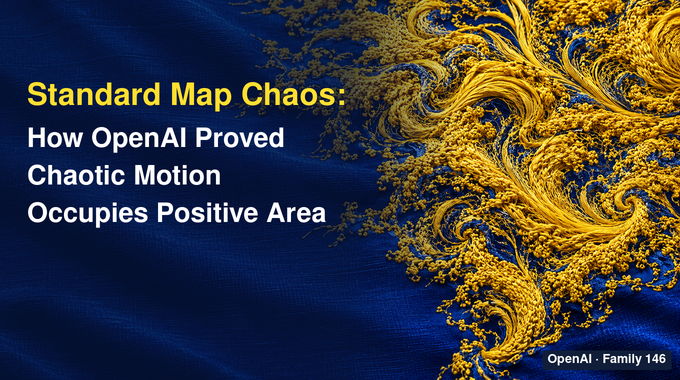
Standard Map Chaos: How OpenAI Proved Chaotic Motion Occupies Positive Area

Standard map chaos as a yellow woven field on blue fabric, with the complete article title.

A computer can draw a turbulent-looking standard map in seconds. Proving that its chaos occupies positive area, rather than an intricate set of area zero, is a different problem entirely. OpenAI’s September 23, 2026 paper proves that standard map chaos has this stronger, measurable form for every sufficiently large positive parameter. Its result concerns the … Read more

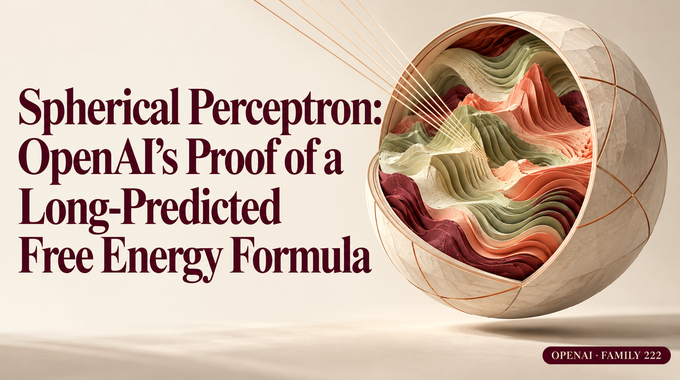
Spherical Perceptron: OpenAI’s Proof of a Long-Predicted Free Energy Formula

Cutaway spherical perceptron artwork with the article title and OpenAI Family 222 label.

A neuron can be simple while the landscape of its possible weights is anything but. Give it thousands of random inputs, constrain its weight vector to a sphere, and even calculating its equilibrium statistical weight becomes a research problem. OpenAI’s spherical perceptron proof identifies an exact variational formula for that model’s limiting pressure, often discussed … Read more

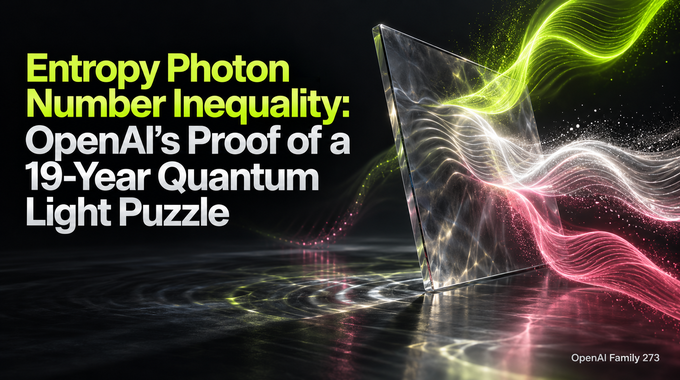
Entropy Photon Number Inequality: OpenAI’s Proof of a 19-Year Quantum Light Puzzle

Entropy photon number inequality artwork showing two colored light waves mixing through smoked glass.

A beam splitter is simple enough to draw on a napkin. Proving the sharp entropy bound for everything that can enter its two ports took considerably more machinery. OpenAI’s September 24, 2026 manuscript presents an entropy photon number inequality proof for independent finite-energy bosonic inputs, allowing arbitrary entanglement among modes within either input. The result … Read more

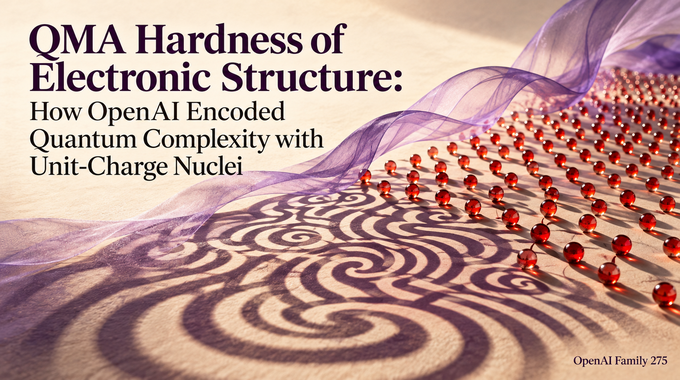
QMA Hardness of Electronic Structure: How OpenAI Encoded Quantum Complexity with Unit-Charge Nuclei

QMA hardness of electronic structure shown as unit-charge nuclei casting a complex quantum labyrinth.

One hydrogen atom is a textbook calculation. A carefully arranged collection of unit-charge nuclei can encode the hardest problems whose quantum witnesses can be checked efficiently. OpenAI’s September 24, 2026 preprint establishes QMA hardness of electronic structure for the electronic ground-energy infimum in continuous three-dimensional space, with every nuclear charge fixed at one. The essential … Read more