Number of Totients: How OpenAI’s Proof Counts Euler’s Distinct Outputs
Number of totients artwork shows separate ribbons converging into one output, with the full article title.

Euler’s totient function sends both 8 and 12 to 4. Computing either output is easy. Counting every distinct output, without counting 4 twice, leads to a question that has resisted precise asymptotics for decades. OpenAI’s September 25, 2026 manuscript gives an asymptotic formula for the number of totients, together with the Erdős–Hall scaling result: multiplying … Read more
Crossing Number of Complete Graphs: How OpenAI Proved Hill’s Drawing Is Optimal

Crossing number of complete graphs shown as interlaced paper ribbons rising from an open book.

Seven dots, twenty-one connections, nine unavoidable crossings. That is the answer for the complete graph K7K_7, even when every connection may bend. The difficult question was whether the same classical formula remained optimal for every graph size, however cleverly its edges were routed. OpenAI’s September 23, 2026 paper presents a proof that the crossing number … Read more

Log-Concave Sampling: How OpenAI Proved Subpolynomial Query Complexity

Log concave sampling artwork with copper probability contours and the OpenAI Family 139 label.

A sampler can know the exact slope of a probability landscape and still spend a dimension-dependent number of queries finding its way around. OpenAI’s manuscript changes that theoretical picture. For log concave sampling with a known minimizer and tightly bounded curvature, it proves that every fixed positive power of dimension can be avoided in the … Read more

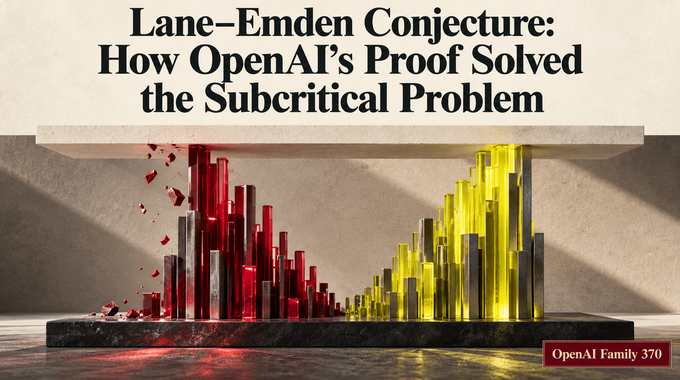
Lane–Emden Conjecture: How OpenAI’s Proof Solved the Subcritical Problem

Lane Emden conjecture artwork shows coupled growth stopped by a fixed energy ceiling.

A positive solution can look harmless near the origin yet become impossible when the same equations are viewed at larger scales. That contradiction drives OpenAI’s Lane Emden conjecture proof. Its manuscript, dated September 24, 2026, proves that the weighted Hénon–Lane–Emden system has no strictly positive entire solution in the subcritical region, without symmetry, boundedness, or … Read more

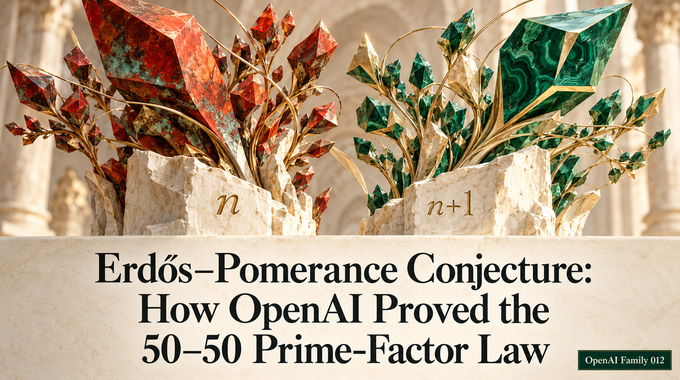
Erdős–Pomerance Conjecture: How OpenAI Proved the 50–50 Prime-Factor Law

Erdős–Pomerance conjecture illustrated by adjacent jade and vermilion prime-factor sculptures.

Two neighbors can share no prime factors and still conceal a statistical dependence. The Erdős–Pomerance conjecture asks whether the relative sizes of their largest prime factors eventually behave independently. OpenAI’s September 24, 2026 preprint, The joint Dickman law for consecutive integers, proves the predicted product law in ordinary natural density. Its striking consequence: each neighbor … Read more

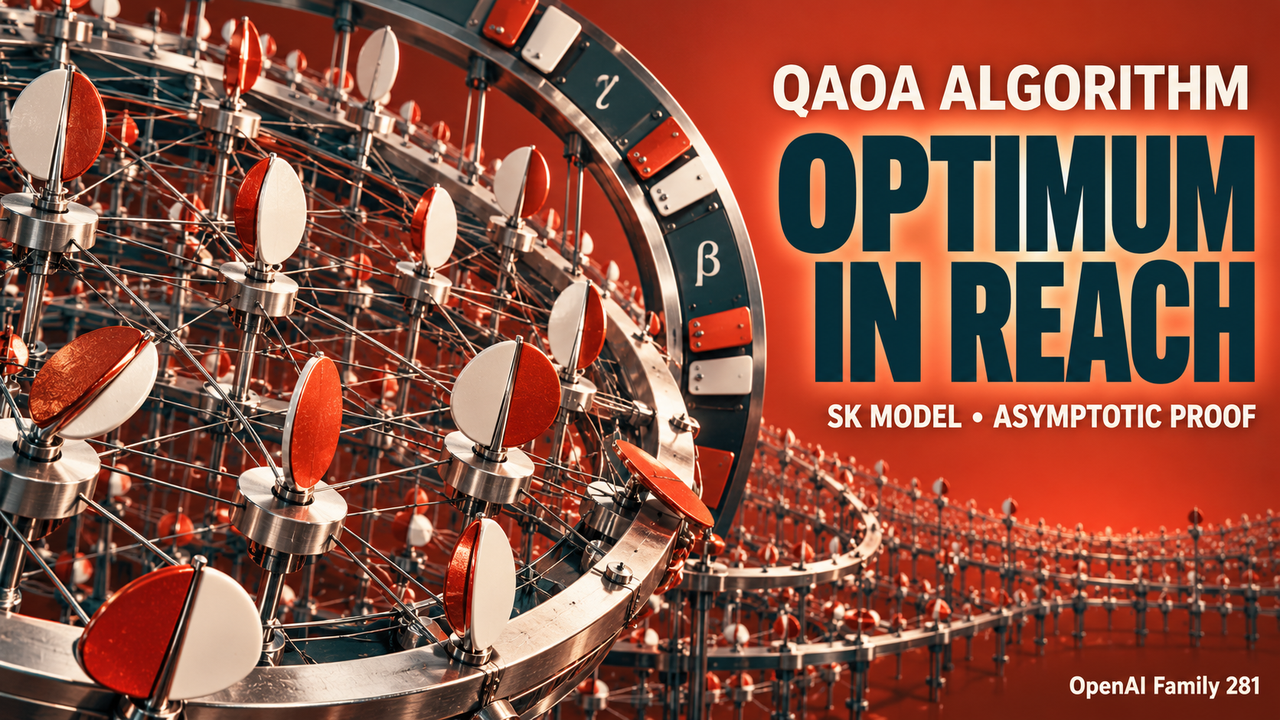
QAOA Algorithm: How OpenAI’s Proof Reaches the SK Spin-Glass Optimum

QAOA algorithm artwork showing interacting binary spins and alternating controls approaching the SK optimum.

A quantum optimizer can improve forever on small test problems without proving it can approach the best possible energy in an infinitely growing system. OpenAI’s September 25, 2026 QAOA proof preprint addresses precisely that gap. The QAOA algorithm, short for Quantum Approximate Optimization Algorithm, alternates problem-dependent interactions with mixing rotations. The manuscript proves that its … Read more

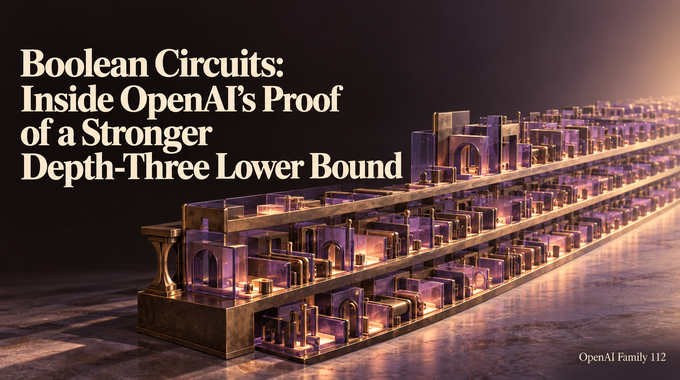
Boolean Circuits: Inside OpenAI’s Proof of a Stronger Depth-Three Lower Bound

Boolean circuits depicted as three shallow logic terraces expanding sideways, illustrating OpenAI’s stronger lower bound.

A three-layer logic circuit can read every input bit at once and reuse intermediate results freely. OpenAI’s new construction still forces it beyond every constant-times-square-root exponential size bound. The September 23, 2026 paper presents one efficiently computable language whose depth-three Boolean circuits require 2ω(n)2^{\omega(\sqrt n)} gates at every sufficiently large input length. That is the … Read more