Bin Packing Problem: How OpenAI’s Proof Overturns a 31-Year Rounding Conjecture

Bin packing problem artwork contrasts a fractional packing plan with solid drawers that need more space.

One extra bin sounded like a reasonable allowance. OpenAI’s September 24, 2026 manuscript argues that no fixed allowance works: the bin packing problem can require arbitrarily more whole bins than its configuration linear program predicts. That disproves the Modified Integer Round-Up Conjecture, whose published formulation dates to 1995. A separate theorem makes every fixed additive … Read more
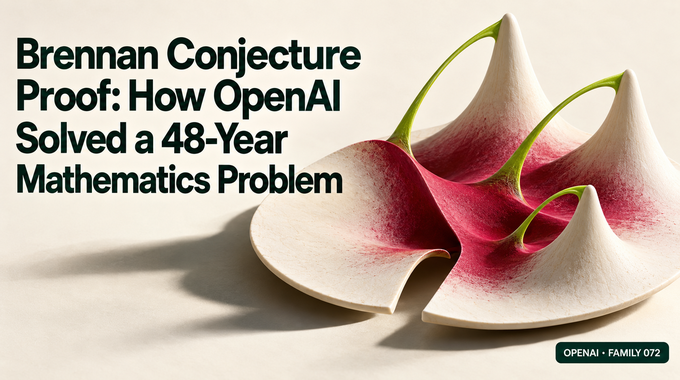
Brennan Conjecture Proof: How OpenAI Solved a 48-Year Mathematics Problem

Brennan conjecture artwork showing a slit ceramic surface, saddles, and higher peaks linked by lime arcs.

A conformal map can preserve every local angle while squeezing area savagely near a slit. The Brennan conjecture asks whether that distortion nevertheless obeys a universal integrability limit. OpenAI’s 31-page manuscript, dated September 24, 2026, proves the conjectured open interval: the derivative raised to any power strictly between four-thirds and four has finite area integral. … Read more

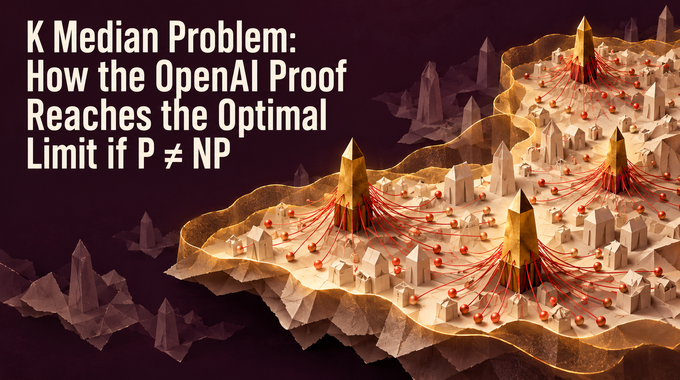
K Median Problem: How the OpenAI Proof Reaches the Optimal Limit if P ≠ NP

K median problem artwork showing selected gold hubs connecting clients across a folded city.

Choosing warehouse locations sounds like a logistics exercise. Requiring a provably near-best choice for every possible metric turns it into a decades-long mathematical challenge. The k median problem asks for at most kk facilities minimizing total client distance. OpenAI’s September 24, 2026 manuscript presents a deterministic polynomial-time approximation within 1+2/e+ε1+2/e+\varepsilon of optimum for every fixed … Read more

Nagata Conjecture: The Proof That Turned Plane Curves Into a Lattice-Point Puzzle

Nagata conjecture artwork showing plane curves lifting into a lattice of copper points.

Can a degree-nine plane curve vanish three times at each of ten very general points? It has 55 coefficients facing 60 conditions, which suggests failure. Proving that those conditions really rule out every curve is the difficult part. The Nagata conjecture turns this example into a universal bound connecting degree, multiplicity, and the square root … Read more

Single-Fold Diophantine Conjecture: How the OpenAI Proof Solved a 52-Year Uniqueness Puzzle

Single fold Diophantine conjecture artwork showing one mint witness inside a copper mathematical capsule.

A polynomial equation can have just one possible solution and still defeat every universal decision algorithm. That is the striking consequence of OpenAI’s September 24, 2026 paper on the single fold Diophantine conjecture. Its main theorem gives every recursively enumerable set a polynomial representation with exactly one complete natural-number witness for each member and none … Read more

Kakeya Conjecture in All Dimensions: OpenAI’s Local Smoothing Proof

Local smoothing conjecture artwork showing blue wavefronts converging into a bright, fleeting focus.

A spherical wave can arrive quietly, concentrate into a violent peak, and disperse again. The local smoothing conjecture asks how expensive that peak remains when we measure the wave across time. OpenAI’s October 25, 2026 manuscript presents a proof for every Euclidean spatial dimension from two upward, with consequences for Kakeya sets, Fourier restriction, and … Read more

Exponential Time Hypothesis: How the OpenAI Proof Breaks the 3-SAT Barrier

Exponential time hypothesis artwork showing branching ribbons crossing a cobalt barrier and emerging as a compact braid.

A formula with a million Boolean variables has more possible assignments than any computer could enumerate. The exponential time hypothesis says that, for worst-case 3-SAT, an exponential dependence on the variable count cannot be escaped. OpenAI’s October 25, 2026 manuscript presents an escape: deterministic, exact counting in subexponential time and polynomial space for every fixed … Read more