
One extra bin sounded like a reasonable allowance. OpenAI’s September 24, 2026 manuscript argues that no fixed allowance works: the bin packing problem can require arbitrarily more whole bins than its configuration linear program predicts. That disproves the Modified Integer Round-Up Conjecture, whose published formulation dates to 1995. A separate theorem makes every fixed additive approximation allowance NP-hard.
Released through OpenAI’s October mathematics announcement, the work comes from an unnamed internal model. It belongs in the discussion of AI mathematical proofs, with a distinction from LLM math benchmark scores: the evidence here is a construction and proof, not a leaderboard result.
Table of Contents
1. What Is the Bin Packing Problem, and Why Did OpenAI Revisit It?
One-dimensional bin packing assigns items to identical bins without exceeding capacity, minimizing the number used. Normalize capacity to one. For an instance , write for that minimum.
A bin packing problem example uses sizes 0.6, 0.6, 0.4, and 0.4. Pair each 0.6 with a 0.4 to fill two bins. Their total size is two, so fewer bins are impossible.
Packing abstracts resource allocation, but it omits dependencies and multiple resource dimensions. Those distinctions matter when comparing it with three-machine scheduling. OpenAI revisits two precise questions: can the fractional estimate always stay within a constant of the true minimum, and can an efficient algorithm always construct a packing within a constant of optimum?
1.1 Bin Packing Problem: Key Research Facts
| Question | Verified Manuscript Statement |
|---|---|
| Input | An explicit list of rational sizes, encoded in binary. |
| Gap theorem | For every integer , both LP values equal an integer , while . |
| Construction | items, each strictly larger than . |
| Algorithmic theorem | Distinguishing bins from more than bins is NP-hard for each fixed . |
| Evidence status | Preprint with published Lean artifacts. No independent peer-review confirmation established here. |
2. The Modified Integer Round-Up Conjecture: A Problem Dating to 1995
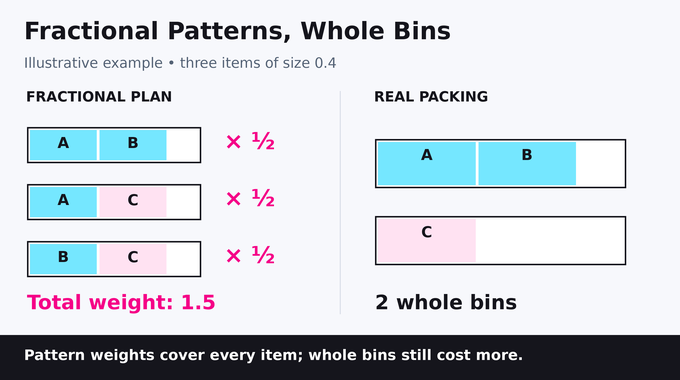
An integer solution uses whole bins. A fractional solution purchases weights of feasible patterns, such as half of one pattern and half of another. Its optimum, , is a lower bound on the integer optimum.
Scheithauer and Terno’s 1995 cutting-stock study investigated the modified integer round-up property:
The ceiling rounds the fractional value upward. If the LP says 10.2, the conjecture allows 12 bins. Needing 11 only defeats exact round-up, and needing 12 defeats neither modified bound nor conjecture. A genuine counterexample must need at least 13.
OpenAI removes ceiling ambiguity altogether. Its LP value is the integer , yet the required packing exceeds for any chosen nonnegative integer . Choosing already contradicts the conjecture.
3. Configuration LP: Why Fractional Bin Packing Looked So Promising
Group equal numerical sizes into a set . Let count input items of size . A configuration specifies integer counts satisfying the capacity constraint:
Let contain every such configuration. Assign nonnegative weight to each pattern, minimize their total, and require enough coverage of every size:
Whole-pattern weights describe packings after redundant coverage is discarded. Fractional weights can be cheaper. The additive bin packing integrality gap is the integer optimum minus this LP optimum. Fractional feasibility is not automatically a recipe for compatible whole-bin choices, a distinction also relevant to LP rounding for the k-median problem.
The ordinary size-type formulation may repeat a size beyond its input multiplicity, provided capacity permits. The stronger individual-copy formulation permits only subsets of actual indexed items. The bin-packing manuscript proves its gap separately for both, preventing that formulation choice from explaining away the result.
4. The Previous Barrier: Why Earlier Counterexamples Could Not Settle the Conjecture
Showing that one rounding procedure fails does not show that the LP has a large gap. A procedure may only round patterns already present in a supplied fractional solution. A successful integer packing could use entirely different patterns.
Earlier discrepancy constructions obstructed this restricted rounding. Earlier examples also defeated exact integer round-up. Neither observation controlled every feasible packing well enough to establish an unbounded additive gap. As with restricted representation models in complexity theory, the scope of the obstruction matters.
Positive approximation results remain compatible with the new theorem. Karmarkar and Karp obtained a squared-logarithmic additive bound. Rothvoss improved the order, followed by Hoberg and Rothvoss’s logarithmic additive guarantee. The latter two algorithms are randomized and their guarantees are relative to the configuration LP.
A percentage guarantee allows a growing bin count: one percent means ten extra bins when optimum is 1,000. An unbounded gap can still grow logarithmically. OpenAI’s instances grow rapidly with the requested gap, and the paper does not prove a matching logarithmic lower bound in instance size.
5. The Competing-Trees Lemma: The Combinatorial Breakthrough
The proof starts with two finite rooted trees, and . Depth means distance from the root. A marking selects nonroot vertices, and a quota limits selections at depth .
Each tree separately admits a marking hitting every root-to-leaf path at least times. Share those same depth quotas between the trees, however, and some path in one tree must receive no mark at all. Separate feasibility does not imply joint feasibility.
5.1 How The Two Trees Are Built
Use phases. Each path meets one red or blue endpoint per phase. Disjoint branches outnumber available marks.
keeps paths with at least red vertices. Red marks satisfy its quotas.
keeps paths with at least blue vertices. Blue marks satisfy its quotas.
Every original path belongs to a retained family. Hitting both trees within shared quotas would hit every auxiliary-tree path, contradicting Step 1.
No edges are contracted during pruning, so depths and quotas retain their meaning. The construction is finite and deterministic, although its size is unsuitable as a practical packing example.
6. From Vertex Cover to Bin Packing: Constructing the Hard Instance
A vertex cover selects vertices so that every graph edge has a selected endpoint. Given a graph with vertices and cover target , the reduction outputs rational items.
For fixed additive allowance and positive tolerance , a cover of size at most gives a packing into bins. Conversely, any packing into at most bins yields a cover of size at most . The reduction runs in polynomial time in the explicit graph encoding, with constants depending on the fixed parameters.
Every item exceeds , so six items exceed unit capacity. Consequently, items require at least bins. Bounding items per bin leaves the number of distinct sizes unrestricted.
The sizes encode combinatorial choices numerically, a useful connection to the subset sum problem. Here, tiny rational perturbations around one fifth enforce structural rules rather than deliver a faster search algorithm.
7. How Intervals, Deadlines, and Scalar Encoding Enforce the Packing Rules
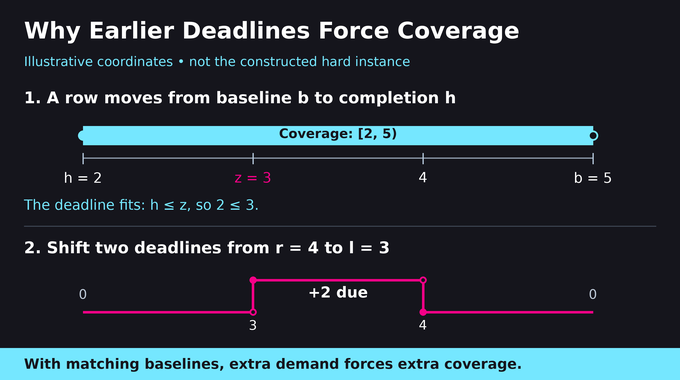
Each graph vertex receives plus and minus interval regions representing its trees, plus repeated edge-job tests. In an intended deadline bin with matching labels, a row has baseline and completion . Auxiliary lengths move completion leftward. Its coverage interval is , and an anchor with deadline fits precisely when .
Here is the small shortening of a short job row, the indicator is one for a short row and zero otherwise, and and are its global and local auxiliaries. These lengths are coordinates used in the encoding, rather than the items’ physical sizes.
Move deadlines from a test interval’s right endpoint to its left endpoint. At every point inside that half-open interval, the number of deadlines already due increases by . Feasible completion-to-deadline matching therefore demands extra coverage. Prefix counts turn geometric coverage into a packing constraint.
7.1 Four Patterns Encode Five Item Roles
| Pattern | Row, Anchor, Global, Local, Flag |
|---|---|
| Plus Tree (M) | , , , , |
| Minus Tree (M) | , , , , |
| Job Deadline (M) | , , , , |
| Job Key (G) | , , , , |
The five roles are rows, anchors, global auxiliaries, local auxiliaries, and flags. A primary integer score encodes role and subclass equations in base 100. A smaller secondary score orders vertex labels using powers of three. Still smaller coordinates carry interval lengths, deadlines, and edge-resource offsets.
Here is item size, and are the two integer scores, and is its coordinate. Positive scales , , and are chosen so each larger scale dominates all smaller contributions in five-item bins. This hierarchy turns scalar capacity into several enforceable constraints.
8. Completeness: How a Vertex Cover Produces Exactly B Bins
Enlarge an available cover to exactly vertices. At a selected vertex, give plus-root rows length-one global auxiliaries. Their intervals cover the plus region. At an unselected vertex, fund the minus roots instead.
The unfunded tree receives its separate quota-respecting marking from the lemma. Corresponding local auxiliaries cover every leaf test at least times. Unselected vertices send short job rows to deadline bins, covering their job tests. Selected vertices send long rows there, relying on funded plus coverage.
Sort completions and deadlines. The coverage inequalities ensure the corresponding completion never exceeds its deadline, so all deadline bins fit.
Remaining job rows meet keys at their exact positions. Long rows need edge permits, while short rows accept permits or nonpermits. Each edge has of each resource, where counts repeated positions per incidence. Because a cover forbids two unselected endpoints, two competing long-row demands never arise. Every item is used once in exactly bins.
9. The Fractional Witness: Why the Configuration LP Equals B
Now use the four-vertex clique with target . At each vertex, construct both local states: selected and unselected. Give every bin template in each state weight one half.
Each labeled item is used once in each state, so its fractional coverage is exactly one. Averaging across four vertices requests exactly the available global resources. Each edge’s two endpoints together request permits and nonpermits.
To obtain actual individual-copy columns, distribute each template’s weight uniformly over the physical copies in its required global and flag pools. Every copy then receives coverage one. Project these columns onto size multiplicities to obtain the ordinary LP witness too.
The total weight is . For the matching lower bound, give every item dual weight one fifth. Every feasible pattern contains at most five items, so its dual weight is at most one. Across items, the dual objective is . Both configuration LP values therefore equal , without requiring the local states to coexist as an integer packing.
10. Soundness: Why No Near-Optimal Integer Packing Can Escape the Construction
An arbitrary packing need not use the four intended patterns. The soundness proof must recover structure without assuming it.
With at most bins, at most five-item slots remain unused. Full bins have nonpositive primary score, while the entire inventory’s primary score is zero. Nonfull bins can compensate only a bounded number of negative-score full bins. Thus fewer than a constant items lie outside table patterns, with depending only on .
Secondary-score conservation bounds unequal-label matches. At each vertex, at most anchors fall outside good tuples, meaning intended patterns with matching labels. This error does not grow with the number of job positions.
Deadline prefixes then force coverage at least throughout every test. The competing trees force substantial global funding onto one side. Repeated jobs expose underfunded plus sides through demand for long-row matches. Coordinate ordering forbids later rows and later-edge resources from rescuing earlier keys.
Earlier-edge inventories are largely consumed by earlier keys. If both endpoints lack plus funding, demand exceeds the current edge’s permits plus the bounded leftovers. Hence vertices with plus funding greater than cover every edge. Resource budgets bound their number by .
11. What OpenAI’s Proof Establishes: Unbounded Gaps and Additive NP-Hardness
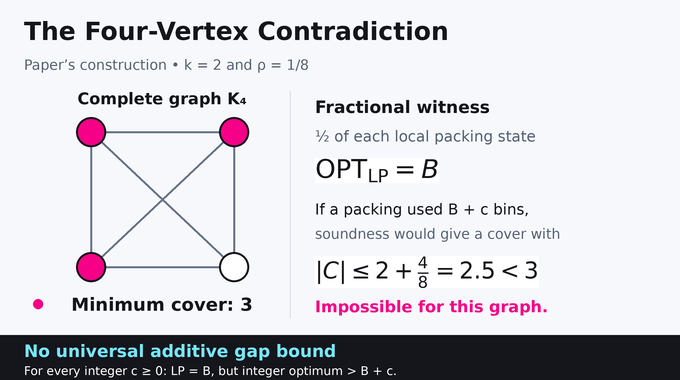
The clique needs three vertices in any cover. Set . A packing within would produce a cover of size at most , an impossibility. Combined with the fractional witness, this proves the unbounded gap for every chosen , without assuming any separation of complexity classes.
Algorithmic hardness needs another argument. A satisfiability-gap theorem gives formulas that are either fully satisfiable or have at most of clauses simultaneously satisfiable. A clause graph converts that separation into a vertex-cover gap, which the packing reduction preserves. For each fixed , distinguishing bins from more than bins is NP-hard.
A deterministic polynomial-time algorithm always returning at most bins, for an absolute constant , would therefore imply . Conversely, that equality would allow exact optimization. This does not prove . Approximation guarantees require this precision, as our edit-distance approximation explainer also emphasizes.
Column generation still supplies valid lower bounds. First-fit heuristics and established approximation guarantees survive. The manuscript supplies no deployment benchmark comparable to AI-assisted algorithm optimization. Developers should keep measuring workload-specific packing quality.
For capacity planning, track the LP lower bound and the bins actually used as separate quantities. A small observed gap is useful evidence for that workload, but it cannot establish a universal theorem. The construction also concerns one-dimensional scalar sizes. Applying it directly to GPU scheduling with memory, compute, and communication constraints would require a separate modeling argument.
As of October 28, 2026, OpenAI’s Lean scope note covers both LP gaps, fixed-additive hardness, and the complexity equivalence. The checker was not rerun for this article, and independent peer review remains unconfirmed. The repository presents its manuscripts as research outputs requiring community scrutiny. Machine checking and independent review remain separate. Our Aletheia verification explainer also shows why verification needs a precise definition.
The bin packing problem now has a precisely stated claimed limit: fractional efficiency can hide arbitrarily large absolute packing costs. The next useful step is independent scrutiny of those claims. Follow Binary Verse AI’s AI and mathematics coverage for explanations that trace the construction, inspect the verification, and keep practical claims tied to evidence.
What does the bin packing problem mean?
The bin packing problem asks how to place items of different sizes into the smallest possible number of fixed-capacity bins without exceeding any bin’s capacity. OpenAI’s paper investigates how accurately a fractional configuration linear program represents that minimum.
How difficult is the bin packing problem?
Classical one-dimensional bin packing is strongly NP-hard. OpenAI’s manuscript establishes an additional limitation: for every fixed nonnegative integer , distinguishing instances packable into bins from those requiring more than bins is NP-hard. Its constructed items all exceed one sixth of bin capacity.
What is the Modified Integer Round-Up Conjecture?
It proposed that the optimal integer solution never needs more than one bin beyond the rounded-up configuration-LP optimum: . OpenAI’s manuscript constructs instances whose additive gap exceeds any prescribed nonnegative integer, contradicting that bound.
How can the configuration LP underestimate the actual number of bins?
The LP distributes fractional weights across individually feasible bin patterns. Those weights can cover every item demand without the patterns combining into equally cheap whole-bin choices. The paper constructs instances where both the ordinary size-type LP and the stronger individual-copy LP underestimate the integer optimum by more than any prescribed additive constant.
Does OpenAI’s proof invalidate first-fit algorithms or column generation?
No. The configuration LP remains a valid lower bound, column generation remains a method for working with its patterns, and established approximation guarantees remain applicable. The manuscript rules out a universal constant-additive relationship between the LP and integer optima. It also gives a separate hardness result for deterministic polynomial-time algorithms with a fixed additive allowance.
Does the bin packing proof establish P ≠ NP?
No. It proves that a deterministic polynomial-time algorithm with a universal constant-additive packing guarantee would imply . Conversely, if , an exact polynomial-time algorithm exists for the explicitly encoded rational instances considered. The paper does not decide whether those complexity classes are equal.
Has OpenAI’s bin packing proof been formally verified?
OpenAI has published Lean proof artifacts and a scope note covering the principal gap theorem for both configuration LPs, fixed-additive NP-hardness, and the equivalence between a deterministic polynomial-time constant-additive algorithm and . The checker was not rerun for this article. Formalization scope, successful machine checking, correspondence with the informal claims, and independent mathematical peer review are distinct checks.