Mazur Conjecture: The Polynomial That Could Overturn a 30-Year Prediction and Go Beyond Hilbert’s Tenth Problem
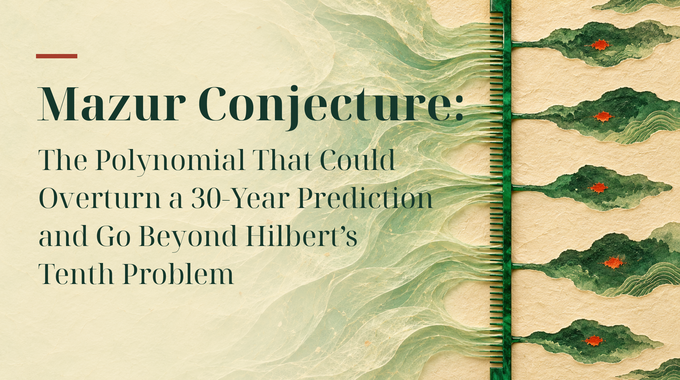
Mazur Conjecture cover with a paper river passing through a comb and emerging as separated jade islands.

Give a polynomial the number 7 as its first input and ask whether rational numbers can fill the remaining slots so that it vanishes. Now try 72\frac{7}{2}. A November 6, 2026 manuscript claims to give one equation that separates those cases for every rational input. If its arithmetic proof holds, the equation would refute the … Read more
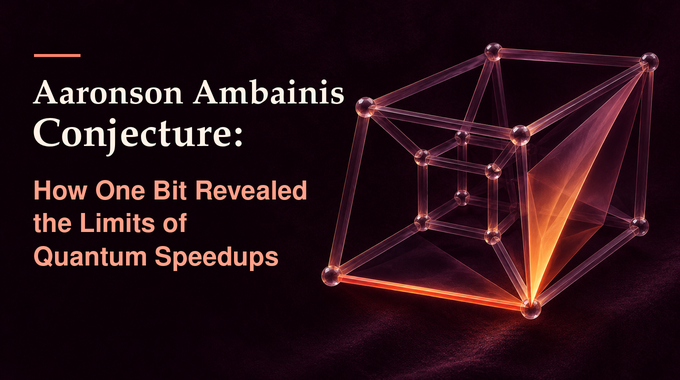
Aaronson Ambainis Conjecture: How One Bit Revealed the Limits of Quantum Speedups

A glowing edge on a glass hypercube represents an influential bit in the Aaronson Ambainis Conjecture.

Suppose a quantum algorithm can query a vast string of bits in superposition, while a classical algorithm has to inspect one bit at a time. How can the classical algorithm know where to look? The November 2026 proof of the Aaronson Ambainis Conjecture gives an answer. Every nonconstant bounded polynomial of low degree on the … Read more

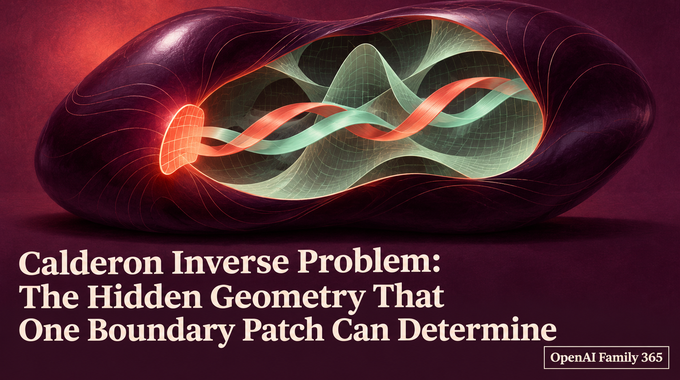
Calderon Inverse Problem: The Hidden Geometry That One Boundary Patch Can Determine

Calderon Inverse Problem artwork reveals hidden geometry and paired transport ribbons through one boundary patch.

Imagine controlling a small accessible patch of an object while its remaining boundary stays out of reach. Can those measurements determine its entire hidden geometry, together with a rule for transporting two-component complex vectors? OpenAI’s October 5, 2026 manuscript answers this version of the Calderon Inverse Problem with a uniqueness theorem. For a smooth metric … Read more

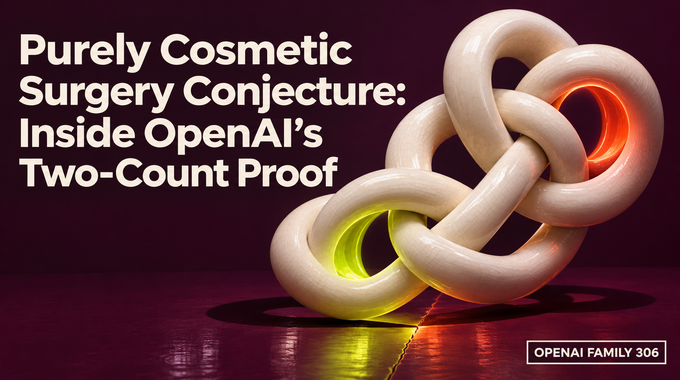
Purely Cosmetic Surgery Conjecture: Inside OpenAI’s Two-Count Proof

Purely Cosmetic Surgery Conjecture artwork showing a porcelain knot and two contrasting portals.

Cut out a thickened knot, glue it back with a different slope, and ask whether the entire oriented universe around it can look unchanged. The Purely Cosmetic Surgery Conjecture says this cannot happen for a nontrivial smooth knot in the three-sphere. OpenAI’s September 23, 2026 manuscript presents a proof: earlier work reduces the problem to … Read more

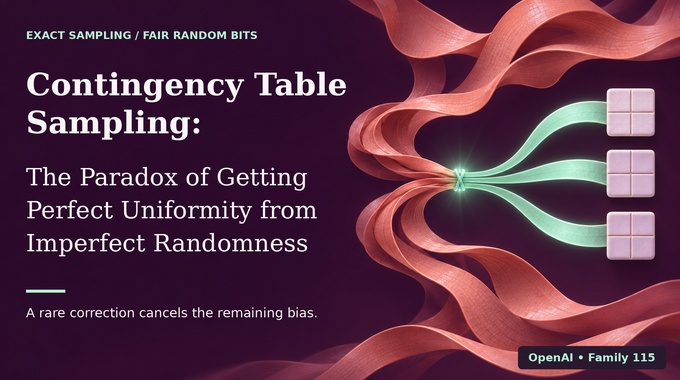
Contingency Table Sampling: The Paradox of Getting Perfect Uniformity from Imperfect Randomness

Contingency table sampling shown as coral ribbons corrected into equal mint streams and table tiles.

Three tables can have identical row and column totals yet receive very different probabilities from a careless random generator. Contingency table sampling asks for something stricter: every feasible integer table must have the same chance. OpenAI’s September 24, 2026 manuscript establishes exact uniform sampling for arbitrary nonnegative margins, with polynomial expected bit complexity. Its route … Read more

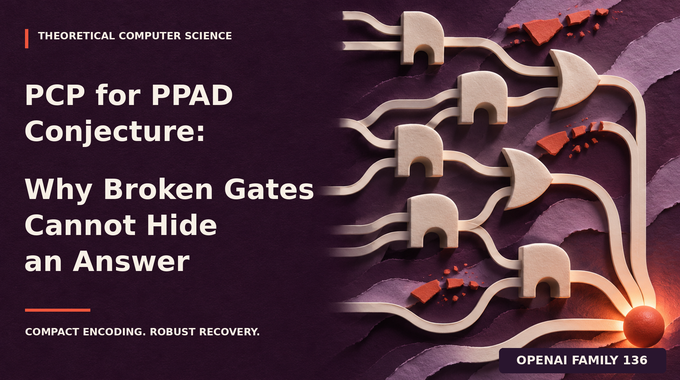
PCP for PPAD Conjecture: Why Broken Gates Cannot Hide an Answer

PCP for PPAD Conjecture illustrated by fractured ceramic gates and intact paths converging on an answer.

Imagine a circuit that can conceal its answer by breaking a few carefully chosen gates. The PCP for PPAD Conjecture asks whether that escape route can be closed with almost linear storage overhead. OpenAI’s September 25, 2026 manuscript presents a proof: even an adversarially placed constant fraction of failed constraints cannot prevent polynomial-time recovery of … Read more

Matroid Prophet Inequality: One Sample, No Secrets, Inside OpenAI’s Proof

Matroid prophet inequality depicted as a golden forest inside transparent blue glass.

Imagine choosing network connections while an opponent already knows every value, every sample and every coin you will flip. Your decisions remain irreversible. OpenAI’s September 23, 2026 paper proves that a matroid prophet inequality survives this information imbalance: one independent sample per element suffices for a universal expected reward fraction of 2−3102^{-310}. The detailed proof … Read more