Ramsey Number Bounds: How OpenAI’s Proof Found the Missing Logarithmic Power in r(5,t)
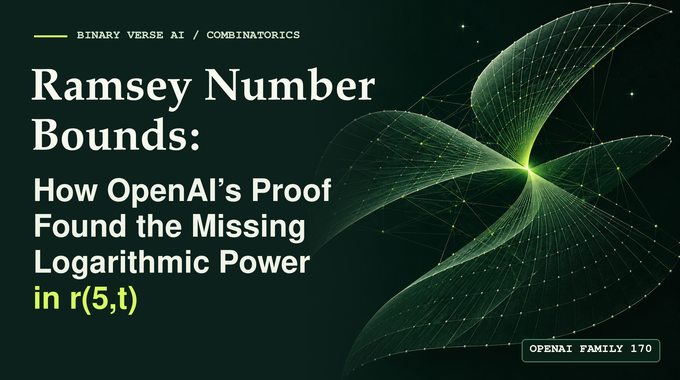
Ramsey number bounds cover with a green wire network converging at a single point.

How long can a network avoid both five mutually connected vertices and a large group with no connections among them? For the Ramsey number r(5,t)r(5,t), the power of tt had been settled, but the best bounds still differed by three powers of a logarithm. OpenAI’s September 24, 2026 preprint pins the logarithmic exponent down to … Read more
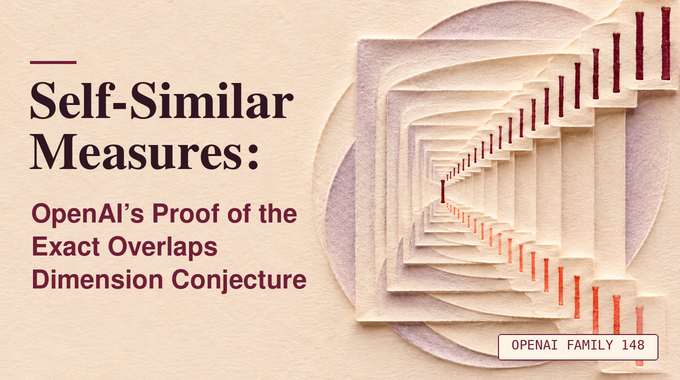
Self-Similar Measures: OpenAI’s Proof of the Exact Overlaps Dimension Conjecture

Embossed paths converge on one mark, illustrating exact overlaps in self-similar measures.

Two different instructions can draw precisely the same piece of a fractal. With the maps “divide by three,” “divide by three and add one,” and “divide by three and add four-thirds,” nine two-step paths produce only eight affine maps. Counting those paths as separate outcomes gives the construction more information than it actually carries. OpenAI’s … Read more

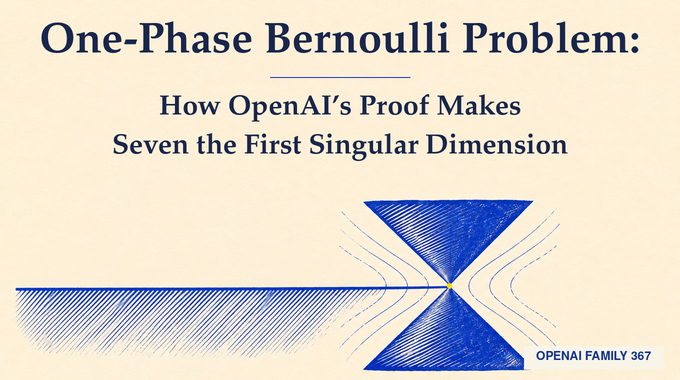
One-Phase Bernoulli Problem: How OpenAI’s Proof Makes Seven the First Singular Dimension

Linocut for the one-phase Bernoulli problem showing a flat interface beside a double cone with a singular tip.

A free boundary can look perfectly smooth in low dimensions yet develop a singular cone when enough coordinates are available. The one phase Bernoulli problem now has an exact threshold: the September 24, 2026 OpenAI mathematical manuscript proves that every nonzero one-homogeneous global minimizer is a half-space solution through dimension six. A nonflat minimizing cone … Read more

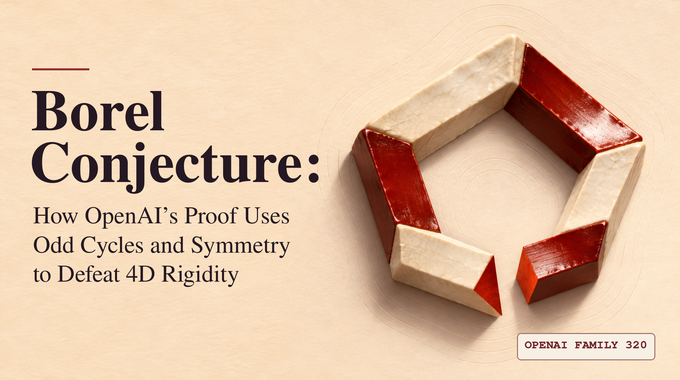
Borel Conjecture: How OpenAI’s Proof Uses Odd Cycles and Symmetry to Defeat 4D Rigidity

A broken ceramic loop with red ends evokes the odd-cycle obstruction in the Borel Conjecture proof.

In the double cover, every plumbing edge has one end where the right cap is selected. On an odd cycle, the same two colors cannot alternate all the way around. That difference drives OpenAI’s Borel Conjecture counterexample in dimension four. The preprint constructs two closed, connected, aspherical topological four-manifolds that are homotopy equivalent but not … Read more

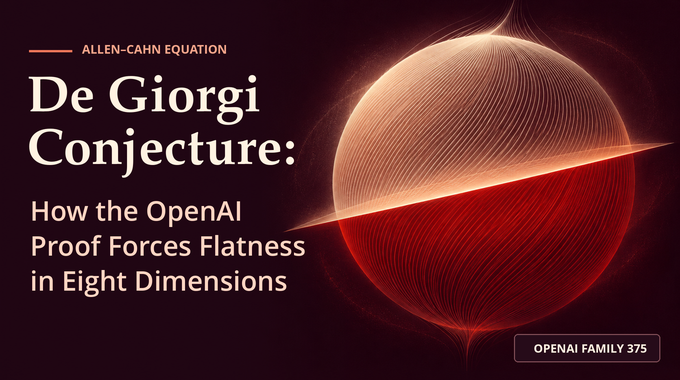
De Giorgi Conjecture: How the OpenAI Proof Forces Flatness in Eight Dimensions

De Giorgi conjecture artwork with a luminous plane dividing a sphere into two phases.

The De Giorgi conjecture asks whether a phase boundary can bend when the field describing it rises in one fixed direction everywhere. In eight dimensions, OpenAI’s September 26, 2026 preprint proves that it cannot for the scalar cubic Allen–Cahn equation. Every entire solution in the open interval between the two wells with an everywhere positive … Read more

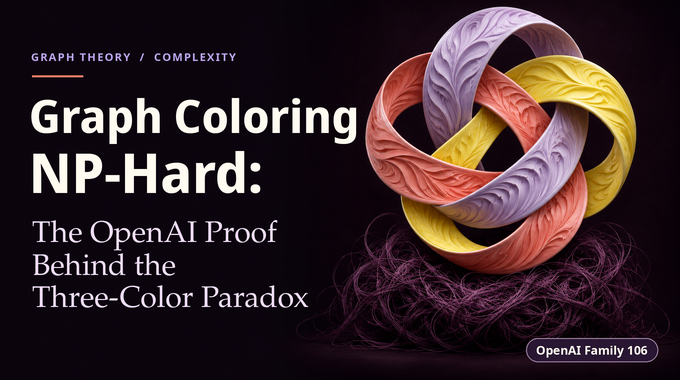
Graph Coloring NP-Hard: The OpenAI Proof Behind the Three-Color Paradox

Three porcelain ribbons rise from tangled threads, illustrating why graph coloring is NP-hard.

A graph can come with a guarantee that three colors suffice and still hide a solution that no polynomial-time algorithm can always find, unless P equals NP. Is graph coloring NP hard even if the algorithm gets a larger palette? Yes, for any fixed palette of three or more colors. OpenAI’s September 24, 2026 preprint … Read more

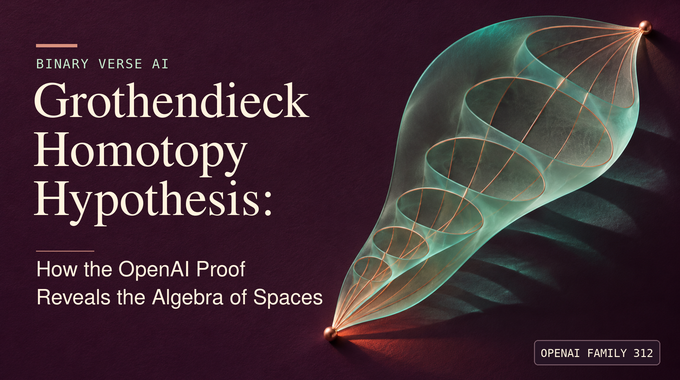
Grothendieck Homotopy Hypothesis: How the OpenAI Proof Reveals the Algebra of Spaces

A glass ribbon traces paths between two points, illustrating the Grothendieck homotopy hypothesis.

Take a path, add a second path with the same endpoints, and join them by a homotopy. In a free algebra of paths, however, it creates new composites, inverses, and higher coherence cells as well. The September 24, 2026 OpenAI preprint proves that the entire extension leaves the homotopy type unchanged for cellular models of … Read more