Yang–Mills Existence Proof: How OpenAI Built a Four-Dimensional Quantum Field Theory
Jade lattice becoming continuous glass, illustrating the Yang–Mills existence proof.

OpenAI’s Yang–Mills existence proof starts with matrices on the edges of a four-dimensional grid and ends with local quantum fields on continuous spacetime. The Yang–Mills Working Group’s November 10 assessment concludes that the Lean submission constructs relativistic pure Yang–Mills theories satisfying the specified Wightman axioms for compact matrix gauge groups with a nonabelian simple Lie … Read more
One-Way Liveness: OpenAI’s Proof That Rereading Cannot Save Exponential States

One-way liveness cover with looping punched tape and a fan of red ceramic tiles representing states.

Give a finite automaton permission to walk back and forth across its input, and it can revisit a choice point as often as it likes. Can that freedom make up for losing nondeterminism? OpenAI’s one-way liveness preprint gives a family for which the answer is no. A nondeterministic machine can recognize the language with h+3h+3 … Read more

Hawking–Page Transition: The Three-Loop Sign That Settled a 23-Year Black Hole Mystery

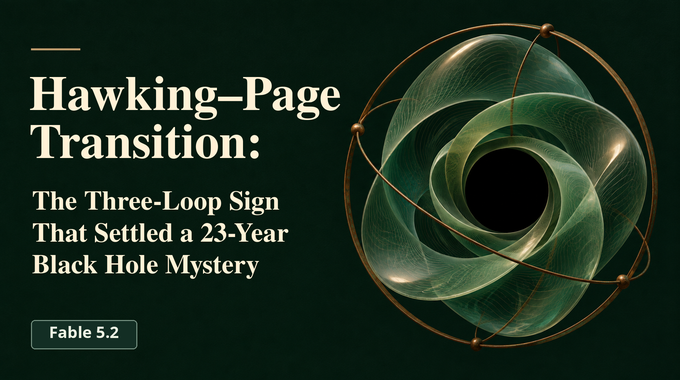
Three jade loops frame a black hole beside the Hawking–Page transition article title and Fable 5.2 label.

A gas of radiation can fill anti-de Sitter space at low temperature. Heat the system enough and a large black hole takes over. The Hawking Page transition is that abrupt switch. In 2003, physicists asked whether its gauge-theory counterpart still switches abruptly when the interactions are weak. A November 2026 preprint on the Hawking–Page transition … Read more

Fourier Series Convergence: How Did OpenAI Solve the L log L Problem?

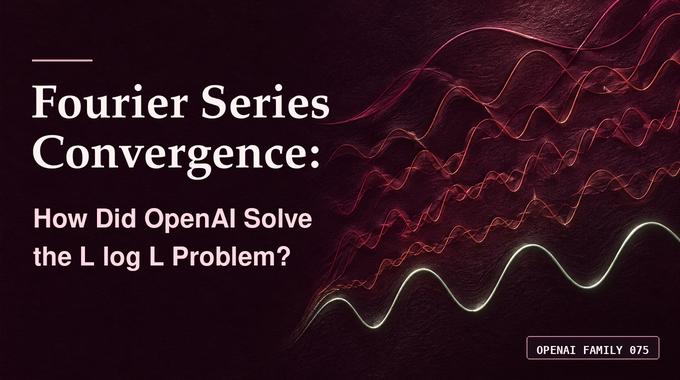
Engraved waves resolve into one jade trace, illustrating Fourier series convergence.

A Fourier sum can approximate a function in mean square while still behaving erratically at individual points. OpenAI’s September 23, 2026 preprint settles a sharper question about Fourier series convergence. For every complex-valued function in Llog⁡LL\log L on the circle, the ordinary symmetric partial sums converge to the function almost everywhere along the full sequence … Read more

Dimension Reduction in Lp: How OpenAI’s Proof Escapes the Quadratic Trap

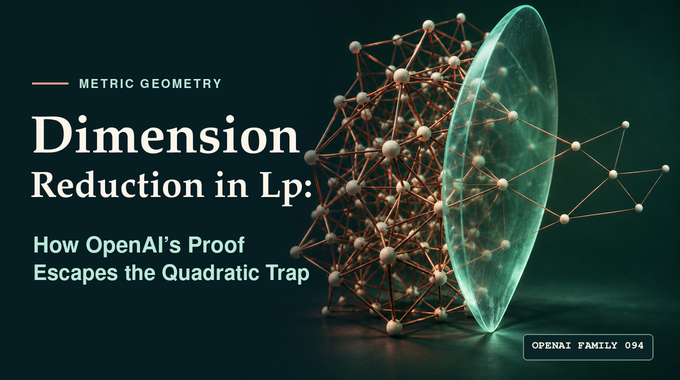
A copper lattice passes through a glass lens and emerges as a sparse network, illustrating dimension reduction in Lp.

An exact copy of the distances among a set of points can need quadratically many coordinates, even when the points themselves number only in the dozens. Allow a fixed amount of distortion, however small, and OpenAI’s preprint proves that the worst-case dimension drops below every positive power of the point count. This is dimension reduction … Read more

Weak vs Strong Normalization: How OpenAI Proved Every Reduction Path Must End

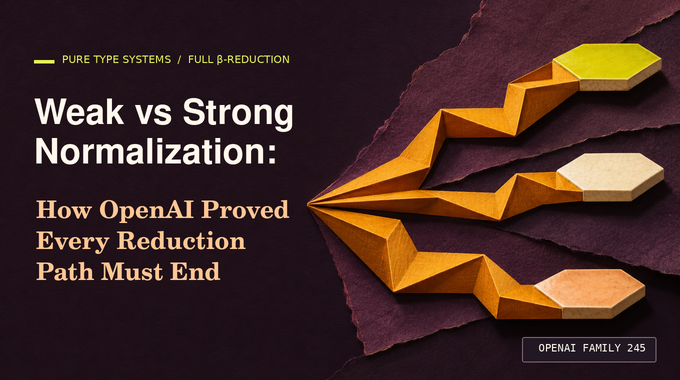
Three folded-paper paths end at separate platforms on the Weak vs Strong Normalization cover.

If every legal expression has a terminating reduction, must every reduction strategy terminate? For pure type systems, OpenAI’s September 2026 manuscript answers yes under a system-wide hypothesis. If every legal expression in every valid context can reach a β-normal form, then no infinite β-reduction sequence can start from any of them. Weak vs strong normalization … Read more