Spherical Perceptron: OpenAI’s Proof of a Long-Predicted Free Energy Formula
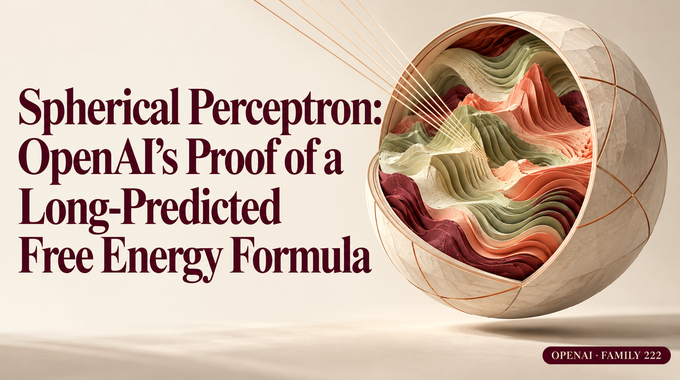
Cutaway spherical perceptron artwork with the article title and OpenAI Family 222 label.

A neuron can be simple while the landscape of its possible weights is anything but. Give it thousands of random inputs, constrain its weight vector to a sphere, and even calculating its equilibrium statistical weight becomes a research problem. OpenAI’s spherical perceptron proof identifies an exact variational formula for that model’s limiting pressure, often discussed … Read more
Entropy Photon Number Inequality: OpenAI’s Proof of a 19-Year Quantum Light Puzzle

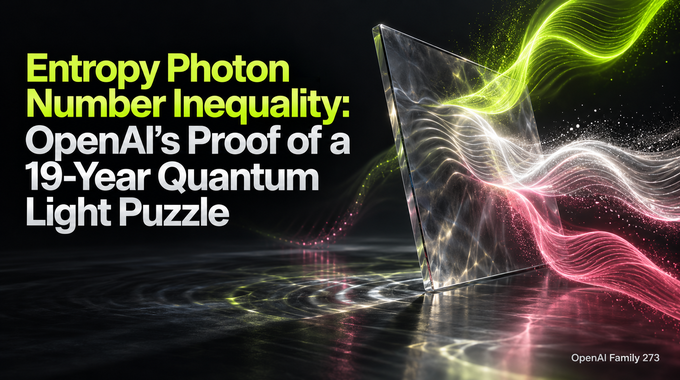
Entropy photon number inequality artwork showing two colored light waves mixing through smoked glass.

A beam splitter is simple enough to draw on a napkin. Proving the sharp entropy bound for everything that can enter its two ports took considerably more machinery. OpenAI’s September 24, 2026 manuscript presents an entropy photon number inequality proof for independent finite-energy bosonic inputs, allowing arbitrary entanglement among modes within either input. The result … Read more

QMA Hardness of Electronic Structure: How OpenAI Encoded Quantum Complexity with Unit-Charge Nuclei

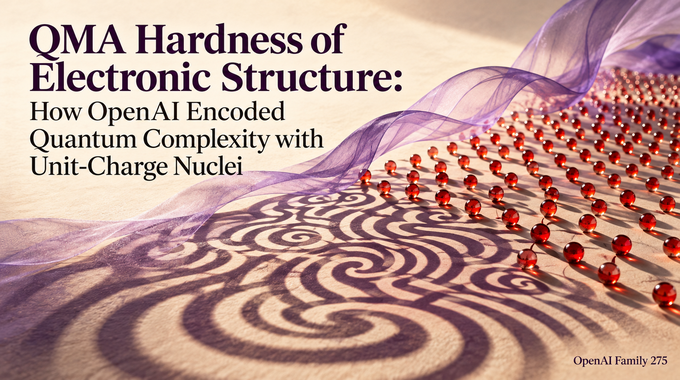
QMA hardness of electronic structure shown as unit-charge nuclei casting a complex quantum labyrinth.

One hydrogen atom is a textbook calculation. A carefully arranged collection of unit-charge nuclei can encode the hardest problems whose quantum witnesses can be checked efficiently. OpenAI’s September 24, 2026 preprint establishes QMA hardness of electronic structure for the electronic ground-energy infimum in continuous three-dimensional space, with every nuclear charge fixed at one. The essential … Read more

Number of Totients: How OpenAI’s Proof Counts Euler’s Distinct Outputs

Number of totients artwork shows separate ribbons converging into one output, with the full article title.

Euler’s totient function sends both 8 and 12 to 4. Computing either output is easy. Counting every distinct output, without counting 4 twice, leads to a question that has resisted precise asymptotics for decades. OpenAI’s September 25, 2026 manuscript gives an asymptotic formula for the number of totients, together with the Erdős–Hall scaling result: multiplying … Read more

Crossing Number of Complete Graphs: How OpenAI Proved Hill’s Drawing Is Optimal

Crossing number of complete graphs shown as interlaced paper ribbons rising from an open book.

Seven dots, twenty-one connections, nine unavoidable crossings. That is the answer for the complete graph K7K_7, even when every connection may bend. The difficult question was whether the same classical formula remained optimal for every graph size, however cleverly its edges were routed. OpenAI’s September 23, 2026 paper presents a proof that the crossing number … Read more

Log-Concave Sampling: How OpenAI Proved Subpolynomial Query Complexity

Log concave sampling artwork with copper probability contours and the OpenAI Family 139 label.

A sampler can know the exact slope of a probability landscape and still spend a dimension-dependent number of queries finding its way around. OpenAI’s manuscript changes that theoretical picture. For log concave sampling with a known minimizer and tightly bounded curvature, it proves that every fixed positive power of dimension can be avoided in the … Read more

Lane–Emden Conjecture: How OpenAI’s Proof Solved the Subcritical Problem

Lane Emden conjecture artwork shows coupled growth stopped by a fixed energy ceiling.

A positive solution can look harmless near the origin yet become impossible when the same equations are viewed at larger scales. That contradiction drives OpenAI’s Lane Emden conjecture proof. Its manuscript, dated September 24, 2026, proves that the weighted Hénon–Lane–Emden system has no strictly positive entire solution in the subcritical region, without symmetry, boundedness, or … Read more