Erdős–Pomerance Conjecture: How OpenAI Proved the 50–50 Prime-Factor Law
Erdős–Pomerance conjecture illustrated by adjacent jade and vermilion prime-factor sculptures.

Two neighbors can share no prime factors and still conceal a statistical dependence. The Erdős–Pomerance conjecture asks whether the relative sizes of their largest prime factors eventually behave independently. OpenAI’s September 24, 2026 preprint, The joint Dickman law for consecutive integers, proves the predicted product law in ordinary natural density. Its striking consequence: each neighbor … Read more

QAOA Algorithm: How OpenAI’s Proof Reaches the SK Spin-Glass Optimum

QAOA algorithm artwork showing interacting binary spins and alternating controls approaching the SK optimum.

A quantum optimizer can improve forever on small test problems without proving it can approach the best possible energy in an infinitely growing system. OpenAI’s September 25, 2026 QAOA proof preprint addresses precisely that gap. The QAOA algorithm, short for Quantum Approximate Optimization Algorithm, alternates problem-dependent interactions with mixing rotations. The manuscript proves that its … Read more

Boolean Circuits: Inside OpenAI’s Proof of a Stronger Depth-Three Lower Bound

Boolean circuits depicted as three shallow logic terraces expanding sideways, illustrating OpenAI’s stronger lower bound.

A three-layer logic circuit can read every input bit at once and reuse intermediate results freely. OpenAI’s new construction still forces it beyond every constant-times-square-root exponential size bound. The September 23, 2026 paper presents one efficiently computable language whose depth-three Boolean circuits require 2ω(n)2^{\omega(\sqrt n)} gates at every sufficiently large input length. That is the … Read more

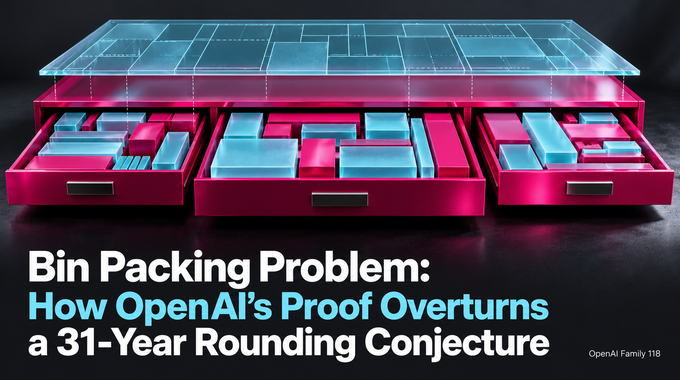
Bin Packing Problem: How OpenAI’s Proof Overturns a 31-Year Rounding Conjecture

Bin packing problem artwork contrasts a fractional packing plan with solid drawers that need more space.

One extra bin sounded like a reasonable allowance. OpenAI’s September 24, 2026 manuscript argues that no fixed allowance works: the bin packing problem can require arbitrarily more whole bins than its configuration linear program predicts. That disproves the Modified Integer Round-Up Conjecture, whose published formulation dates to 1995. A separate theorem makes every fixed additive … Read more

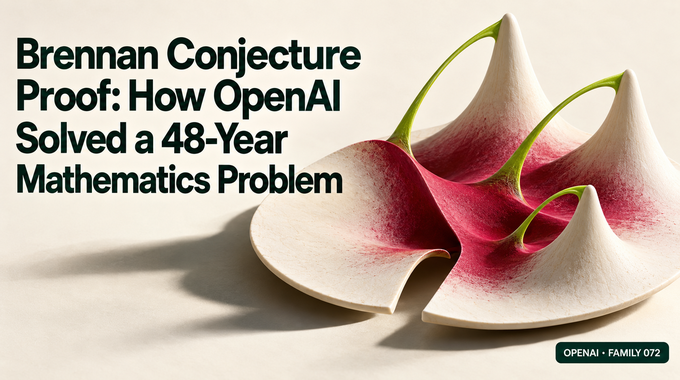
Brennan Conjecture Proof: How OpenAI Solved a 48-Year Mathematics Problem

Brennan conjecture artwork showing a slit ceramic surface, saddles, and higher peaks linked by lime arcs.

A conformal map can preserve every local angle while squeezing area savagely near a slit. The Brennan conjecture asks whether that distortion nevertheless obeys a universal integrability limit. OpenAI’s 31-page manuscript, dated September 24, 2026, proves the conjectured open interval: the derivative raised to any power strictly between four-thirds and four has finite area integral. … Read more

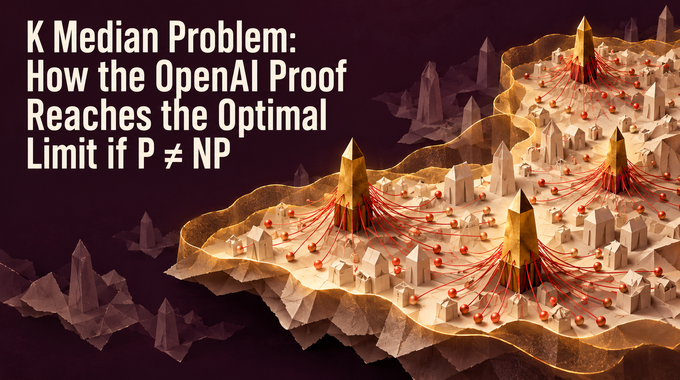
K Median Problem: How the OpenAI Proof Reaches the Optimal Limit if P ≠ NP

K median problem artwork showing selected gold hubs connecting clients across a folded city.

Choosing warehouse locations sounds like a logistics exercise. Requiring a provably near-best choice for every possible metric turns it into a decades-long mathematical challenge. The k median problem asks for at most kk facilities minimizing total client distance. OpenAI’s September 24, 2026 manuscript presents a deterministic polynomial-time approximation within 1+2/e+ε1+2/e+\varepsilon of optimum for every fixed … Read more

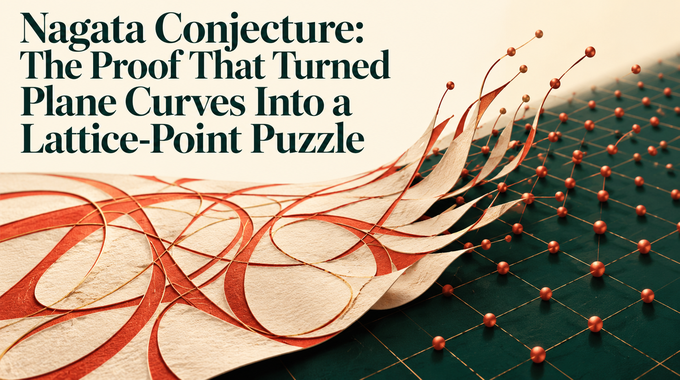
Nagata Conjecture: The Proof That Turned Plane Curves Into a Lattice-Point Puzzle

Nagata conjecture artwork showing plane curves lifting into a lattice of copper points.

Can a degree-nine plane curve vanish three times at each of ten very general points? It has 55 coefficients facing 60 conditions, which suggests failure. Proving that those conditions really rule out every curve is the difficult part. The Nagata conjecture turns this example into a universal bound connecting degree, multiplicity, and the square root … Read more