
An AI “discovered a room temperature semiconductor” is the kind of headline that almost guarantees confusion. Silicon already works at room temperature, and this result has nothing to do with room-temperature superconductivity.
What a team of Claude Opus 5.5 agents actually identified is more specific, and arguably more interesting: two candidates for room-temperature magnetic semiconductors with almost no net magnetization but strongly spin-selective electronic states. One, YBaMnFeO₅, is a new computational design that may be difficult to make in the atomic arrangement the effect requires. The other, KV[Cr(CN)₆], was synthesized back in 1999 and was experimentally magnetic above room temperature, but its newly highlighted electronic and spin properties still haven’t been directly measured.
So this is not a finished materials breakthrough. It is a particularly testable computational result, backed by unusually open calculations, code, raw outputs and documented caveats.
Table of Contents
1. What Did Claude Opus 5.5 Actually Find?
The safest way to describe the result is one designed candidate and one newly recognized candidate, not “AI invented two new materials.”
Room Temperature Semiconductor: What the Evidence Actually Shows
| Question | What The Evidence Actually Says |
|---|---|
| What was found? | Two candidate Luttinger-compensated magnetic semiconductors, YBaMnFeO₅ and KV[Cr(CN)₆] |
| Is either a superconductor? | No. Both are being studied as magnetic semiconductors |
| Is YBaMnFeO₅ new? | It is a computational design and has not been made |
| Is KV[Cr(CN)₆] new? | No. It was synthesized in 1999 |
| What has been experimentally verified? | KV[Cr(CN)₆] remained magnetically ordered to 376 K in the original hydrated powder |
| What remains computational? | Band gaps, spin-selective windows and the ideal zero-net-spin electronic structure |
| Has the key spin behavior been measured? | No |
| Is this a proven device material? | No |
The distinction matters. The agents predicted that both ideal crystals could combine zero net spin moment with spin-sorted band edges. For KV[Cr(CN)₆], however, the compound itself and its high-temperature magnetic ordering were already known. The newer work mainly reframes the material as a possible Luttinger-compensated semiconductor, quantifies its spin windows and tests how robust the behavior might be.
YBaMnFeO₅ is the more conventional “AI materials discovery” story. It was designed computationally. The catch is that the same calculations suggest the structure needed for the effect may be difficult to preserve during synthesis.
2. YBaMnFeO₅ vs KV[Cr(CN)₆]: Predicted And Measured
This is where much of the viral discussion loses an important distinction. A predicted number and an experimentally measured number are not interchangeable.
Room Temperature Semiconductor: YBaMnFeO₅ vs KV[Cr(CN)₆]
| Property | YBaMnFeO₅ | KV[Cr(CN)₆] |
|---|---|---|
| Material status | Computational design | Synthesized in 1999 |
| HSE06 band gap | 2.35 eV, predicted | 2.09 eV, predicted |
| Spin-selective window | 1.0 eV holes, 1.4 eV electrons, predicted | 2.6 eV holes, 1.6 eV electrons, predicted |
| Magnetic ordering temperature | About 420 K raw, about 490 K after calibration, predicted | 376 K measured in hydrated powder, 365 K after heating |
| Net spin moment | Zero in idealized calculation | Zero in idealized calculation, small residual moment measured in the real powder |
| Biggest concern | Mn/Fe disorder may destroy the effect | Water, defects and lack of direct electronic measurements |
| Experimental spin polarization or band gap | None | None |
The repository explicitly labels YBaMnFeO₅ as a design study rather than a realizable discovery at this stage, while describing KV[Cr(CN)₆] more modestly as an “identification plus numbers.” It also states that neither material has a measured spin polarization, conductivity or band gap.
That wording is much closer to the scientific status than “Claude discovered two revolutionary semiconductors.”
3. Why “Room Temperature Semiconductor” Is So Easy To Misunderstand
A room temperature semiconductor is not unusual by itself. Your phone, laptop and data center are already full of semiconductor devices that operate around room temperature.
The special part is magnetic.
These candidates are interesting because the calculations suggest they could remain magnetically ordered while also behaving as semiconductors and separating available electronic states according to spin.
That immediately clears up the biggest misconception: semiconductor does not mean superconductor.
A superconductor can carry electrical current with zero resistance under the relevant conditions. A semiconductor has a tunable electronic band structure and still has ordinary resistive losses. Nothing here implies lossless power transmission, room-temperature superconductivity, or servers that suddenly stop producing heat.
So if you saw the phrase “Claude Opus 5.5 semiconductor” and pictured an LK-99-style claim, that is the wrong scientific category.
4. What Is A Room-Temperature Magnetic Semiconductor?
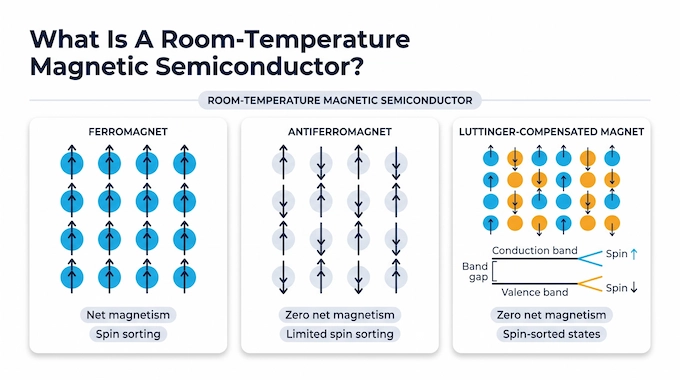
A semiconductor has an energy gap between occupied and unoccupied electronic states. A magnetic semiconductor adds magnetic order to that electronic structure.
For spintronics, the interesting variable isn’t only electric charge. It is also electron spin.
In a ferromagnet, many magnetic moments align in the same direction. That can separate electronic states by spin, but it also creates a macroscopic magnetic field.
An ordinary antiferromagnetic semiconductor behaves differently. Opposing magnetic moments cancel, which can reduce stray magnetic fields, but conventional antiferromagnets do not necessarily give you useful spin separation at the band edges.
The candidates here belong to a more specialized idea called a Luttinger-compensated magnet.
In the ideal picture, two inequivalent magnetic sites carry opposite magnetic moments of equal magnitude. Their overall spin moment cancels, yet because the sites are electronically different, the available states can still be separated by spin. The source illustrates this directly: ferromagnets have large net magnetism and spin sorting, ordinary antiferromagnets have zero net magnetism without the same sorting, while the Luttinger-compensated case aims for both zero net magnetism and spin sorting.
That combination is the real attraction of this room temperature semiconductor story.
5. Was KV[Cr(CN)₆] Really Hiding In Plain Sight Since 1999?
Sort of, but the timeline is more interesting than the slogan.
1999:
KV[Cr(CN)₆] was synthesized as a Prussian-blue-type magnetic material. Its magnetic ordering was measured up to 376 K in the hydrated powder.
2008:
A hybrid-functional study plotted its spin-resolved electronic structure. According to the new analysis, the same-spin character of the band edges was already visible, but that work focused on magnetic coupling under pressure and did not frame the compound as a Luttinger-compensated semiconductor.
2026:
The Claude-led analysis recognized that connection, quantified the predicted spin-selective windows and examined defects, water and structural robustness.
That means the AI did not unearth a forgotten compound whose properties had never been studied. More accurately, it connected older experimental and theoretical results to a newer materials concept.
The project authors themselves narrowed their novelty claim after finding the missed 2008 work. That correction is a strength of the record, even if it makes the headline less dramatic.
6. How Did The Claude Opus 5.5 Agents Do The Science?
The agents did not replace quantum mechanics with language-model intuition.
They acted more like an automated research team around conventional computational physics.
The Claude agents searched the literature, proposed candidates, prepared calculations, inspected results and challenged claims. The actual electronic-structure calculations were run with Quantum ESPRESSO 7.5 using density functional theory, primarily PBE+U and the more computationally expensive HSE06 hybrid functional.
The repository says several Claude agents worked in parallel from October 1 to 4, with separate research lanes, predefined pass or fail criteria and adversarial “referee” agents tasked with trying to break the claims. The Luttinger-compensated lane submitted roughly 750 computational jobs. Humans set the goals, directed the search and decided what to publish.
That is a better model for AI semiconductor discovery than “the model imagined a crystal and declared victory.”
AI handled orchestration and scientific search. Established physics software handled the heavy numerical work.
7. How Reliable Are The DFT Predictions?
This is the section that determines whether the story is science or just a polished demo.
The calculations are reproducible in a useful computational sense. The public ledger includes raw inputs and outputs, verification scripts and rerun instructions. Of 61 tracked claims, 52 could be recomputed directly from raw outputs, with others checked through included scripts, analysis files or literature values.
The repository also reports fresh reruns of selected Quantum ESPRESSO calculations that reproduced the checked values.
But computational reproducibility is not physical validation.
The authors explicitly warn that these are ideal-crystal DFT predictions. Spin-orbit effects were not reliably included in the zero-moment result, finite-temperature compensation may not remain exact, and even HSE06 can shift electronic levels by tenths of an electron volt. PBE+U and HSE06 also disagree over how strongly water affects KV[Cr(CN)₆].
And yes, many AI agents can still make the same mistake.
Multiple copies of one model are not equivalent to multiple independent laboratories. Correlated assumptions, shared literature blind spots or identical computational setups can propagate the same error across agents.
The project provides a perfect example: subsequent checking uncovered several mistakes or omissions, including an initially incorrect hull-distance calculation, an unconverged HSE06 run and the missed 2008 paper. None overturned the main conclusions, but they show why agent count should never be confused with independent evidence.
8. Can These Materials Actually Be Made And Tested?
For YBaMnFeO₅, synthesis is the uncomfortable part of the story.
The desired behavior depends on manganese and iron occupying an ordered checkerboard arrangement. The simulations suggest that arrangement becomes disordered around 950 K, while conventional synthesis of this type of oxide requires substantially higher temperatures for atoms to move efficiently. Once the Mn and Fe scramble, the predicted spin-selective behavior disappears.
So YBaMnFeO₅ may be computationally elegant but experimentally awkward.
KV[Cr(CN)₆] is much more attractive as a near-term test because chemists have already made it. Its cyanide framework also locks chromium and vanadium into chemically distinct sites, avoiding the same ordering problem.
The drawback is that the only reported sample was a hydrated powder with a small residual magnetic moment. Its predicted electronic structure still needs direct experimental measurement.
9. What Could Room-Temperature Magnetic Semiconductors Be Used For?
The obvious target is spintronics, where information is manipulated using electron spin as well as charge.
The source points to familiar examples such as hard-drive read heads and MRAM. A Luttinger-compensated magnetic semiconductor could be especially interesting because it promises two properties engineers usually struggle to combine: spin-selective electronic states and very little stray magnetic field.
In principle, that could matter for dense magnetic memory, spin-based logic and devices where neighboring magnetic elements need to interfere with each other as little as possible.
But “could” is doing important work there.
No MRAM cell has been demonstrated using either material. No commercial switching advantage has been measured. No device-level energy savings have been shown.
And a room temperature semiconductor of this type would not remove the need to cool data centers. It still has electrical resistance and ordinary sources of heat. This is a spintronics materials story, not a zero-resistance computing story.
10. Is This Another LK-99?
The superficial similarity is obvious: an exotic material claim, room temperature in the headline, and instant skepticism.
Scientifically, the cases are very different.
LK-99 was presented as a room-temperature superconductivity claim, which would have implied an extraordinary change in electrical transport. The Claude Opus 5.5 result is a computational prediction about a much narrower combination of magnetic and semiconductor properties.
There is also less ambiguity about the current evidence. The researchers openly call YBaMnFeO₅ a design that may be difficult to realize and KV[Cr(CN)₆] an identification rather than a breakthrough. They explicitly state which properties remain unmeasured.
Skepticism is still healthy. It just needs to target the actual claim.
11. What Has To Happen Before This Becomes A Real Breakthrough?
The validation path is straightforward:
independent calculation → synthesis or resynthesis → structural confirmation → magnetic characterization → electronic measurements → spin-resolved measurement → replication
KV[Cr(CN)₆] is the obvious place to start.
The project proposes remaking the compound, measuring its composition and saturation magnetization, then using element-specific magnetic measurements and ultimately spin-resolved photoemission. For the valence-band prediction, the expected signal is especially crisp: strong spin polarization across a broad energy range that reverses with the magnetic order.
That is what makes this result scientifically useful even before confirmation. It produces concrete experiments that could prove it right or wrong.
12. What This Room Temperature Semiconductor Story Really Says About AI Science
The most important result may not be a new room temperature semiconductor at all.
It may be the workflow.
Claude Opus 5.5 agents searched literature, generated hypotheses, launched established physics calculations, compared alternatives, challenged conclusions and published enough of the computational trail for outsiders to inspect the work. The associated repository contains hundreds of raw calculation inputs and outputs, claim-level provenance, rerun scripts and documented corrections.
That is a credible example of AI materials discovery becoming more than candidate generation. AI can compress the search-and-test loop around established scientific tools.
But the experiment also exposes the boundary clearly. Agents can make the search faster. They can run more calculations. They can even critique one another. They cannot negotiate with physical reality.
Right now, YBaMnFeO₅ is an intriguing design with a serious synthesis problem. KV[Cr(CN)₆] is the stronger candidate because the material already exists and its above-room-temperature magnetic ordering has been measured, but its predicted spin-selective semiconductor behavior is still waiting for the decisive experiment.
That is enough to make the story worth following without pretending the finish line has already been crossed.
Binary Verse AI will keep tracking the experimental follow-up, independent replication and the broader shift toward AI-directed scientific discovery. If KV[Cr(CN)₆] gets remade and its predicted spin structure survives measurement, that will be the moment this story changes from an impressive computational result into a genuine materials breakthrough.
1. What happens to semiconductors at room temperature?
Most conventional semiconductors, including silicon, already operate at room temperature. In this story, “room temperature” refers primarily to maintaining the material’s unusual magnetic and spin-dependent properties at temperatures useful for real devices, not simply to its ability to behave as a semiconductor.
2. Is a room-temperature semiconductor the same as a room-temperature superconductor?
No. A semiconductor controls electrical conduction through its band structure, while a superconductor can conduct electricity with essentially zero electrical resistance below a critical temperature. The Opus 5.5 research concerns magnetic semiconductors, not room-temperature superconductivity.
3. What did Claude Opus 5.5 actually discover?
A Vals AI experiment using more than 90 Opus 5.5 agents identified two promising room-temperature magnetic-semiconductor candidates: YBaMnFeO₅ and KV[Cr(CN)₆]. One was computationally proposed, while KV[Cr(CN)₆] had already been synthesized decades earlier. The newly claimed electronic and spin properties are computational predictions that still require experimental verification.
4. Have the Opus 5.5 room-temperature semiconductor results been experimentally proven?
Not yet. The calculations predict promising electronic and magnetic behavior, but simulations are not the same as laboratory verification. KV[Cr(CN)₆] is particularly interesting because the material has previously been synthesized, making it a practical candidate for follow-up measurements.
5. What could room-temperature magnetic semiconductors be used for?
Their main promise is spintronics, where devices use electron spin as well as electric charge. Potential applications include nonvolatile memory, spin-based electronics and very fast switching devices. However, the two Opus 5.5 candidates remain research-stage materials, so commercial applications are not yet demonstrated.