Exponential Time Hypothesis: How the OpenAI Proof Breaks the 3-SAT Barrier
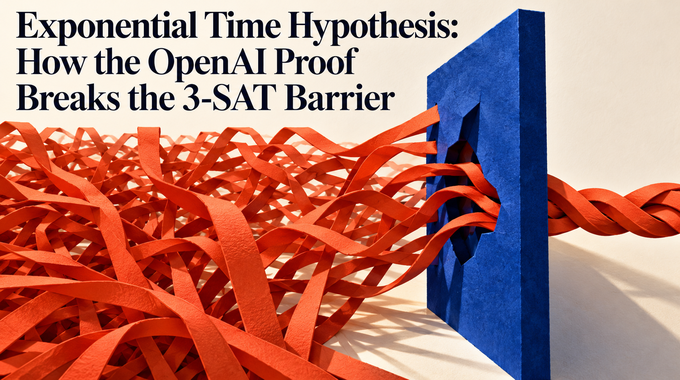
Exponential time hypothesis artwork showing branching ribbons crossing a cobalt barrier and emerging as a compact braid.

A formula with a million Boolean variables has more possible assignments than any computer could enumerate. The exponential time hypothesis says that, for worst-case 3-SAT, an exponential dependence on the variable count cannot be escaped. OpenAI’s October 25, 2026 manuscript presents an escape: deterministic, exact counting in subexponential time and polynomial space for every fixed … Read more
Random 3 SAT Threshold: How OpenAI Proved the Critical Ratio Is Computable

Random 3 SAT threshold enclosed by sculptural lower and upper bounds beneath the article title.

A computer can count every satisfying assignment of a finite Boolean formula and still lack a guaranteed way to calculate the transition point of infinitely growing random formulas. OpenAI’s September 27, 2026 preprint closes that gap for the random 3 sat threshold: one deterministic program can approximate the limiting critical ratio to any requested accuracy. … Read more

Mean Payoff Games: OpenAI Proof Breaks the Binary-Weight Bottleneck in Quasipolynomial Time

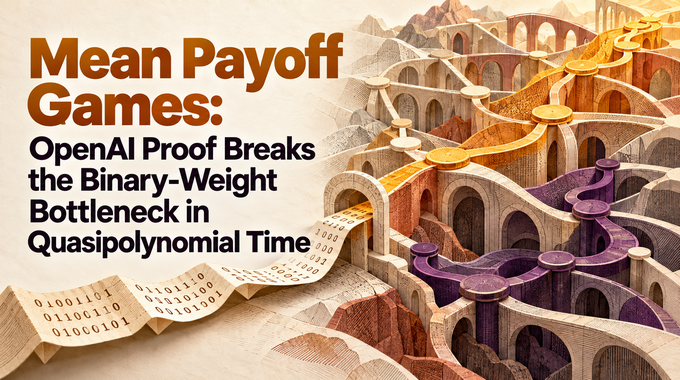
Mean payoff games artwork shows compact binary code opening a vast game landscape.

A weight with a hundred binary digits can derail an algorithm that looks efficient on small numbers. Mean payoff games have carried that trap for decades: compact inputs can encode enormous numerical work. OpenAI’s September 25, 2026 manuscript presents a deterministic algorithm that computes every zero-threshold winner in quasipolynomial time measured against the complete binary … Read more

Randomized K Server Problem: How OpenAI’s Proof Reaches the Optimal Log² k Bound

Randomized k server problem illustrated by tangled routes and an elegant path across a sculpted landscape.

Two mobile servers can spend forever chasing nearby requests while a better plan moves once and stops. The randomized k server problem asks how much that lack of foresight must cost. OpenAI’s September 24, 2026 preprint gives a squared-logarithmic answer: on every metric space, a randomized online policy can stay within a universal constant times … Read more

Trace Reconstruction: OpenAI Proof Reveals Why Deleted Data Is So Hard to Recover

Trace reconstruction artwork shows different binary crystal structures obscured by frosted glass.

Delete one bit and every later position can become ambiguous. Delete bits independently across repeated copies, and even unlimited computation may need more observations than any fixed polynomial can supply. That is the central result of OpenAI’s September 24, 2026 paper, Quantitative Lower Bounds for Trace Reconstruction. For every fixed deletion probability strictly between zero … Read more

Three Machine Scheduling: OpenAI Proof Solves a 47-Year-Old Algorithm Puzzle

Three machine scheduling artwork shows three job streams woven into an ordered schedule beneath the article title.

Six jobs, three machines, and a dependency chain can still leave processors idle. The difficulty is choosing which available work to run now without delaying the finish later. Three machine scheduling turns that familiar coordination problem into a precise mathematical question: can an optimal schedule always be found in polynomial time? OpenAI’s September 24, 2026 … Read more

Shortest Common Superstring: How OpenAI Finally Proved the Factor-2 Guarantee

Shortest common superstring artwork showing letter ribbons merging through shared overlaps.

The fragments CAT, ATG, and TGC fit into CATGC. Five letters do the work of nine. Scale that puzzle to arbitrary strings, and finding the shortest possible assembly becomes computationally hard. OpenAI’s September 24, 2026 preprint proves a deterministic polynomial-time shortest common superstring approximation: its output contains every input and is at most twice as … Read more