Random 3 SAT Threshold: How OpenAI Proved the Critical Ratio Is Computable
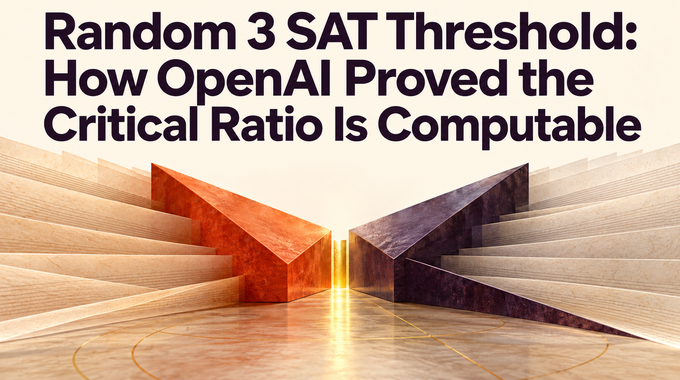
Random 3 SAT threshold enclosed by sculptural lower and upper bounds beneath the article title.

A computer can count every satisfying assignment of a finite Boolean formula and still lack a guaranteed way to calculate the transition point of infinitely growing random formulas. OpenAI’s September 27, 2026 preprint closes that gap for the random 3 sat threshold: one deterministic program can approximate the limiting critical ratio to any requested accuracy. … Read more
Triangular Lattice Universal Optimality: OpenAI Proof Breaks the Nonperiodic Barrier with an Atomic Certificate

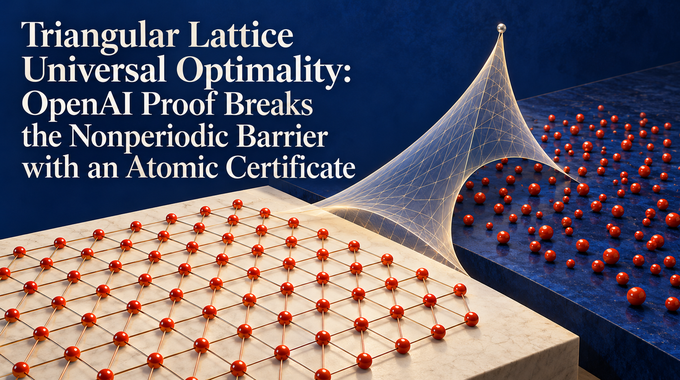
Triangular lattice universal optimality shown as a red lattice facing irregular points beneath a certificate.

A perfect triangular grid has a formidable opponent: every disordered arrangement of points in the plane. The opponent can abandon repetition, squeeze distinct points arbitrarily close together, and concentrate enormous crowds in scattered regions. OpenAI’s September 26, 2026 preprint presents a proof that none can beat the grid’s lower energy per particle for an entire … Read more

Mean Payoff Games: OpenAI Proof Breaks the Binary-Weight Bottleneck in Quasipolynomial Time

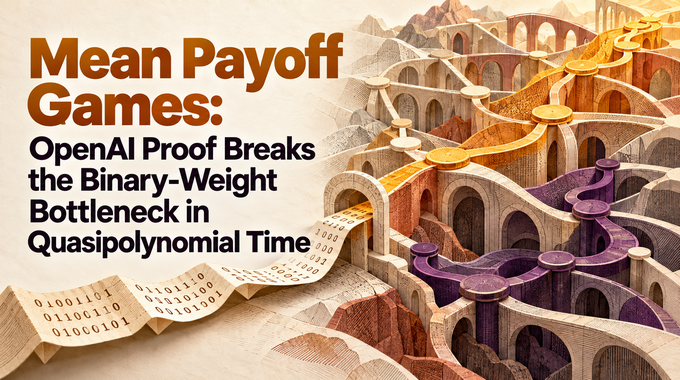
Mean payoff games artwork shows compact binary code opening a vast game landscape.

A weight with a hundred binary digits can derail an algorithm that looks efficient on small numbers. Mean payoff games have carried that trap for decades: compact inputs can encode enormous numerical work. OpenAI’s September 25, 2026 manuscript presents a deterministic algorithm that computes every zero-threshold winner in quasipolynomial time measured against the complete binary … Read more

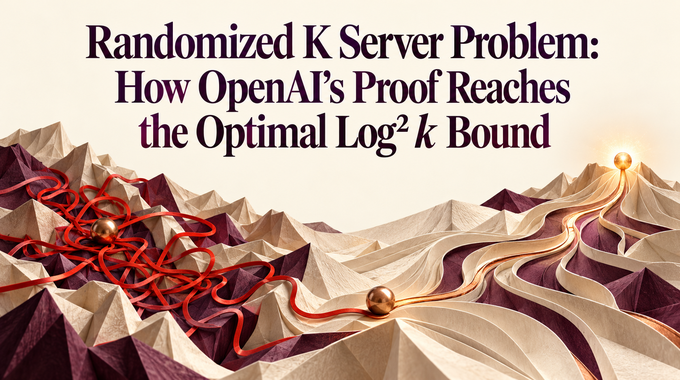
Randomized K Server Problem: How OpenAI’s Proof Reaches the Optimal Log² k Bound

Randomized k server problem illustrated by tangled routes and an elegant path across a sculpted landscape.

Two mobile servers can spend forever chasing nearby requests while a better plan moves once and stops. The randomized k server problem asks how much that lack of foresight must cost. OpenAI’s September 24, 2026 preprint gives a squared-logarithmic answer: on every metric space, a randomized online policy can stay within a universal constant times … Read more

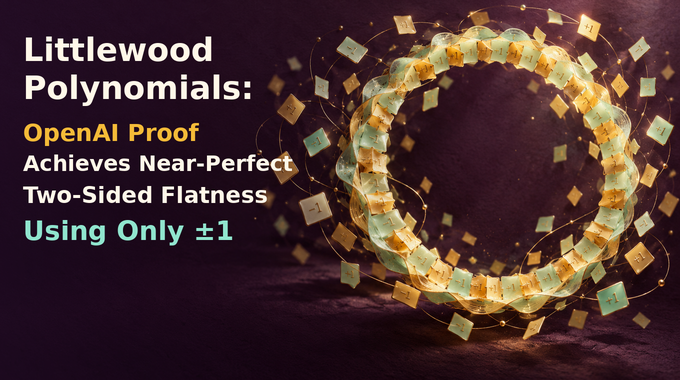
Littlewood Polynomials: OpenAI Proof Achieves Near-Perfect Two-Sided Flatness Using Only ±1

Littlewood polynomials illustrated by binary sign tiles forming a luminous ring of nearly constant magnitude.

A polynomial can have only two choices for each coefficient and still face an entire circle of tests. OpenAI’s October 5, 2026 manuscript presents a proof that littlewood polynomials with coefficients ±1 can have magnitude arbitrarily close to their natural square-root scale at every angle, for every sufficiently large integer length. The achievement asserted is … Read more

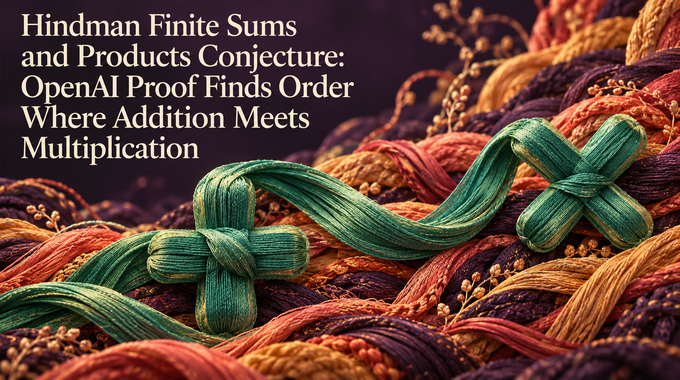
Hindman Finite Sums and Products Conjecture: OpenAI Proof Finds Order Where Addition Meets Multiplication

Hindman Finite Sums and Products Conjecture illustrated by jade addition and multiplication woven through colored threads.

Choose three positive integers. Add any selection of them, or multiply it. Can every result carry the same color, however someone has colored the number line? The Hindman Finite Sums and Products Conjecture asks for this cooperation between addition and multiplication for every prescribed finite set size. OpenAI’s September 23, 2026 manuscript presents a proof … Read more

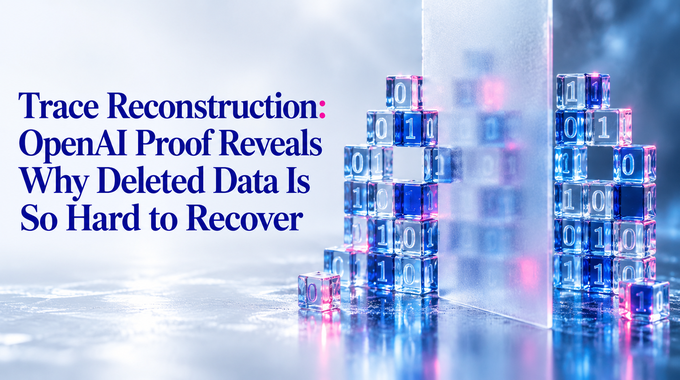
Trace Reconstruction: OpenAI Proof Reveals Why Deleted Data Is So Hard to Recover

Trace reconstruction artwork shows different binary crystal structures obscured by frosted glass.

Delete one bit and every later position can become ambiguous. Delete bits independently across repeated copies, and even unlimited computation may need more observations than any fixed polynomial can supply. That is the central result of OpenAI’s September 24, 2026 paper, Quantitative Lower Bounds for Trace Reconstruction. For every fixed deletion probability strictly between zero … Read more