Large Prime Gaps: OpenAI Proof Solves a Longstanding Frequency Puzzle
Large prime gaps represented by recurring chasms in a sculptural ribbon, with the full article title.

A prime desert is easy to admire and surprisingly difficult to count. One enormous gap can contain thousands of empty intervals, making rare events look common. OpenAI’s September 25, 2026 manuscript, Positive Lower Density of Large Prime Gaps, presents a proof that large prime gaps occur with positive lower density: for every fixed positive multiplier, … Read more

Kimi K3.1 Pro: The 3T-Class AI Model Closing In on Claude and GPT-6

Coral bridges connect sculptural islands, illustrating Kimi K3.1 Pro approaching frontier AI performance.

A coding agent can look almost tied with Claude on one test and fall far behind it on the next. Kimi K3.1 Pro makes that tension unusually concrete: Moonshot reports 65.7% on Terminal-Bench 4.0 against Claude Opus 5.5’s 66.4%, yet only 31.5 against Opus’s 65.0 on ProgramBench’s binary scoring. Released October 23, 2026, Moonshot’s new … Read more

Three Machine Scheduling: OpenAI Proof Solves a 47-Year-Old Algorithm Puzzle

Three machine scheduling artwork shows three job streams woven into an ordered schedule beneath the article title.

Six jobs, three machines, and a dependency chain can still leave processors idle. The difficulty is choosing which available work to run now without delaying the finish later. Three machine scheduling turns that familiar coordination problem into a precise mathematical question: can an optimal schedule always be found in polynomial time? OpenAI’s September 24, 2026 … Read more

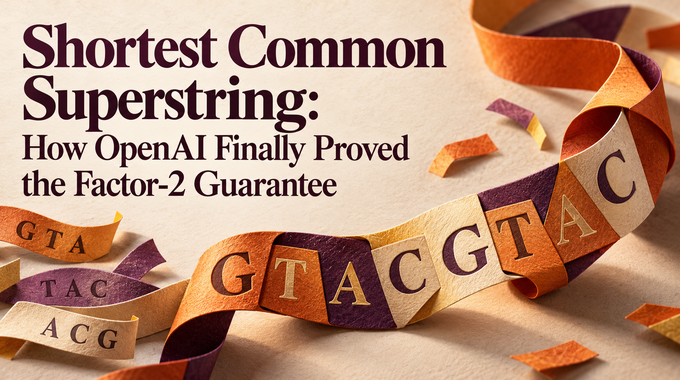
Shortest Common Superstring: How OpenAI Finally Proved the Factor-2 Guarantee

Shortest common superstring artwork showing letter ribbons merging through shared overlaps.

The fragments CAT, ATG, and TGC fit into CATGC. Five letters do the work of nine. Scale that puzzle to arbitrary strings, and finding the shortest possible assembly becomes computationally hard. OpenAI’s September 24, 2026 preprint proves a deterministic polynomial-time shortest common superstring approximation: its output contains every input and is at most twice as … Read more

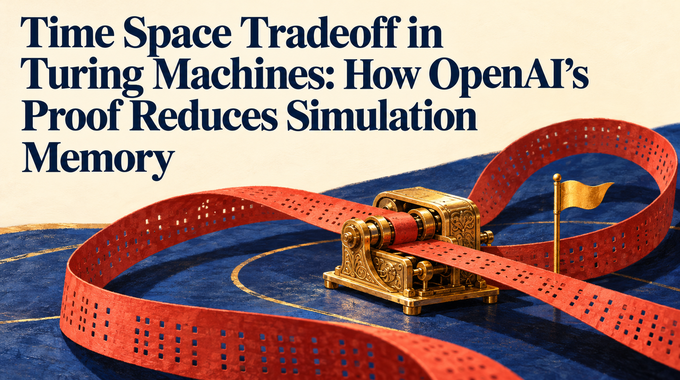
Time Space Tradeoff in Turing Machines: How OpenAI’s Proof Reduces Simulation Memory

Time space tradeoff in Turing machines shown as a looping paper tape passing through one small reusable workspace.

A machine may spend a trillion steps changing its tape, yet a simulator need not remember every changed cell to recover its answer. OpenAI’s September 25, 2026 preprint advances the time space tradeoff in Turing machines: a fixed deterministic machine with one writable tape can be simulated using two-fifths-power space, up to polylogarithmic factors, when … Read more

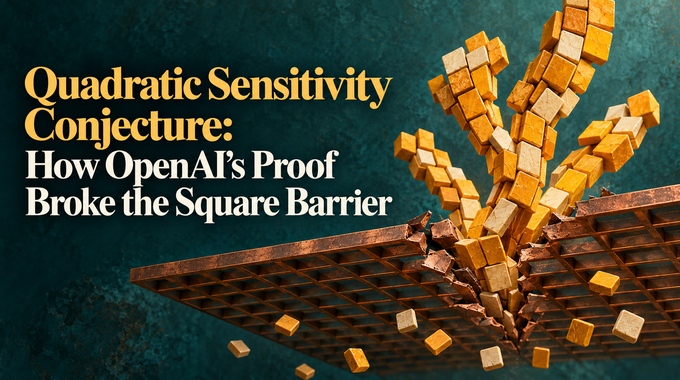
Quadratic Sensitivity Conjecture: How OpenAI’s Proof Broke the Square Barrier

Quadratic sensitivity conjecture artwork: grouped tiles breaking a copper square barrier.

A square looked like a plausible ceiling. OpenAI’s September 25, 2026 paper constructs Boolean functions that break it: for every positive constant CC, some total function satisfies bs(f)>Cs(f)2\mathrm{bs}(f)>C\,s(f)^2. That disproves the quadratic sensitivity conjecture, while leaving Hao Huang’s 2019 polynomial Sensitivity Conjecture theorem intact. The construction combines separated Hamming balls, labelled tournaments, and recursive target-and-gate … Read more

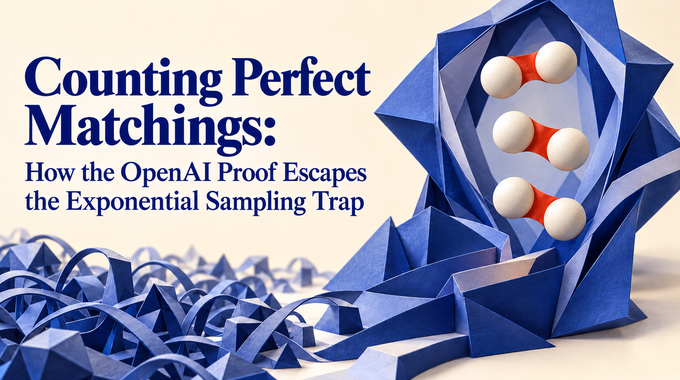
Counting Perfect Matchings: How the OpenAI Proof Escapes the Exponential Sampling Trap

Counting perfect matchings shown as three paired sculptures escaping an ultramarine sampling trap.

A graph can reveal one perfect pairing quickly while concealing how many others exist. Counting perfect matchings asks for that hidden population, and arbitrary graphs have resisted a general randomized approximation guarantee for decades. OpenAI’s September 23, 2026 paper supplies a fully polynomial randomized approximation scheme, or FPRAS: an estimate with selectable relative accuracy and … Read more