Poincare Conjecture: From Perelman’s Proof to AI and Lean
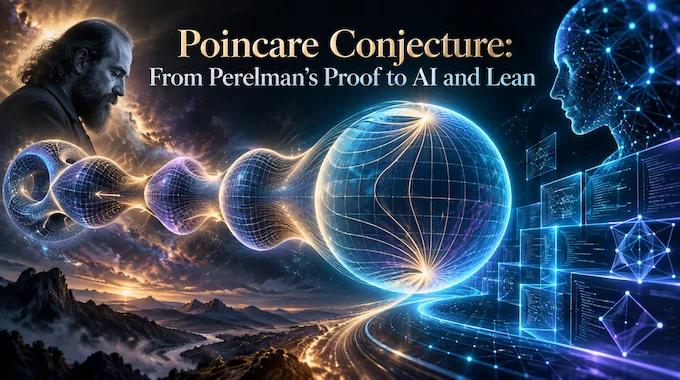
Poincare Conjecture concept art: a loop shrinking on a glowing three-sphere beside a digital proof grid

Every closed, simply connected three-dimensional manifold is homeomorphic to the three-sphere. That is the Poincare Conjecture, a statement whose vocabulary takes some unpacking and whose proof took nearly a century. The question is whether a certain test involving loops can identify the overall shape of a three-dimensional space. Grigori Perelman solved it in 2002–2003, building … Read more


Claude Nine Loops: What the $2,000 Physics Result Actually Proved

Claude Nine Loops feature cover showing AI-generated glowing rings representing a nine-loop physics calculation

A nine-loop scattering amplitude sounds like the kind of phrase designed to make everyone except theoretical physicists close the tab. This one is worth staying for. Anthropic says Claude Fable 5.1, working through its Claude Science research harness, completed a nine-loop calculation for a six-particle amplitude in planar N=4 super Yang-Mills. The model pursued the … Read more

MiMo-V2.6: Xiaomi Scales Agentic RL Toward Self-Improving AI

MiMo-V2.6 self-improving AI concept image with a glowing reinforcement learning feedback loop

Most frontier model launches make the model itself the headline. MiMo-V2.6 is more interesting because Xiaomi wants the training loop to be the headline. The new family combines a large mixture of experts architecture with multimodal pre-training, agent-focused mid-training, and an unusually large reinforcement learning run. Xiaomi says MiMo-V2.6-Pro used 1,568 prompts and 16 rollouts … Read more

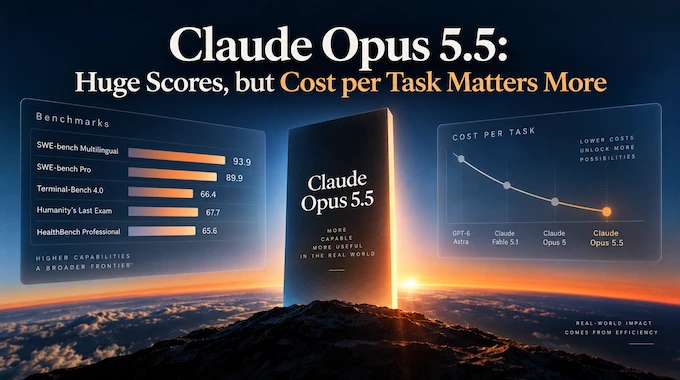
Claude Opus 5.5: Huge Scores, but Cost per Task Matters More

Claude Opus 5.5 feature graphic comparing high benchmark scores against real cost per task

Claude Opus 5.5 arrives with the kind of benchmark table designed to dominate launch-day discussion. It posts large gains over Opus 5, leads several coding and professional-work evaluations, and lands surprisingly close to or above newer rivals. But the headline scores are not the most interesting part of this release. The bigger change is economic. … Read more

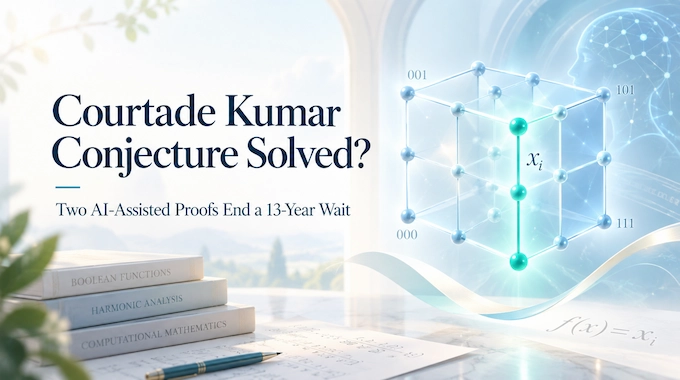
Courtade Kumar Conjecture Solved? Two AI-Assisted Proofs End a 13-Year Wait

Cover image illustrating the Courtade Kumar conjecture, a single glowing bit outshining a complex network under noise.

A one-bit summary can combine thousands of inputs, compute parity, take a threshold, or apply some elaborate Boolean rule. The Courtade Kumar conjecture says that for preserving information about a noisy copy of the input, this cleverness buys you nothing. The best one-bit summary is simply one original bit. Mathematically, let Xbe uniform on {-ⓜ,11}^n, … Read more

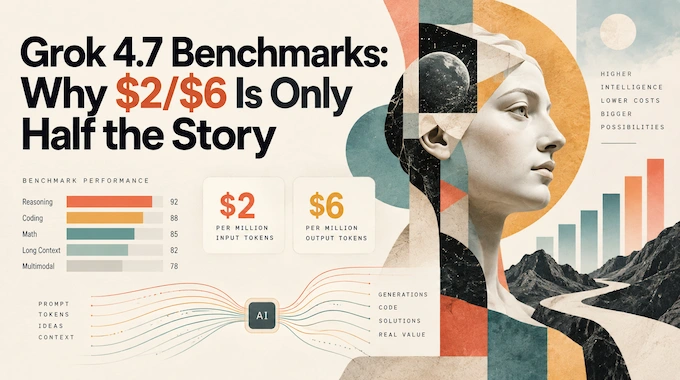
Grok 4.7 Benchmarks: Why $2/$6 Is Only Half The Story

Grok 4.7 benchmarks feature image showing a price tag above a hidden iceberg of compute costs.

Grok 4.7 arrives with an unusually attractive headline: $2 per million input tokens, $6 per million output tokens, and stronger results than Grok 4.6 across several long-horizon coding and professional-work tests. The Grok 4.7 benchmarks make the upgrade look substantial in places. DeepSWE rises to 71.0% at High effort, Terminal-Bench reaches 38.0% at xHigh, and … Read more

GLM-5.3 Inference Infrastructure: Inside the AI Agent That Took GLM-5.3-Flash to Production in Under Two Weeks

GLM-5.3 inference infrastructure agent optimizing AI data center servers

Z.ai’s latest infrastructure story sounds almost circular: GLM-5.3 helped optimize the system that serves GLM-5.3-Flash. The headline invites a bigger claim, that the model somehow built its own infrastructure. The engineering reality is more interesting, and more useful. The GLM-5.3 inference infrastructure was a production serving stack built on more than 100,000 Chinese-made AI accelerators. … Read more