Nonlinear Schrödinger Equation: How Meta’s Muse Spark Closed a 2015 Blow-Up Problem
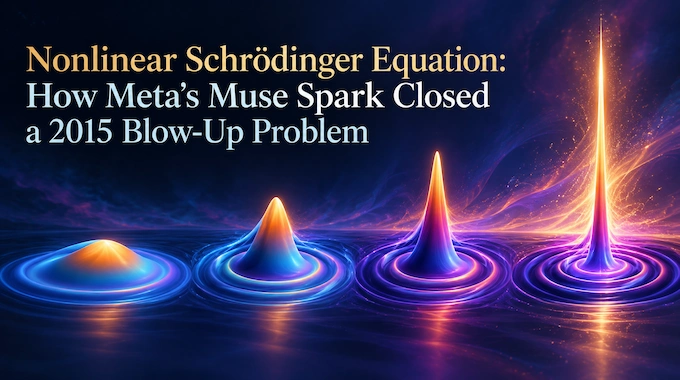
Nonlinear Schrödinger Equation cover showing a glowing wave collapsing into a bright focal point

For decades, mathematicians have studied a deceptively simple question about nonlinear waves: when a wave keeps focusing, must it collapse in finite time, or can it keep concentrating forever without quite reaching a singularity? A new paper by mathematician Leonard Dinh, developed with Meta’s Muse Spark, settles one version of that question for a specific … Read more
Percolation Theory Breakthrough: What Anthropic’s AI Actually Proved in Lean

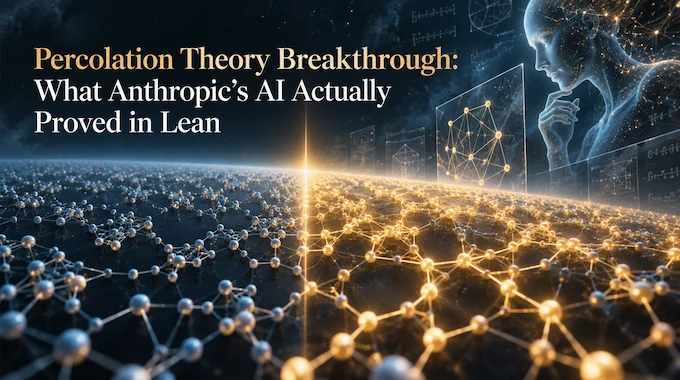
Glowing cubic lattice illustrating the Percolation Theory breakthrough proved by Claude in Lean

A decades-old gap in percolation theory now has a machine-checked proof. Anthropic’s Claude models, working under mathematician Justin Leder’s direction, produced a Lean formalization proving that nearest-neighbour Bernoulli bond percolation on (\mathbb{Z}^d) does not percolate at the critical point for every dimension (d \ge 2). The previously unresolved cases were dimensions (3) through (10). That … Read more

Gemini 4 Argon: Inside Google’s 1M-Token Output Model, Benchmarks, Pricing and Release Date

Gemini 4 Argon infographic comparing a short context-window input with a one-million-token output budget

Google’s newest frontier model arrives with an unusual headline: Gemini 4 Argon can produce up to one million output tokens in a single trajectory. That is not just a bigger chatbot reply. Google is positioning the model for jobs that may involve hours of reasoning, tool use, code changes, document analysis and repeated decisions before … Read more

GPT-6.1 Sol: Near-Astra at One-Fifth the Cost, How Close?

GPT-6.1 Sol as a small amber orb on one coin stack nearly matching Astra's blue orb on five stacks

An AI agent that costs less to run can still be expensive to finish with. A cheap refactor becomes a costly afternoon when someone has to untangle its mistakes. GPT-6.1 Sol makes that tradeoff more interesting. OpenAI’s September 29 release targets complex coding, computer use and sustained work across apps. The company reports performance approaching … Read more

Grad’s Conjecture: How AI Helped Crack a 59-Year Fusion Physics Puzzle

Nested glowing torus breaking through a symmetric shell, illustrating Grad's Conjecture and AI-assisted fusion physics

For nearly six decades, Grad’s Conjecture hung over one of the strangest questions in plasma physics: can a smooth, fully three-dimensional plasma sit in equilibrium inside nested toroidal surfaces without being forced into a strong symmetry? The intuition said probably not. Stellarator researchers, meanwhile, work precisely with complicated three-dimensional magnetic fields. Then September 2026 produced … Read more

Claude Sonnet 5.5 vs Opus 5.5: When Cheaper Costs More

Claude Sonnet 5.5 and Opus 5.5 shown as two receipt printers, one printing a much longer cost receipt

The cheaper model just complicated the buying decision. Claude Sonnet 5.5 beats Opus 5.5 on Anthropic’s Terminal-Bench evaluation, nearly matches it on professional knowledge work, and charges half as much for standard input and output tokens. Yet running Sonnet at maximum effort can cost more per benchmark task than running Opus. That’s the central question … Read more