
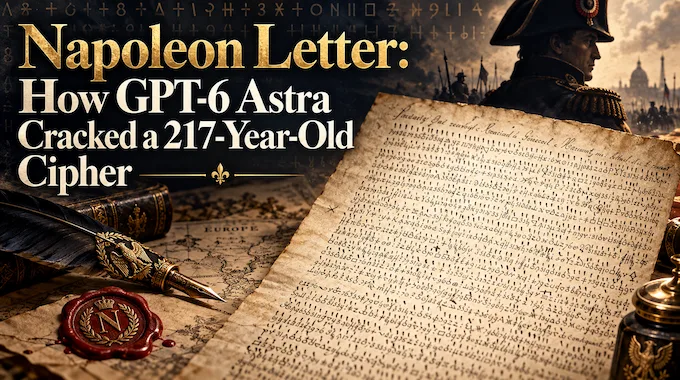
A 24-row encrypted military briefing from March 1809 has become a revealing test of what frontier AI can do when a problem crosses vision, research, coding, history, and cryptanalysis. The Napoleon letter, sent to General Auguste de Marmont from Eugène de Beauharnais’s headquarters under Napoleon’s instructions, contains about 1,300 cipher units built from 155 distinct signs.
Carter Church used GPT-6 Astra to produce a full working reading in about six hours of model execution time. But the sharpest version of the story is not “AI solved a cipher no human could crack.” Astra did not start from zero. A partial key already gave 33 letter values, covering 435 of the 1,300 units. The real achievement was combining transcription, code generation, statistical search, historical research, and image-level checking into one end-to-end workflow.
That makes the Napoleon cipher less a story about superhuman codebreaking and more a glimpse of AI as a fast, persistent research collaborator.
Table of Contents
1. What Is the Napoleon Letter Everyone Is Talking About?
The document is a military letter addressed to Marmont, then commanding French forces in Dalmatia. On March 16, 1809, Napoleon instructed his stepson Eugène de Beauharnais, Viceroy of Italy, to send Marmont an encrypted account of where French and allied armies were positioned. Austria was preparing for war, while Marmont’s corps was unusually exposed on the far side of the Adriatic.
The surviving document opens with a short line of clear French, then drops into 24 rows of numbers, letters, and hand-drawn symbols. For decades, it was known mainly from a single plate reproduced in a 1969 French army journal. The document had also been associated with the wrong year. The new reading places it in late March 1809, shortly before Austria invaded Bavaria in April.
Napoleon Letter: Key Facts About the 1809 Cipher
| Key Fact | What We Know |
|---|---|
| Date | Late March 1809 |
| Recipient | General Auguste de Marmont |
| Origin | Eugène de Beauharnais’s headquarters, following Napoleon’s March 16 instruction |
| Ciphertext | 24 rows, about 1,300 cipher units |
| Distinct signs | 155 in the reconstructed key |
| Starting help | 33 published letter values covering 435 units |
| Astra runtime | About six hours of model execution |
| Modern status | Reviewed by Satoshi Tomokiyo and listed by Cryptiana as solved |
The important distinction is that this was not a personal Napoleon letter like the famous correspondence with Joséphine. It was an operational briefing, written for a commander who might soon have to move through hostile territory.
2. What Did the Napoleon Letter Actually Say?
The decoded text is a compact strategic briefing. It tells Marmont where major French and allied forces were positioned and tries to convince him that Austria would face pressure from several directions.
The message places Bavarian troops around Munich and Passau, Polish forces on the Vistula threatening Cracow, Saxons near Dresden, French forces around Bayreuth, Ulm, Donauwörth, Augsburg, and the Lech, plus the Army of Friuli and Marmont’s own Dalmatian corps. It also says the Russians are moving against Austria, a claim that later proved far more political than operational.
The second half shifts to Austrian positions. It mentions forces around Laybach, Klagenfurth, Villach, and Salzburg, possible movement toward the Tyrol and Galicia, and skepticism about how much Austria’s militia would really add. Marmont is told not to be intimidated by “a few troops or a gathering of rabble.”
Napoleon Letter: What the Decoded Military Message Revealed
| Decoded Point | Why It Matters |
|---|---|
| French and allied deployments | Closely match Napoleon’s March 16 instruction to Eugène |
| Austrian positions | Add information not present in Napoleon’s original order |
| Russian movement | Shows the political messaging being passed to Marmont |
| Marmont and reserves | Expands the force picture beyond the published instruction |
| Austrian militia | Gives a contemporary French assessment of the Landwehr |
| “Gathering of rabble” | Helps fill the sense of a missing passage in Napoleon’s published correspondence |
This is not a lost command that rewrites the Napoleonic Wars. Much of the broad strategic picture was already known. What is new is the receiving-end version of the briefing, including extra intelligence, tone, and some wording that does not survive cleanly in the published correspondence.
3. What Kind of Cipher Protected the Napoleon Letter?
The Marmont cipher is a homophonic substitution cipher. In a simple substitution, one symbol might always stand for one letter. Homophonic systems make that harder by giving common letters several possible symbols. A French clerk could encode the same letter in different ways, which flattens the obvious frequency patterns that classical cryptanalysis likes to exploit.
The reconstructed letter contains 1,300 units and 155 distinct signs. Those signs include two-digit numbers, ordinary letters, invented marks, symbols that stand for letters, signs that represent whole words, and nulls that contribute no plaintext at all.
That design explains why “just count the symbols” was not enough. If the letter E can appear as several different signs, its normal dominance in French gets split across them. Whole-word signs also interrupt ordinary letter patterns. Add a low-resolution scan and variable nineteenth-century handwriting, and the first problem is not cryptanalysis at all. It is deciding what the symbols actually are.
4. Did GPT-6 Astra Really Crack the Napoleon Cipher From Scratch?
No, not completely from scratch. But saying Astra merely used an existing key is equally misleading.
French cryptology historian Daniel Tant had already published 33 letter values for this cipher system. Those values accounted for 435 of the 1,300 units, about 33 percent of the ciphertext. Roughly 865 units, about 67 percent, still had to be reconstructed from the letter itself. The published table also did not supply the whole-word signs needed to make the message readable.
So the fair description is that GPT-6 Astra Napoleon cipher work started with a meaningful foothold, then completed most of the unresolved work. That matters because historical-cipher headlines often collapse three very different tasks into one phrase, “cracked the code.”
The partial key reduced the search space. It did not provide the transcription, the complete key, the word signs, the dating correction, or the final verification.
5. How GPT-6 Astra Decoded the Napoleon Letter in Six Hours
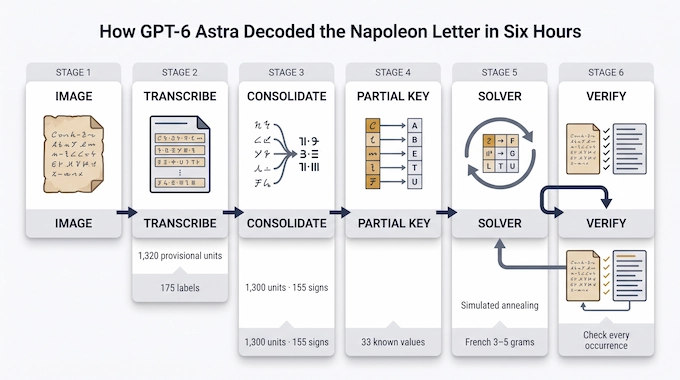
The most interesting part of the Napoleon letter AI story is the workflow. Astra was given a single low-resolution plate rather than a clean digital ciphertext.
First, it split the image into row crops and transcribed the marks line by line. It initially treated visibly different marks as separate candidates, then reconciled handwriting variants. That process produced 1,320 provisional units and 175 provisional labels before they were consolidated into the final 1,300-unit, 155-sign system.
Next, it locked in Tant’s known values. From there, Astra generated and used a solver based on simulated annealing. Candidate mappings were scored against French 3-grams, 4-grams, and 5-grams, meaning short letter sequences that help distinguish plausible French from noise.
Signs that repeatedly damaged otherwise good French were tested as whole words. This exposed tokens for common terms such as de, que, les, vous, and général. Proposed values were then checked across every occurrence of the same sign in the original image.
The key point is that the plate stayed in the loop. Astra was not simply optimizing text in isolation. It repeatedly returned from a statistical hypothesis to the visual evidence and asked whether the same glyph behaved consistently everywhere it appeared. The source write-up describes this as a roughly six-hour model run from one image, with transcription and cryptanalysis handled as one connected process.
6. Was It Brute Force, Pattern Matching, or AI Reasoning?
It was a mixture of search, pattern recognition, coding, and tool-driven reasoning.
This was not brute force in the sense of exhaustively trying every possible mapping. A 155-sign system would make that approach absurdly large. Simulated annealing instead explores the space intelligently. It starts with a candidate key, makes changes, keeps improvements, and sometimes accepts worse moves so it can escape local dead ends. Over many iterations, the search can settle on mappings that produce increasingly plausible French.
Nor was Astra simply “guessing what Napoleon would have said.” The workflow used historical context, but it also had hard constraints from repeated symbols, known key values, language statistics, and the source image.
The strongest part of the demonstration is orchestration. Astra moved between visual transcription, literature lookup, code generation, statistical optimization, linguistic interpretation, and validation without requiring a different specialist for each step.
7. How Do We Know GPT-6 Astra’s Decipherment Is Correct?
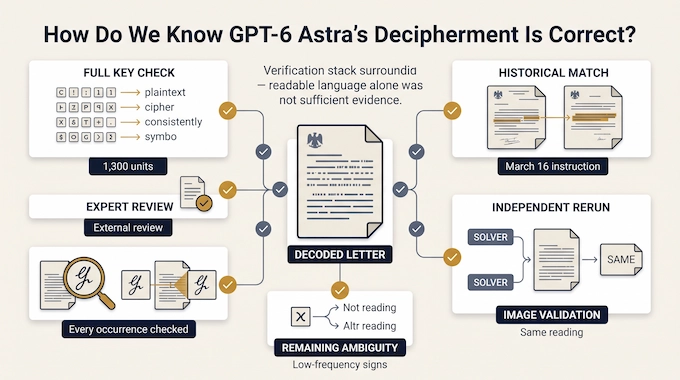
A historical cipher solution needs more than readable prose. A language model can make nonsense sound elegant, so the verification chain matters more than the headline.
First, the reconstructed key works across the complete 1,300-unit ciphertext. The published solution package includes the transcription, key, row-by-row decoding, and scripts that check the files and regenerate the reading.
Second, the decoded force list closely matches Napoleon’s March 16 instruction to Eugène. The same military formations appear in essentially the same sequence, with matching locations and figures. That is powerful external evidence because the correspondence existed independently of the new decryption.
Third, the solver was rerun without Marmont’s memoirs and other Napoleonic texts in its language model. It reportedly recovered the same reading. That test reduces the risk that the system merely overfit toward familiar historical wording.
Fourth, proposed signs were checked against every occurrence in the original plate. A value was not accepted simply because it made one sentence look good.
Finally, Satoshi Tomokiyo reviewed the solution, and Cryptiana now lists the cipher as solved with the date corrected to 1809.
There are still soft spots. Several low-frequency signs appear only once, and a handful of readings remain ambiguous. One phrase might mean “His Majesty” or “the Emperor,” for example. Those uncertainties affect wording at the edges, not the letter’s core meaning, force list, or strategic message.
8. Was Napoleon’s Letter Really Unread for 217 Years?
Not literally.
Marmont or someone on his staff almost certainly read the Napoleon encrypted letter in 1809. Otherwise the cipher would have failed at its only job. What disappeared was the usable key and, apparently, any complete modern decipherment.
So “unread for 217 years” is a good headline but an imprecise historical claim. A safer formulation is that the document is a 217-year-old Napoleon letter that had no known complete modern reading until this solution.
That distinction matters because it separates historical mystery from marketing. The achievement does not require pretending the original recipient never understood the message.
9. Why Had Nobody Cracked the Marmont Cipher Earlier?
Because it was neglected more than impossible.
The material was scattered but public. The cipher survived as a low-resolution plate in a specialist military journal. Tant’s partial key existed elsewhere. Napoleon’s correspondence had been printed since the nineteenth century. Marmont’s memoirs were also available.
What was missing was cheap, persistent labor across several disciplines. A human specialist could have spent days or weeks transcribing 1,300 hand-drawn signs, resolving variants, writing a solver, checking period French, digging through correspondence, and testing each hypothesis against the image. That is a lot of expert time for one obscure military letter.
Astra changed the economics of the problem. The result is less “humans could not do this” and more “the cost of trying just collapsed.”
10. What Is Historically New in the Decoded Napoleon Letter?
The historical contribution is real, but modest.
Napoleon’s March 16 instruction told Eugène to send Marmont the dispositions of French and allied forces. The Napoleon cipher decoded text shows what actually reached Marmont. It adds Austrian positions not included in that order, includes Marmont’s corps and reserves in the wider force picture, and records skepticism about the Austrian militia.
It also offers evidence about a broken passage in Napoleon’s published correspondence. In the printed version, a phrase about not being intimidated by “a handful of…” trails into dots. The ciphered relay contains the fuller idea, “a few troops or a gathering of rabble.” Because Eugène’s letter paraphrases Napoleon rather than reproducing him word for word, it does not prove Napoleon’s exact missing phrase. It does show what the receiving headquarters understood the instruction to mean.
The dating correction is useful too. The internal references place the document in late March 1809, not 1807.
11. What the Napoleon Cipher Really Shows About GPT-6 Astra
The cryptographic breakthrough itself is modest. Homophonic substitution ciphers are historical systems with known attack methods, and Astra had a partial key. The historical discovery is interesting, but it does not overturn the story of the 1809 campaign.
The AI workflow is the bigger deal.
GPT-6 Astra took a problem that crossed document vision, transcription, historical research, solver construction, statistical cryptanalysis, French language analysis, and source verification, then compressed those tasks into one sustained workflow. That is a more useful benchmark for agentic AI than a dramatic claim that it “beat” centuries of cryptography.
It also tells us what not to infer. This result says essentially nothing about breaking Bitcoin, AES, modern public-key cryptography, or other systems built around computational hardness rather than hand-designed substitution. The Napoleon cipher and modern cryptography share the word “cipher,” but they are different classes of problem.
The same caution applies to famous undeciphered texts such as the Voynich manuscript, Linear A, or the Indus script. Those problems may lack a known language, sufficient text, clear encoding rules, external anchors, or a verifiable plaintext. The Marmont case had several advantages: French was known, related correspondence existed, part of the key survived, and the result could be checked against independent history.
So, was the Napoleon letter decoded by AI a breakthrough or hype? Both labels miss the interesting middle.
As codebreaking, it is a solid completion of a solvable historical cipher. As history, it adds useful detail rather than rewriting an era. As a demonstration of autonomous research work, it is genuinely striking.
That is the reason to pay attention. The next wave of AI-assisted discovery may not come from impossible problems suddenly becoming possible. It may come from thousands of neglected problems becoming cheap enough to attempt.
For more careful breakdowns of frontier AI research, model capabilities, and the evidence behind viral claims, follow Binary Verse AI at binaryverseai.com.
1. What did the decoded Napoleon letter say?
The 1809 encrypted letter briefed General Auguste de Marmont on the positions and strength of French and allied armies, described Austrian deployments and expected Russian movements, and encouraged Marmont not to be intimidated when ordered to advance. It also preserves wording connected to a gap in Napoleon’s published correspondence.
2. Did GPT-6 Astra really crack Napoleon’s cipher?
Yes, but not entirely from scratch. A previously published partial key supplied 33 letter values covering roughly one-third of the 1,300 cipher units. GPT-6 Astra’s workflow reconstructed most of the remaining cipher, including previously unknown signs and whole-word symbols.
3. How was the Napoleon cipher decoded?
GPT-6 Astra first transcribed the handwritten symbols from a low-resolution image, applied known symbol values, and then used computational cryptanalysis including simulated annealing and French-language statistics to infer the remaining key. Candidate solutions were repeatedly checked against the original image.
4. How do we know the decoded Napoleon letter is accurate?
The reconstructed key consistently produces coherent French across the ciphertext, the decoded troop information closely matches Napoleon’s surviving March 1809 instructions, the result was reproduced after removing Napoleonic texts from the solver’s language corpus, and historical-cipher researcher Satoshi Tomokiyo reviewed the solution.
5. Was Napoleon’s letter really unread for 217 years?
Not literally. The intended recipient or his staff almost certainly read it in 1809 using the original key. What disappeared was the key itself, leaving the surviving encrypted copy without a known complete modern decipherment for roughly two centuries.