Unique Games Conjecture: OpenAI’s Proof and the Approximation Ceiling
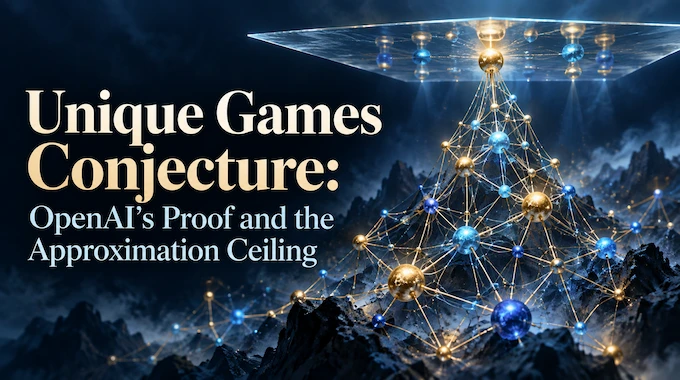
Glowing graph lattice meeting a glass ceiling, symbolizing the Unique Games Conjecture and the approximation limit

When an algorithm gives you a pretty good answer, the obvious next question is whether a cleverer algorithm could do better. Sometimes the obstacle is engineering. Sometimes it may be a mathematical ceiling. The Unique Games Conjecture sits at that boundary. OpenAI has published a manuscript claiming to prove it, alongside formalization materials describing the … Read more
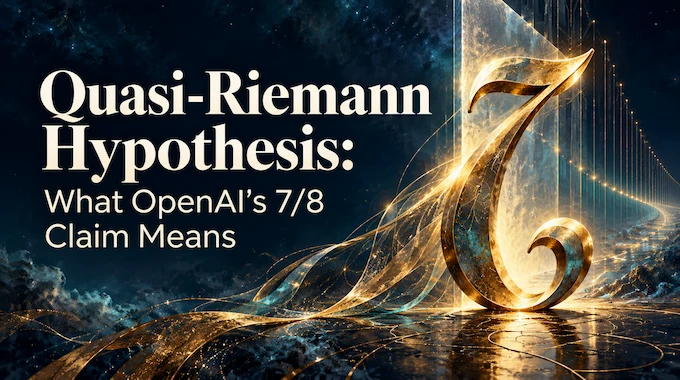
Quasi-Riemann Hypothesis: What OpenAI’s 7/8 Claim Means

Quasi-Riemann Hypothesis cover showing a glowing barrier wall holding back points of light at the 7/8 line

The Riemann hypothesis remains unsolved. Clay Mathematics Institute still lists it as an open Millennium Prize Problem. OpenAI’s new Quasi-Riemann Hypothesis manuscript addresses a weaker statement, but “weaker” hardly means small. If its argument holds, it establishes a fixed limit on where certain mathematical zeros can occur, tightening our understanding of prime numbers. Released on … Read more

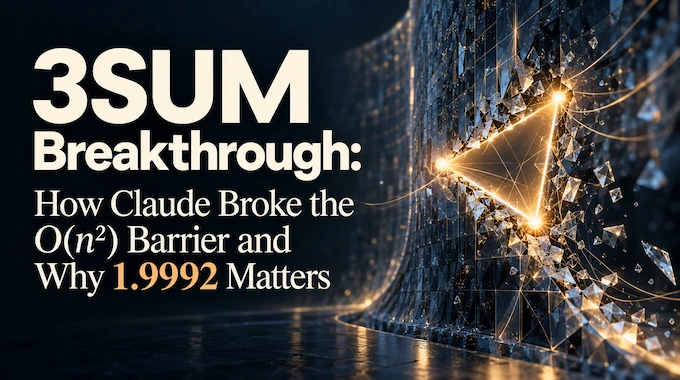
3SUM Breakthrough: How Claude Broke the O(n²) Barrier and Why 1.9992 Matters

3SUM breakthrough illustrated by three connected light nodes piercing a crystalline barrier beneath the article title.

Given a list of numbers, can you find three that add up to zero? That’s the 3SUM problem. The familiar solution takes quadratic time, roughly proportional to the square of the input size. A new paper credits Claude with discovering an algorithm that pushes the exponent below two. The headline result is a deterministic running … Read more

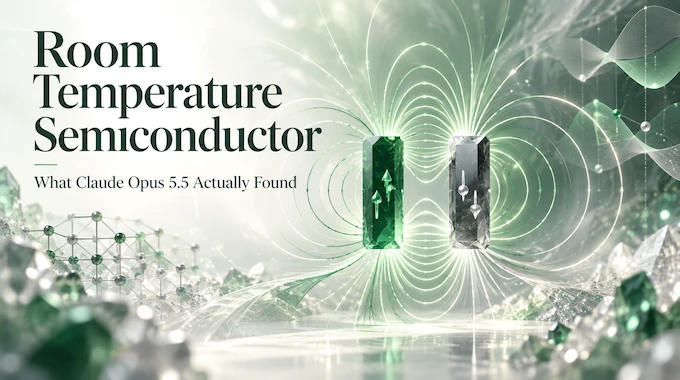
Room Temperature Semiconductor: What Claude Opus 5.5 Actually Found

Room Temperature Semiconductor crystal showing opposing magnetic spins and AI-guided materials discovery.

An AI “discovered a room temperature semiconductor” is the kind of headline that almost guarantees confusion. Silicon already works at room temperature, and this result has nothing to do with room-temperature superconductivity. What a team of Claude Opus 5.5 agents actually identified is more specific, and arguably more interesting: two candidates for room-temperature magnetic semiconductors … Read more

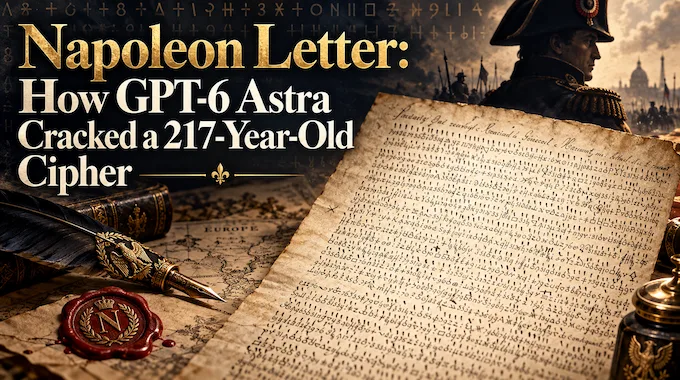
Napoleon Letter: How GPT-6 Astra Cracked the 217-Year-Old Napoleon Cipher

Napoleon Letter cipher being decoded by an advanced AI research system from a historic military document.

A 24-row encrypted military briefing from March 1809 has become a revealing test of what frontier AI can do when a problem crosses vision, research, coding, history, and cryptanalysis. The Napoleon letter, sent to General Auguste de Marmont from Eugène de Beauharnais’s headquarters under Napoleon’s instructions, contains about 1,300 cipher units built from 155 distinct … Read more

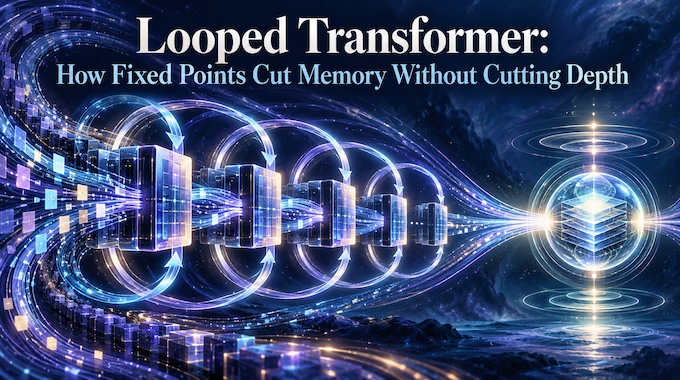
Looped Transformer: How Fixed Points Cut Memory Without Cutting Depth

Looped Transformer concept: glowing recurrent blocks spiral inward and settle at a single fixed point

A looped transformer takes a different route to a deeper language model. Instead of assigning fresh weights to every logical layer, it reuses the same Transformer block across multiple recurrences. That can create more logical depth without proportionally increasing resident parameters, but it introduces a new bill: every loop still costs compute, activations, KV-cache storage, … Read more