2D Area Law: How OpenAI’s Proof Connects the Global Gap to Entanglement
2D area law artwork linking a glowing lattice boundary with the global spectral gap.

A square of quantum spins can contain a vast number of possible states. The striking question is how much of that complexity a ground state actually uses to connect the square with its surroundings. OpenAI’s September 24, 2026 manuscript presents a proof of the 2D area law: under fixed locality bounds, a unique ground state … Read more
Subset Sum Problem: Inside OpenAI’s Proof Beyond the 52-Year Barrier

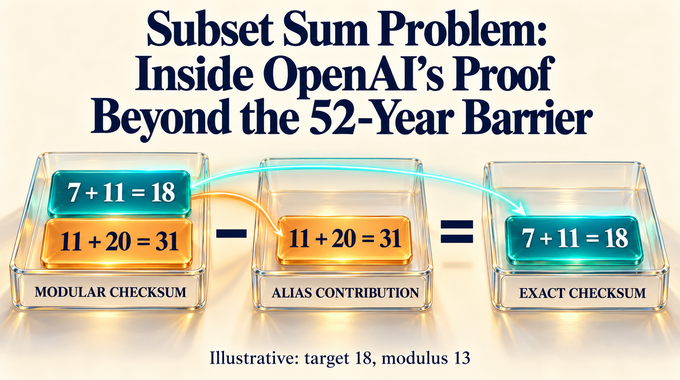
Subset sum problem artwork shows a lime path crossing a coral barrier beneath the article title.

For 52 years, the Subset sum problem had a stubborn exponential benchmark: split the inputs in half and search at the 2n/22^{n/2} scale. OpenAI’s October 4, 2026 preprint presents a randomized classical algorithm running in O(20.49n)O(2^{0.49n}) for polynomial-bit inputs in a specified word-RAM model. It promises at least 2/32/3 correctness probability for every fixed input, … Read more

Borsuk Conjecture: OpenAI’s 9D Proof Shatters the 63-Dimension Record

Feature image for the Borsuk conjecture article showing OpenAI's 9D proof breaking the 63-dimension record.

Ten pieces should have been enough. OpenAI’s September 23, 2026 preprint gives a compact set in nine-dimensional Euclidean space that refuses to fit that rule: every cover by ten subsets leaves at least one subset with the original diameter. The Borsuk conjecture counterexample lowers the previously reported counterexample dimension from 63 to nine. The original … Read more

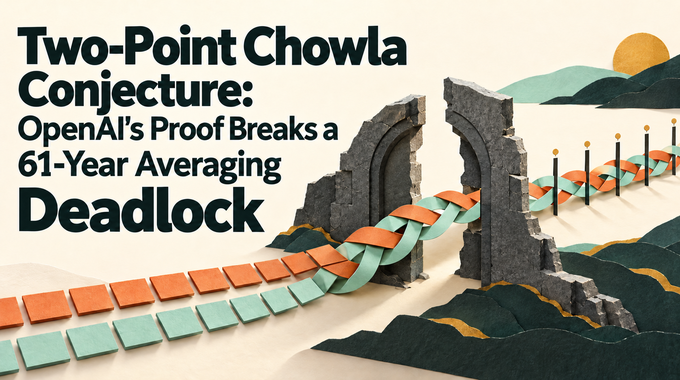
Two-Point Chowla Conjecture: OpenAI’s Proof Breaks a 61-Year Averaging Deadlock

Two-point Chowla conjecture artwork showing paired parity streams crossing a broken 61-year averaging barrier.

Prime factors can be counted, but their parity has resisted a deceptively simple prediction for decades. The two-point Chowla conjecture asks whether the even-or-odd factor counts of two integers a fixed distance apart become uncorrelated. OpenAI’s September 24, 2026 manuscript claims a proof for ordinary averages at every cutoff, with a power-of-logarithm saving. It also … Read more

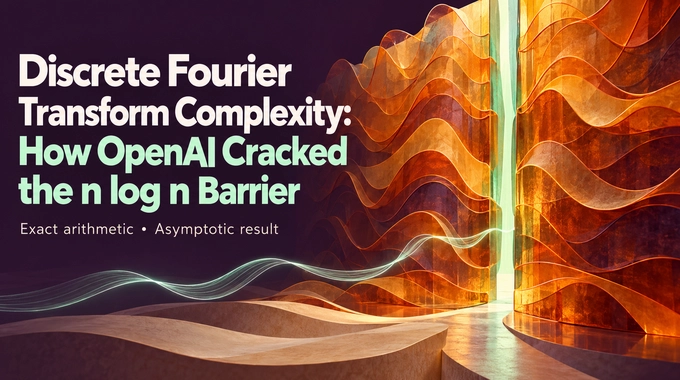
Discrete Fourier Transform Complexity: How OpenAI Cracked the n log n Barrier

Discrete Fourier transform complexity shown as a mint wave passing through a narrow amber barrier.

The Fast Fourier Transform has spent decades turning quadratic calculations into manageable work. OpenAI now presents a proof that discrete Fourier transform complexity can fall below the familiar O(nlog⁡n)O(n\log n) scale, at every input length. The improvement is asymptotic, deterministic, and exact, but it belongs to a computational model with unrestricted complex coefficients and supplied … Read more

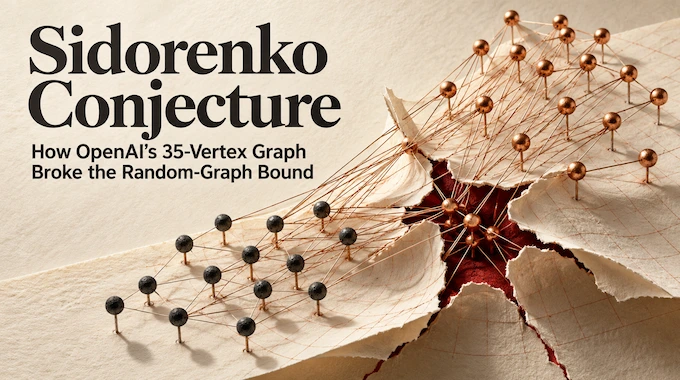
Sidorenko Conjecture: How OpenAI’s 35-Vertex Graph Challenges the Random-Graph Bound

Glowing 35-vertex graph breaking through a glass floor, illustrating the Sidorenko conjecture counterexample

Randomness was supposed to set the floor. For every bipartite pattern, the Sidorenko conjecture predicts that a graph with a given edge density contains at least the pattern density supplied by a uniformly random model. OpenAI’s manuscript claims that a carefully arranged graph can slip beneath that floor. The proposed Sidorenko conjecture counterexample has 35 … Read more

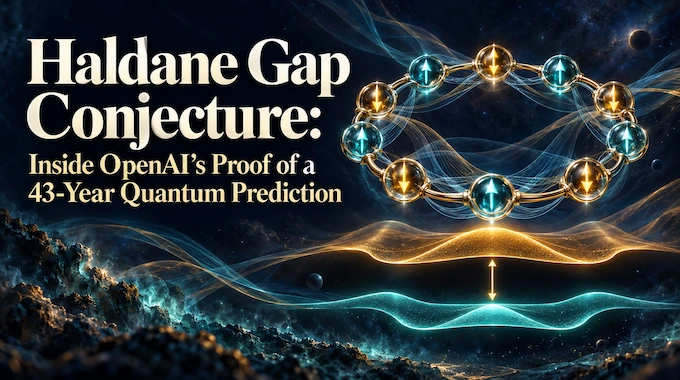
Haldane Gap Conjecture: Inside OpenAI’s Proof of a 43-Year Quantum Prediction

Glowing ring of quantum spins above an energy gap illustrating the Haldane gap conjecture proof

Physicists have spent decades confidently describing an energy gap that mathematicians couldn’t rigorously guarantee for the simplest model behind it. The evidence was strong. The missing step was proving that the gap survives however long the quantum chain becomes. OpenAI’s September 24, 2026 manuscript, The periodic spin-one Haldane gap, presents a proof of that claim … Read more