
A cube needs eight smaller copies to cover it because each copy can reach at most one of its eight corners. For 69 years, the Hadwiger Covering Conjecture asked whether a three-dimensional convex body could do worse. In a November 2026 preprint, Dror Aiger, Sariel Har-Peled and Goran Žužić prove that eight always suffice, even when a body has no symmetry and its boundary mixes curved surfaces, flat faces and sharp edges.
An experimental harness built on Gemini 4 Carbon discovered the proof, which the authors report was formally verified in Lean 4. The argument starts by changing the question. Two opposite directions illuminate most of the surface, and a strict bound on the length of the remaining rim makes six more directions sufficient.
Table of Contents
1. Hadwiger Covering Conjecture and the 69-Year-Old Geometry Problem
Hugo Hadwiger proposed the bound in 1957 for every convex body in -dimensional Euclidean space. A convex body is compact, contains the segment between any two of its points and has nonempty interior. A smaller positive homothet is a copy , formed by multiplying every point by a factor and then translating by a vector . The covering number is the smallest number of such copies whose union contains . The Hadwiger conjecture in graph theory concerns vertex coloring and complete graph minors.
2. Why Eight Copies Are Enough for a Cube but Four for a Sphere
For the unit cube , cover each coordinate interval by and . Take all eight combinations of the two intervals across three coordinates. Each resulting cube is scaled by , and every point belongs to at least one box. Any smaller positive homothetic cube has width less than one along all three coordinate axes. Two distinct original vertices differ by one in at least one coordinate, so no copy can contain both. An invertible affine map transfers the result to every parallelepiped.
On the unit sphere, a direction enters the ball from a boundary point exactly when its dot product with the outward unit normal is negative. Pick four directions pointing toward the vertices of a regular tetrahedron centered at the origin. Their sum is zero and they span three dimensions, so for every normal at least one dot product is negative. Three or fewer directions lie in a closed hemisphere, giving some normal for which all those products are nonnegative. By illumination equivalence, the solid ball therefore needs exactly four copies. At a corner, a direction must move inward across every active supporting plane at once, making the sphere’s single-normal test insufficient for general bodies.
3. The Best 3D Covering Bounds Before the Proof
In 1955, Friedrich Wilhelm Levi proved that four copies suffice in the plane, with equality only for parallelograms. Marek Lassak reached eight in 1984 for centrally symmetric three-dimensional bodies. Ioannis Papadoperakis proved a general bound of 16 in 1999, and Andriy Prymak reduced it to 14 in 2023. A central difficulty was finding an argument that also works for bodies with neither smoothness nor symmetry.
Covering numbers are upper semicontinuous. They can jump upward at the limit. Smooth convex bodies in three dimensions need at most four copies, yet smooth bodies can converge to a cube that needs eight. Along a sequence tending to that cube, the largest scale factor in a four-copy cover can approach one, where the strict shrinkage requirement fails. The proof uses lower semicontinuity of length instead.
4. Gemini 4 Carbon’s Proof Roadmap
The written proof proceeds through six stages, from replacing geometric covers with rays to converting the rays back into a cover.
- Switch to boundary illumination. Look for directions that lead from every boundary point into the interior. A finite set of directions can later be converted into the same number of smaller copies.
- Isolate the shadow boundary. Project the body onto a plane. Two opposite directions do all the work away from the points projecting onto the outline.
- Build a ruler from the body. Take half of every difference of two points in the body. The resulting symmetric set measures how costly each chord is to fit inside a smaller copy.
- Find one short rim. Normalize this ruler with John’s ellipsoid. Average the lengths of polyhedral rims using mean width, then carry a strict bound back to the original body.
- Split the rim into six arcs. Each is short enough that any four points fit in a common smaller copy. Helly’s theorem turns those local fits into a single direction per arc.
- Recover the cover. Add the six arc directions to the two opposite ones and translate the illumination back into eight copies with a common scale.
5. From Covering to Illumination With Boltyanski’s Equivalence
A nonzero vector illuminates , where denotes the boundary, if there is a positive step that takes into the interior.
Place the origin in the interior. If a smaller copy contains , then lies in , which lies strictly inside . For a boundary point, cannot be zero, so is an illumination direction. Conversely, a successful inward step stays successful at every smaller positive step by convexity. With finitely many directions, compactness gives one small step that works throughout when each point can choose its direction. The resulting translates of the open interior cover . The largest, over all points, of the least scale needed in those translates is strictly below one by continuity and compactness. That gives a common shrink factor.
Now project orthogonally along a unit vector onto its perpendicular plane . The shadow boundary consists of the points above the outline of the projection. Above an interior point of the projection, the line parallel to meets the interior of . One of and therefore works at each boundary point on that line. Over the outline, the whole fiber stays out of the interior. The proof must illuminate those fibers with other directions.
6. The Halved Difference Body and Its Minkowski Norm
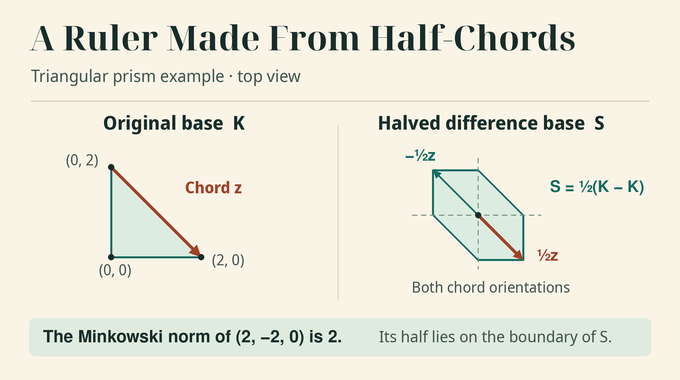
The body may be asymmetric, so it cannot generally serve as the unit ball of a norm. Its halved difference body records every possible half-chord, with both orientations included.
The Minkowski norm is the smallest scale of that reaches a displacement . The symmetry makes reversal cost the same. The variation of a curve is the supremum, over ordered partitions of its parameter interval, of the sums of these chord norms. That definition also handles corners and requires no derivative.
For a triangular prism with base vertices , and and height two, is a hexagonal prism. The reversal of each of the three edge displacements of the base contributes another vertex to the horizontal hexagon after halving. The chord has norm two. Its half lies in , and no smaller scale reaches because the first coordinate of every point of is at most one.
7. Why Helly’s Theorem Gives One Direction Per Short Arc
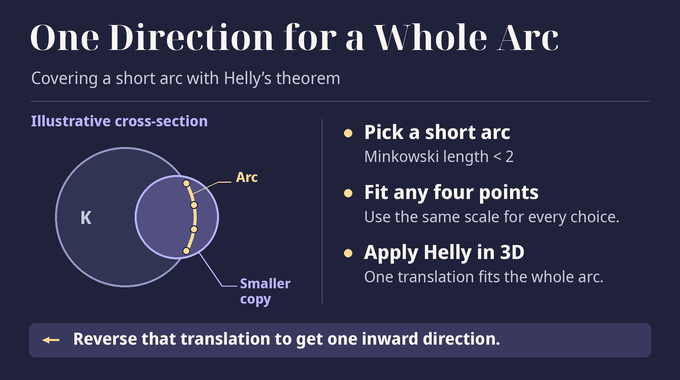
Suppose a boundary arc satisfies the following threshold. Choose at least half its length. A point fits in exactly when belongs to the compact convex set .
Helly’s theorem in three dimensions says that a finite family of convex sets intersects if every subfamily of at most four intersects. Compactness extends this to the family of allowed translations along the entire arc. Take four points in travel order. Consecutive chords are for and . Their weights sum to at most because the three chords use at most the arc’s total variation.
Set . Then uses all three terms. Moving to swaps only the first for its corresponding . Each subsequent step swaps one more term. Fill the unused weight up to with the origin, which lies inside . Every shifted point is therefore in by convexity. This is the telescoping step of Lemma 3.4. Helly gives one translation for the entire arc, and its negative illuminates every point on it.
8. John’s Ellipsoid and the Mean-Width Inequality
An invertible linear map sends the maximum-volume inscribed ellipsoid of to the unit ball . Apply the same map to , which preserves its covering number, and keep the same notation for the normalized bodies. Since , the Minkowski norm is bounded above by Euclidean length. Maximality also forces contact vectors on the unit sphere with positive weights satisfying John’s decomposition. Here is an outer product and is the identity matrix.
Taking traces gives . At each contact, for every . Expanding the dot product with the identity above bounds the support function by . Each absolute dot product averages to over the unit sphere with normalized area measure . The average support is therefore at most .
Equality in the average forces pointwise equality by continuity. Evaluating at the contact directions and comparing absolute inner products with their squares forces distinct contact axes to be orthogonal. The support function then matches that of a rotated cube. If is a cube, the extreme differences between opposite vertices force itself to have all eight vertices of its bounding cube in those coordinates. Thus when is any non-parallelepiped, the estimate is strict.
9. How the Length Bound Survives Polyhedral Approximation
Enclose in polytopes with . For a generic projection direction, a polyhedral shadow rim follows edges whose two adjacent face normals have opposite signs when dotted with that direction. Average the projected edge lengths using Cauchy’s planar perimeter formula. The paper then accounts for edge foreshortening to show that the average Euclidean length of the lifted rim equals eight times the spherical average support of the polytope’s halved difference body. Since that body lies inside , and -length is bounded by Euclidean length, the limiting average is at most for some .
Theorem 4.4 excludes directions parallel to nontrivial boundary segments. Flat faces contribute only a countable union of great circles. For other segments, convex planar slices let the authors organize the directions into countably many Lipschitz curve images. Both families have spherical measure zero. In a remaining direction, each fiber above the projection’s outline has just one point. Fatou’s lemma finds one such direction in which the lower limit of the polyhedral rim lengths is at most . The projected outlines converge along every radial angle, and the singleton fibers force the lifted points to converge too. For any fixed partition, its finite chord sum passes to the limit. Taking the supremum over partitions gives the length bound on the original shadow curve .
10. The Final Hadwiger Covering Conjecture Proof and Why 2 + 6 = 8
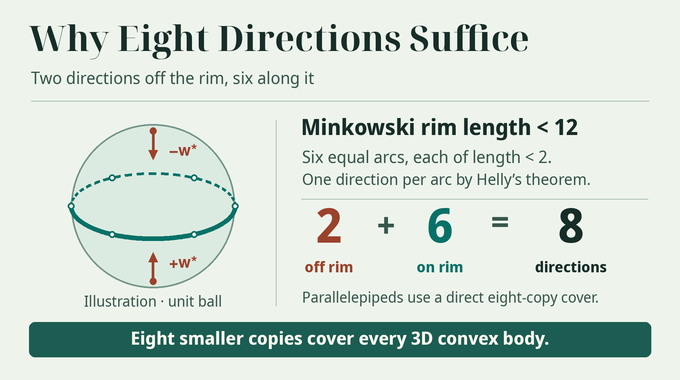
Cumulative length along the original rim varies continuously, so the authors mark off six consecutive pieces of equal -length. Each measures one sixth of the total and therefore less than two. Lemma 3.4 gives one inward direction per piece, and and handle everything else. Boltyanski’s equivalence gives eight smaller copies in the normalized coordinates. Undoing the affine map gives the theorem in the original coordinates, with translation vectors and one common scale.
The strict inequality matters. Six equal pieces of a rim of length exactly 12 would reach the cutoff of two. The direct cube construction handles the parallelepipeds that can attain the mean-width equality, and their eight vertices make the universal bound optimal.
11. How the Gemini 4 Carbon Proof Was Verified in Lean 4
The authors report that an experimental Gemini 4 Carbon harness discovered the proof with minimal steering from Aiger and Žužić. An agentic harness using the same model produced the Lean formalization. All three authors checked the mathematics and prepared the manuscript. The paper gives this division of work and the finished proof, without a step-by-step discovery log.
Appendix A reproduces an 18-line standalone Lean statement. It uses Mathlib’s definitions of compactness, convexity and interior, then requires a common real scale strictly between zero and one and one translation for each of eight indices. The printed challenge ends in “sorry”, Lean’s placeholder for a proof. The authors report that comparator checked the separate complete solution against that statement in Lean’s kernel. Their reported formalization spans 13,725 lines across 34 files, with zero unproved steps and only the standard Lean axioms propext, Classical.choice and Quot.sound. Kernel checking establishes that the formal proof proves the encoded theorem. Peer review also evaluates the mathematical exposition, attribution and significance.
12. What the Proof Resolves and Why Higher Dimensions Remain Open
In three dimensions the projected outline is a planar loop whose lift can be split into arcs. A higher-dimensional projection has a higher-dimensional boundary. Cutting it into patches with small diameters does not supply the ordered chord chain that makes the Helly argument work, and the three-dimensional mean-width calculation does not supply the needed estimate there. The paper settles the Hadwiger Covering Conjecture in three dimensions. The corresponding bound in dimensions four and above remains open.
Picture satellites sending parallel rays from far away. The picture helps to locate the two sides and the rim, but the proof tests whether a ray enters the interior, even at a sharp corner. Its decisive move is to find a rim short enough to finish with six directions using a ruler built from the body itself. Follow Binary Verse AI for more analyses of AI-assisted mathematical discovery.
What is Hadwiger’s covering conjecture?
Hadwiger’s covering conjecture states that every convex body in -dimensional Euclidean space can be covered by at most strictly smaller positive homothetic copies of itself. In three dimensions, eight smaller copies suffice.
Has Gemini 4 Carbon solved Hadwiger’s covering conjecture?
Yes, in three dimensions. A November 2026 preprint presents a complete proof discovered using an experimental Gemini 4 Carbon harness and formally verified in Lean 4, according to the authors. Higher dimensions are outside the scope of the proof.
Why are eight copies necessary when a sphere requires only four?
Eight is the optimal universal bound. A cube has eight vertices, and each strictly smaller positive homothetic cube can contain at most one original vertex. A solid ball needs only four copies because four tetrahedral directions suffice to illuminate its boundary.
How did Gemini 4 Carbon prove Hadwiger’s covering conjecture?
The proof recasts covering as boundary illumination. For a body other than a parallelepiped, it finds a shadow boundary of Minkowski length less than 12. Helly’s theorem provides one direction for each of six short arcs, and two opposite directions illuminate the rest.
Is Gemini’s Hadwiger conjecture proof verified in Lean?
The authors report formal verification of the theorem and its proof in Lean 4 with Mathlib. The solution spans 13,725 lines across 34 files and has no unproved steps. The paper’s ancillary files contain the formalization.
Is Hadwiger’s covering conjecture the same problem that OpenAI addressed?
The two problems are distinct. Hadwiger’s covering conjecture is about covering convex bodies with smaller copies. Hadwiger’s graph theory conjecture concerns vertex coloring and complete graph minors.
Does the proof solve Hadwiger’s covering conjecture in four or more dimensions?
The proof settles the three-dimensional case. Its shadow-boundary length estimates and arc decomposition depend on three-dimensional geometry. The paper does not establish the required higher-dimensional generalizations.