
Gravity presents quantum theory with an awkward question. If the geometry itself fluctuates, what tells you where an experiment happened? Venkatesa Chandrasekaran’s November 2026 preprint proposes a quantum gravity theory in which intersecting light cones carry their own reference frames. He solves the classical constraints on those boundaries before quantizing their remaining degrees of freedom. The resulting construction gives a finite answer for a specific graviton-pair process that diverges when expanded term by term. It also yields a finite-dimensional state space for a bounded macroscopic causal diamond under the paper’s assumptions. The same framework recovers black hole entropy and the one-loop semiclassical Einstein equations.
Table of Contents
1. Quantum Gravity Theory: What Has the New Research Achieved?
In An algebraic quantization of gravity from the null cone, Chandrasekaran starts with four-dimensional Lorentzian vacuum general relativity and keeps Newton’s constant finite. Physical locations are specified relative to gravitational boundary data that belong to the system being quantized.
The acknowledgements report months of back-and-forth with GPT-6 Astra on several calculations and proofs, using about 400 million tokens in total. The roadmap follows the mathematical derivation. The preprint gives no step-by-step account of the model’s contributions or experimental test.
2. Why Quantizing Gravity Has Remained So Difficult
Conventional quantum field theory uses a background metric to specify distances and causal relations. General relativity makes that metric dynamical, so coordinates alone cannot identify the same physical event across fluctuating geometries. Expanding the Einstein–Hilbert action about a chosen metric gives a low-energy theory of gravitons. In perturbative quantum gravity, the ultraviolet problem appears at two loops in pure gravity. The on-shell divergence requires a new counterterm cubic in curvature. Renormalizing the original couplings cannot absorb it.
String theory replaces pointlike interactions with splitting and joining strings. Exact amplitudes on general fluctuating finite boundaries are beyond its perturbative expansion. Loop quantum gravity uses spatial slices, where obtaining a slicing-independent physical inner product for general boundary states remains open. AdS/CFT supplies a nonperturbative description in settings with a boundary field theory dual.
3. The New Quantum Gravity Approach: A Roadmap of the Proof
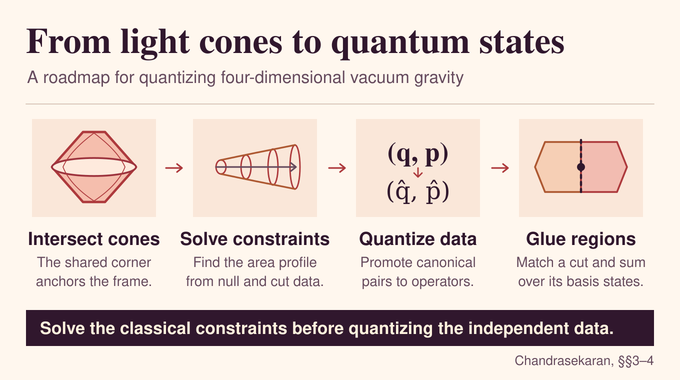
- Use light to define the region. Intersect two null boundaries. Their shared corner provides a frame for specifying where measurements act as the metric changes.
- Solve the classical constraints. Once the freely specifiable radiation and suitable cut data are given, integrate the null equations along the light rays to determine constrained quantities such as the area profile.
- Keep the independent variables. Remove gauge redundancies while retaining the boundary frame variables needed to compare adjoining regions. The resulting phase space gives the canonical brackets and Hamiltonian.
- Turn preparations into quantum states. Quantize the canonical pairs and use source deformations to build observables. Choose a state on that algebra to define a physical inner product.
- Join regions through their common states. Match boundary data, then insert a complete basis at an intermediate cut. Unitary evolution supplies the norm bound that controls the sum.
- Count bounded states and test the classical limit. Focusing links the clock bound to area and radiation. Corner boosts then give entropy weights, and coherent states recover Einstein dynamics through one loop.
4. Why Light Cones Hold the Key to Quantizing Spacetime
A causal diamond is the overlap of the causal future of an earlier event and the causal past of a later one. Lightlike rays called null generators trace its boundaries. Trim the tips with spacelike caps and set each ray’s affine parameter to zero at its cap, with scale fixed by gravitational data there. The value at the corner is the clock reading. It can fluctuate with geometry even though the ray’s proper time is zero.
The paper first tests the idea in two-dimensional Jackiw–Teitelboim gravity coupled to a massless scalar. Varying the diamond’s width changes the clock reading while leaving the curvature fixed. With the corner dilaton and matter state fixed, clock wavefunctions can share one probability distribution. Phases built from integer Fourier modes of the cumulative probability make them orthogonal. Even a finite interval of readings therefore allows infinitely many independent states. Four-dimensional shear supplies the missing link. Radiation focuses the light rays and increases the affine distance needed to reach a given corner area element.
5. From Einstein’s Action to the Reduced Gravitational Phase Space
The tetrad defines orthonormal frames and the metric. The spin connection transports vectors between frames. Its curvature couples to a two-form that, if unrestricted, would give a topological theory. The simplicity constraint makes it the internal Hodge dual of a wedge product of tetrads, restoring general relativity for an invertible tetrad. The connection equation enforces zero torsion. With no derivatives, the simplicity term adds no boundary variation.
On a null sheet, the vacuum Raychaudhuri equation (3.25e) relates expansion to shear , the shape distortion of a thin bundle of rays. The vector is the affinely normalized tangent. The Lie derivative along that tangent gives the expansion’s rate of change.
Shear contributes with the same focusing sign as the squared expansion. Fix the conformal two-metric along a generator and the initial area element and its slope, and the equation fixes the area profile. In Sections 3.3–3.5 and Appendices A–B, pulling the symplectic form back to the constraint surface and factoring out simultaneous gauge transformations yields Poisson brackets for the surviving radiation and edge modes, the variables tracking the position and orientation of the boundary frame. At the corner, for example, the local area element supplies momentum conjugate to a frame boost. The reduced Hamiltonian generates cap displacements. The boundary frame locates a shear measurement and specifies its polarization across varying geometries.
6. Turning Classical Spacetime Into a Quantum Algebra
For canonical coordinates and momenta , the Poisson brackets become commutators. The Kronecker delta selects identical modes, and is the reduced Planck constant.
At fixed corner area, applying creation operators to the Gaussian reference state gives an orthonormal basis of occupation-number states. To describe insertions that change area, evolve with a source, then undo evolution with the source off. Varying the source inserts the observable defined relative to the boundary frame.
The author chooses a pure extension of the fixed-area Gaussian state to the full algebra. The Gelfand–Naimark–Segal (GNS) construction defines the overlap of preparations and using the adjoint of the first.
Quotienting out zero-norm vectors and completing gives the physical Hilbert space. Purity makes the representation irreducible. The generated von Neumann algebra contains all bounded operators on this space, making it a type I factor. Under the admissibility conditions on the action deformation, evolution between caps is unitary because left multiplication by the evolution operator preserves this inner product (Equations 4.16–4.19).
7. How the New Quantum Gravity Theory Tackles Ultraviolet Divergences
In the Lorentzian path integral, opposite orientations cancel the matched cap’s boundary terms. Insert an orthonormal basis at the cap to compose the amplitudes. The two factors in each term are components of a forward-evolved ket and a backward-evolved ket from the final state. Their coefficient sequences are square summable, so Cauchy–Schwarz bounds the absolute sum by the product of the original state norms (Equation 4.30). A finite subdivision admits a similar truncation bound.
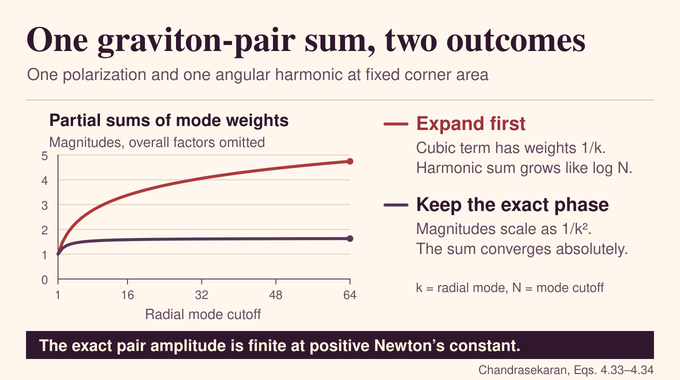
The ultraviolet test fixes the corner area , one polarization and one angular harmonic. A quadratic insertion creates two gravitons in a radial mode , and a second insertion annihilates the pair with phase . Here and is Newton’s constant. With variance , the two connected contractions give the series in Equation 4.33. Here is the dilogarithm.
With a cutoff at mode , the first phase correction, , cancels one factor of in the denominator. The resulting cubic term in now contains the harmonic sum.
Taking to infinity now gives the harmonic divergence. Summing the exact phases first keeps the absolute weights proportional to . Even at very weak coupling, modes with comparable to have order-one phases. Expanding at fixed mode misses that part of the sum. Expanding the exact result gives the finite term at positive coupling. General ultraviolet completeness remains open.
8. Does a Finite Region of Spacetime Contain Finite Quantum Information?
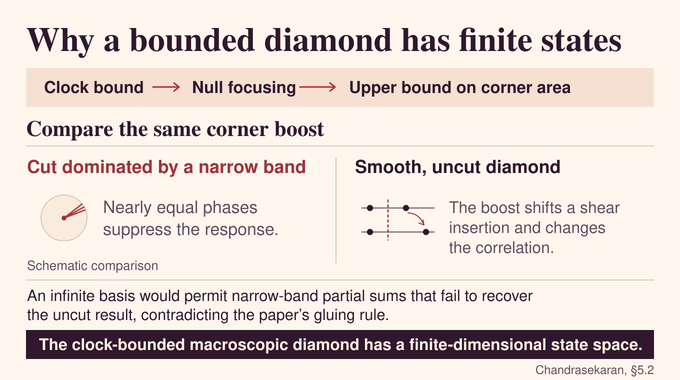
The clock projection preserves coherence within the allowed interval. Focusing then bounds the corner area by (Equation 5.21d), where is the clock limit and fixes the cap cutoff. A bounded operator can still have infinitely many states in its spectrum. The proof compares one corner boost with and without an internal cut.
Area generates the boost. In a narrow area band, all boost phases are almost equal, so an observable’s expectation changes very little if nearly all its weight lies in that band. On the smooth, uncut geometry, the same boost shifts one of two shear insertions along the ray. It changes their correlation by a calculable amount (Equation 5.29). The smearing width lies between the Planck length and the insertion separation, itself below the corner and curvature scales.
If the physical space were infinite-dimensional, the bounded area range could be partitioned into finitely many narrow bands, one containing as many basis vectors as the full space. Order the basis in finite cycles with at most one outsider per cycle. The trace weights are bounded above and away from zero, so long cycles force each finite partial preparation to be dominated by the narrow band. Subtracting half the reference boost signal from the bounded observable gives nonpositive partial amplitudes but a strictly positive uncut amplitude. Diffeomorphism-invariant gluing must recover that positive value, a contradiction. The finite-dimensional space has finitely many area eigenvalues (Equations 5.39–5.40). Their discreteness is a property of the projected diamond.
9. Deriving Black Hole Entropy From Quantum Gravity
A marginally trapped surface has zero outward null expansion and negative inward expansion. The condition uses local data, so the entropy calculation need not determine the full spacetime event horizon. Gluing a half-diamond to its time reflection cancels unitary evolution. Continuing the corner boost around a full turn leaves each area eigenstate with weight .
The density operator is the exponential of divided by its trace over the bounded diamond. Substituting its logarithm into the von Neumann entropy gives Equation 5.50.
Weighted multiplicities correct the Bekenstein–Hawking area term. For a large Schwarzschild black hole, the paper first estimates it at a fixed clock bound. To count states at fixed mass, it undoes the area weight and changes variables from area to mass. The Jacobian subtracts one half from the logarithmic coefficient. In Equation 5.69, for Schwarzschild mass , and is the exponent obtained from the clock and one-loop analysis.
That is the coefficient of at fixed mass with angular momenta summed. Sen’s Euclidean calculation gives multiplying the logarithm of a length scale in this ensemble. Since area scales as length squared, the results agree.
10. Quantum Spacetime, Entanglement and the ER = EPR Connection
With a single boundary, adding more distinct fillings than the dimension yields a zero-norm linear combination. With two boundaries fixed, a connected interior defines a matrix of overlaps with product preparations made by filling each boundary separately. Gluing the connected filling to its reflection gives a squared norm equal to the sum of the squared matrix entries. Subtract the corresponding product-state superposition from the connected preparation and the difference has zero norm (Equation 5.73). In the physical Hilbert space both descriptions therefore represent one state.
This realizes the algebraic criterion for ER = EPR discussed by McNamara and Wang. A spatial bridge can have an equivalent description as an entangled state on disconnected components. A two-sided Schwarzschild example reproduces the shear correlation on disconnected components without enabling signal transmission.
11. How Einstein’s Equations Emerge From Quantum Spacetime
For a coherent state peaked on smooth data, the canonical means follow the reduced Hamiltonian trajectory as tends to zero. Invariance under interior field shifts gives the vacuum Einstein equations in each region. Matching at cuts assembles the solutions.
At one loop the mean graviton fluctuation vanishes, but its covariance propagates by the linearized equations, including changes in the frame used to locate the metric. The quadratic Einstein tensor provides a conserved, retarded source for the mean geometry. Appendix D checks the one-loop generating functional against constrained general relativity with the same boundary conditions.
In Equation 6.13, is the mean metric, is the Einstein tensor plus the cosmological term, and the expectation of its quadratic part is taken with the graviton two-point function for fluctuations . Recovering this source checks that the boundary construction reproduces gravitational backreaction in the regime where the loop expansion applies.
12. Has Quantum Gravity Finally Been Solved?
This quantum gravity theory defines a physical inner product and a gluing rule for fluctuating boundaries. Convergence relies on normalizability and unitarity. Finite dimension additionally requires the clock bound and the macroscopic boost-correlation estimates. The equivalence of different pure-state extensions remains open. Coupling the four-dimensional vacuum theory to realistic matter and finding distinctive experimental tests remain open.
Quantizing the clock alongside the geometry turns focusing into a restriction on how many independent quantum states a diamond can hold. Follow Binary Verse AI for more research explainers grounded in the original papers.
Has GPT-6 Astra solved quantum gravity?
GPT-6 Astra helped Chandrasekaran develop several calculations and proofs for a proposed background-independent quantization of four-dimensional vacuum gravity. The results apply within that construction. Experimental confirmation and a theory that incorporates realistic matter remain open.
How does the new quantum gravity theory work?
The proposal uses intersecting light cones with dynamical geometry. It solves classical gravitational constraints on their boundaries, turns the remaining data into quantum observables, and composes amplitudes across neighboring regions by matching and summing over states on shared cuts.
Why is quantum gravity so difficult to solve?
General relativity makes the geometry of spacetime dynamical, whereas conventional quantum field theory generally starts with a specified background. Expanding pure general relativity around a fixed metric also generates ultraviolet divergences that require couplings beyond those in the original action.
Does the new quantum gravity theory eliminate infinities?
For a specific graviton-pair process, the paper gives a finite amplitude at positive Newton’s constant even though expanding before summing produces a logarithmic ultraviolet divergence. It also shows absolute convergence of the gluing sum for normalizable states under unitary evolution. General ultraviolet completeness remains open.
Does the research prove that spacetime is discrete?
It derives a discrete corner-area spectrum for a bounded macroscopic causal diamond under the framework’s assumptions. The spectrum belongs to that region’s projected Hilbert space. A universal spacetime lattice does not follow.
How does this theory differ from string theory and loop quantum gravity?
The proposal begins with four-dimensional general relativity and introduces no fundamental strings. It quantizes reduced gravitational data on null boundaries, using gravitational clocks and an observable algebra. In the comparison made in the paper, loop quantum gravity starts with connection and triad variables on a spacelike slice.
Can the new quantum gravity theory be experimentally verified?
The paper establishes theoretical checks, including the black hole area law and recovery of the semiclassical Einstein equations through one loop. It proposes no decisive experiment that would distinguish the framework from competing quantum gravity theories.