Discrete Fourier Transform Complexity: How OpenAI Cracked the n log n Barrier
Discrete Fourier transform complexity shown as a mint wave passing through a narrow amber barrier.

The Fast Fourier Transform has spent decades turning quadratic calculations into manageable work. OpenAI now presents a proof that discrete Fourier transform complexity can fall below the familiar O(nlog⁡n)O(n\log n) scale, at every input length. The improvement is asymptotic, deterministic, and exact, but it belongs to a computational model with unrestricted complex coefficients and supplied … Read more
Edit Distance Approximation: OpenAI’s Almost-Linear Proof Meets the DNA Reality Check

Edit distance approximation concept: glowing DNA strands crossing a grid with a narrow light path

Comparing two strings sounds like a small job. Then the strings become long, insertions shift everything sideways, and a simple comparison becomes a search through millions of possible alignments. OpenAI’s September 24, 2026 manuscript tackles that cost with an edit distance approximation that combines almost-linear expected runtime with accuracy arbitrarily close to exact, provided the … Read more

Sidorenko Conjecture: How OpenAI’s 35-Vertex Graph Challenges the Random-Graph Bound

Glowing 35-vertex graph breaking through a glass floor, illustrating the Sidorenko conjecture counterexample

Randomness was supposed to set the floor. For every bipartite pattern, the Sidorenko conjecture predicts that a graph with a given edge density contains at least the pattern density supplied by a uniformly random model. OpenAI’s manuscript claims that a carefully arranged graph can slip beneath that floor. The proposed Sidorenko conjecture counterexample has 35 … Read more

Haldane Gap Conjecture: Inside OpenAI’s Proof of a 43-Year Quantum Prediction

Glowing ring of quantum spins above an energy gap illustrating the Haldane gap conjecture proof

Physicists have spent decades confidently describing an energy gap that mathematicians couldn’t rigorously guarantee for the simplest model behind it. The evidence was strong. The missing step was proving that the gap survives however long the quantum chain becomes. OpenAI’s September 24, 2026 manuscript, The periodic spin-one Haldane gap, presents a proof of that claim … Read more

Erdős–Turán Conjecture: How OpenAI Tackled the Arithmetic Progression Barrier

Erdős–Turán conjecture feature image: sparse glowing integers forming an evenly spaced chain through a barrier

A set of numbers can become vanishingly sparse and still carry enough arithmetic weight to force patterns. That’s the striking promise of the Erdős–Turán conjecture: if the reciprocals of a set’s positive integers add up without bound, the set must contain equally spaced sequences of every finite length. OpenAI’s Quasipolynomial Bounds for Arithmetic Progressions, dated … Read more

Vlasov Maxwell System: How OpenAI Tackled a Decades-Old Plasma Physics Problem

Vlasov Maxwell system concept art: glowing plasma particles and a light cone with cancelling force arrows

A plasma can behave chaotically without its governing equations becoming mathematically singular. Proving that distinction, however, has defeated researchers working on the Vlasov Maxwell system for decades. In a 49-page manuscript dated September 23, 2026, OpenAI presents a proof of global existence, uniqueness, and smoothness for a three-dimensional relativistic plasma model with arbitrarily large smooth … Read more

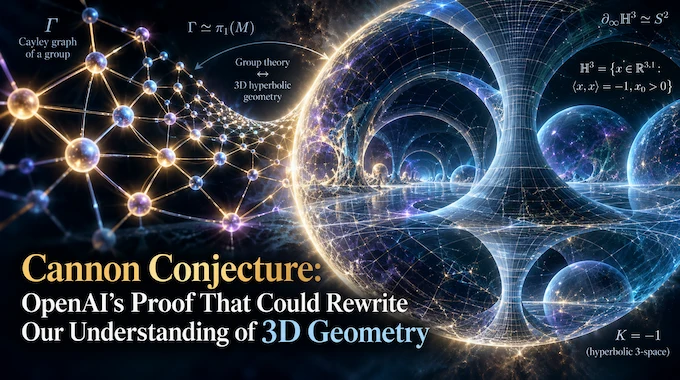
Cannon Conjecture: OpenAI’s Proof That Could Rewrite Our Understanding of 3D Geometry

Cannon Conjecture feature image: glowing sphere boundary revealing a hyperbolic 3D tiling

Can the shape of an abstract group’s boundary reveal the three-dimensional geometry hidden inside it? That question has driven research into Cannon Conjecture, one of geometric group theory’s most important longstanding problems. It asks whether every word-hyperbolic group whose boundary at infinity resembles a two-dimensional sphere must admit a geometric action on hyperbolic three-space. On … Read more