Sidorenko Conjecture: How OpenAI’s 35-Vertex Graph Challenges the Random-Graph Bound
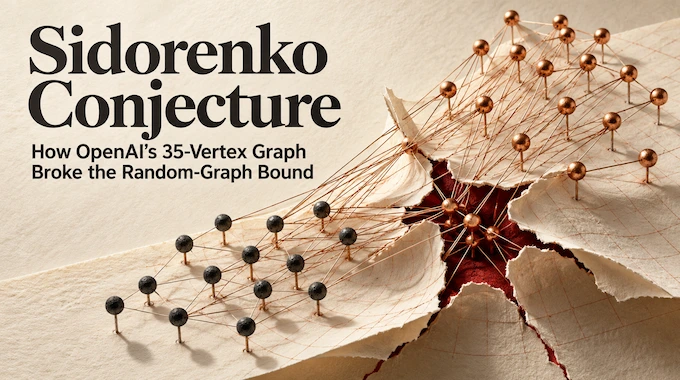
Glowing 35-vertex graph breaking through a glass floor, illustrating the Sidorenko conjecture counterexample

Randomness was supposed to set the floor. For every bipartite pattern, the Sidorenko conjecture predicts that a graph with a given edge density contains at least the pattern density supplied by a uniformly random model. OpenAI’s manuscript claims that a carefully arranged graph can slip beneath that floor. The proposed Sidorenko conjecture counterexample has 35 … Read more
Haldane Gap Conjecture: Inside OpenAI’s Proof of a 43-Year Quantum Prediction

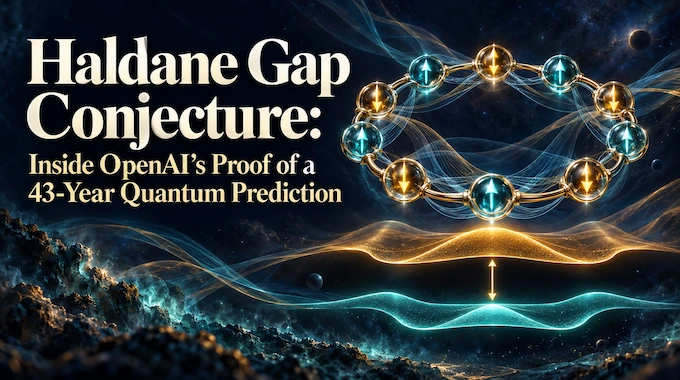
Glowing ring of quantum spins above an energy gap illustrating the Haldane gap conjecture proof

Physicists have spent decades confidently describing an energy gap that mathematicians couldn’t rigorously guarantee for the simplest model behind it. The evidence was strong. The missing step was proving that the gap survives however long the quantum chain becomes. OpenAI’s September 24, 2026 manuscript, The periodic spin-one Haldane gap, presents a proof of that claim … Read more

Erdős–Turán Conjecture: How OpenAI Tackled the Arithmetic Progression Barrier

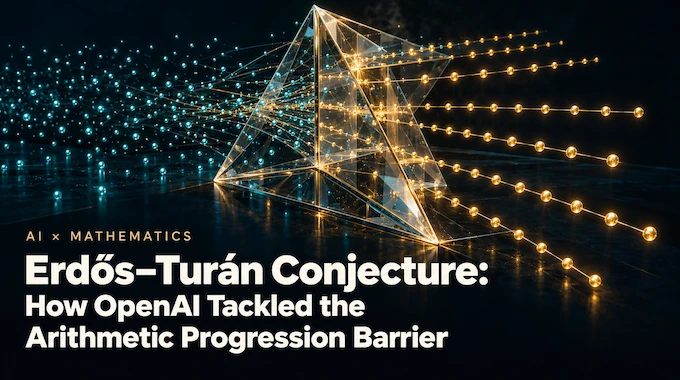
Erdős–Turán conjecture feature image: sparse glowing integers forming an evenly spaced chain through a barrier

A set of numbers can become vanishingly sparse and still carry enough arithmetic weight to force patterns. That’s the striking promise of the Erdős–Turán conjecture: if the reciprocals of a set’s positive integers add up without bound, the set must contain equally spaced sequences of every finite length. OpenAI’s Quasipolynomial Bounds for Arithmetic Progressions, dated … Read more

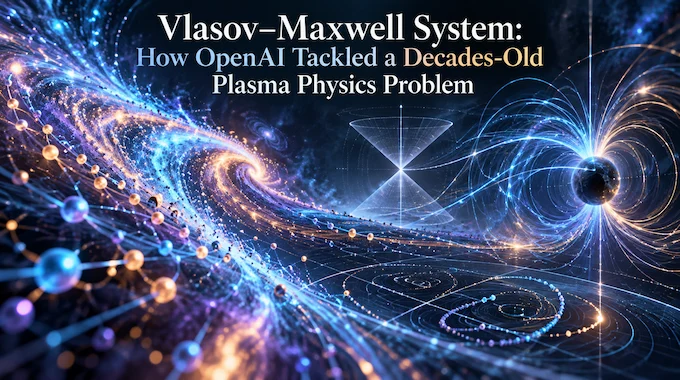
Vlasov Maxwell System: How OpenAI Tackled a Decades-Old Plasma Physics Problem

Vlasov Maxwell system concept art: glowing plasma particles and a light cone with cancelling force arrows

A plasma can behave chaotically without its governing equations becoming mathematically singular. Proving that distinction, however, has defeated researchers working on the Vlasov Maxwell system for decades. In a 49-page manuscript dated September 23, 2026, OpenAI presents a proof of global existence, uniqueness, and smoothness for a three-dimensional relativistic plasma model with arbitrarily large smooth … Read more

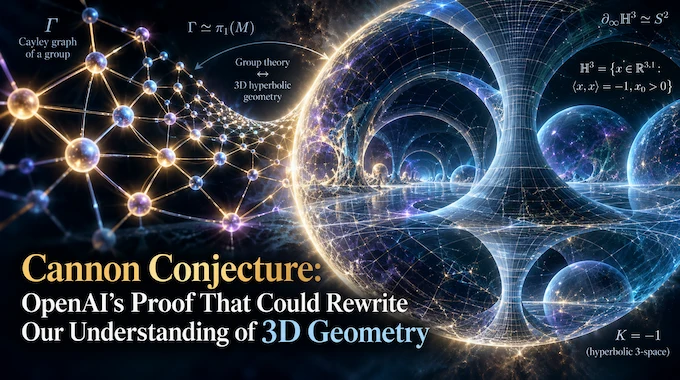
Cannon Conjecture: OpenAI’s Proof That Could Rewrite Our Understanding of 3D Geometry

Cannon Conjecture feature image: glowing sphere boundary revealing a hyperbolic 3D tiling

Can the shape of an abstract group’s boundary reveal the three-dimensional geometry hidden inside it? That question has driven research into Cannon Conjecture, one of geometric group theory’s most important longstanding problems. It asks whether every word-hyperbolic group whose boundary at infinity resembles a two-dimensional sphere must admit a geometric action on hyperbolic three-space. On … Read more

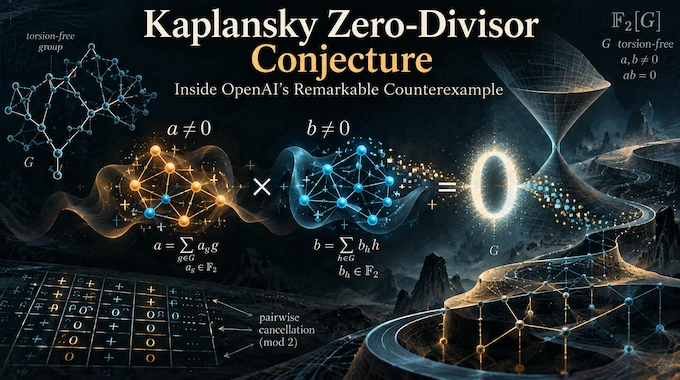
Kaplansky Zero-Divisor Conjecture: Inside OpenAI’s Remarkable Counterexample

Two glowing graphs multiplying to zero, illustrating the Kaplansky Zero-Divisor Conjecture counterexample

For decades, mathematicians had good reasons to believe that a certain kind of algebra could never contain zero divisors. The argument seemed plausible: remove finite-order elements from the underlying group, and the familiar route to producing those troublesome products disappears. But plausibility isn’t a proof. On September 23, 2026, OpenAI released A Torsion-Free Group Algebra … Read more

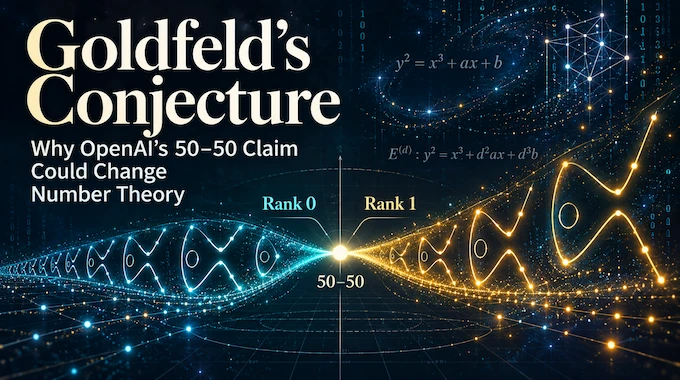
Goldfeld’s Conjecture: Why OpenAI’s 50–50 Claim Could Change Number Theory

Goldfeld’s Conjecture visualized as a balanced teal and amber coin on a glowing elliptic curve

An infinite collection of equations, a coin-flip prediction, and a proof that has resisted mathematicians for decades. Goldfeld’s Conjecture sounds deceptively tidy: take one elliptic curve, build its quadratic twists, and analytic ranks zero and one should each appear half the time. The average should approach one-half. OpenAI now claims arguments establishing both conclusions for … Read more