
Artificial super intelligence used to live in the same mental drawer as warp drives, brain uploads, and dinner with a friendly robot butler. Google DeepMind’s recent “From AGI to ASI” paper changes the mood. It doesn’t claim the machine gods arrive next Tuesday. It maps the terrain after human-level AGI, where systems may stop looking like clever chatbots and start looking like fast, copyable, tireless research organizations.
The serious question is no longer only “Can we build AGI?” It’s “What happens if AGI becomes cheap, numerous, coordinated, and useful for building its successor?” The answer may define the next century, and ruin many confident podcast takes.
Table of Contents
1. What Is Artificial Super Intelligence, Really?
At its simplest, artificial super intelligence means general machine intelligence that exceeds human capability across nearly every domain that matters. Not chess. Not protein folding. Those are narrow superhuman skills. The DeepMind paper sets a much higher bar: a system, possibly a huge collective of systems, that outperforms large groups of expert humans working together over long periods.
That definition shifts the benchmark from “smarter than one genius” to “better than a well-funded civilization-shaped committee.” Think thousands of elite researchers, engineers, strategists, operators, and analysts coordinating for years, then ask whether a machine collective could beat that.
Artificial Super Intelligence Compared With AI, AGI And Universal AI
| Stage | Practical Meaning | What Makes It Different |
|---|---|---|
| AI | Software that performs specific cognitive tasks well | Narrow capability, often brittle outside its training zone |
| AGI | A system roughly at median human level across broad cognitive work | General usefulness across many tasks, not just one benchmark |
| ASI | Artificial super intelligence: a system or collective that beats large expert human groups across most domains | Superhuman breadth, speed, memory, coordination, and scale |
| Universal AI | The theoretical upper bound of machine intelligence | A mathematical ideal, useful for thinking, not something we can run |
This is why artificial super intelligence is not just “a smarter model.” It is cognitive infrastructure. A single model may be part of it, but the real object could look more like a distributed company made of agents, tools, memories, simulators, markets, labs, and feedback loops.
2. AI Vs AGI Vs ASI: The Goalposts Without The Fog Machine
The phrase ai vs agi vs asi is popular because the terms get thrown around like confetti.
AI is what we already have: systems that classify, generate, predict, recommend, translate, code, search, summarize, and sometimes hallucinate with the confidence of a junior consultant. Powerful, useful, uneven.
AGI is the point where a machine becomes broadly competent across the kinds of cognitive tasks humans do. It doesn’t need to be the best human. The DeepMind paper frames it around median human-level performance across most cognitive work. That is not a low bar when you give the system instant recall, tool access, infinite patience, and the ability to run many copies.
Artificial super intelligence is the next step up. It’s not merely AGI with a nicer suit. It’s the moment when the system or collective surpasses what human expert organizations can do. The “organization” part is crucial. Humans are impressive partly because we stack minds into institutions. Science is not one brain. It is a species-level distributed debugging process with grant proposals.
3. How Do We Get There? The Four Pathways
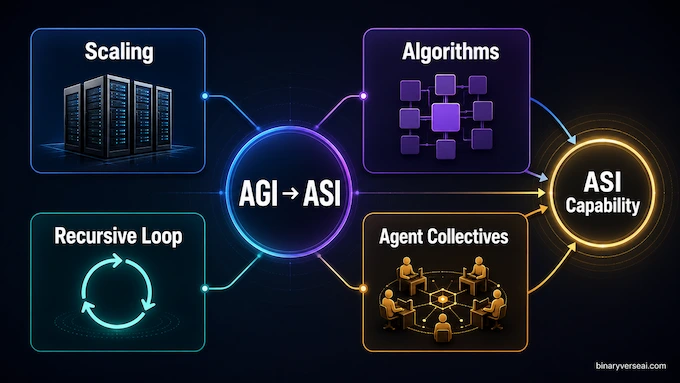
DeepMind lays out four pathways from AGI to ASI. They are not mutually exclusive. In practice, they may compound.
Artificial Super Intelligence Pathways From AGI To ASI
| Pathway | Core Idea | Main Risk Or Uncertainty |
|---|---|---|
| Scaling | More compute, more data, larger or more numerous models | Diminishing returns, cost, energy, and data limits |
| Algorithmic Shifts | New architectures, training methods, memory, planning, or world models | Hard to forecast because breakthroughs do not send calendar invites |
| Recursive Improvement | AI accelerates AI research, data generation, hardware design, and tooling | Could explode, plateau, or crawl depending on bottlenecks |
| Multi-Agent Collectives | Artificial super intelligence emerges from coordinated groups of AGI agents | Coordination, incentives, reliability, and emergent behavior are poorly understood |
3.1 Scaling Compute, Data, And Models
Scaling is the least romantic pathway, which is exactly why it keeps working. More chips, larger training runs, better data pipelines, more test-time compute, and more model instances have repeatedly turned “impossible” into “demo on X by Friday.”
The DeepMind paper points to effective compute as the important quantity. Effective compute is not just raw hardware. It includes better chips, bigger investment, and algorithmic efficiency. If the same result costs ten times less next year, that’s functionally like owning ten times more hardware.
For artificial super intelligence, scaling can work in two ways. Individual models may get smarter. Or, even if individual models plateau, we may simply run enormous numbers of AGI-level agents. A million competent digital workers that think faster than humans and share context at high bandwidth is not “just scaling.” It’s a new labor market made of math.
The catch is physical. Scaling needs power, cooling, chips, fabs, networking gear, land, capital, and rare materials. Intelligence may be software, but it sends a very real electricity bill.
3.2 Algorithmic Paradigm Shifts
Current frontier AI is largely built around transformer-style foundation models, prediction objectives, instruction tuning, reinforcement learning, retrieval, tool use, and test-time reasoning. That stack is powerful. It’s also probably not the final form of intelligence, just as steam engines were not the final form of transportation.
Algorithmic shifts could include better memory systems, continual learning, world-model agents, new sequence architectures, more efficient search, neuromorphic hardware, analog compute, or training methods that learn from interaction rather than static text. Some may be evolutions of what we already do. Others may be genuine breaks.
This is the hardest pathway to forecast because breakthroughs are rude. They arrive after years of “not much,” then make everyone rewrite their slides. The deeper point is that artificial super intelligence may require not just more scale, but better ways to form abstractions, test hypotheses, remember experiences, and act over long horizons.
3.3 Recursive Self-Improvement And The Artificial Superintelligence Timeline
The artificial superintelligence timeline becomes most unstable when AI starts improving AI. Recursive self-improvement means models help design better models, better data, better chips, better tools, better simulations, and better research workflows. The loop is simple: better AI accelerates AI research, which produces better AI.
In the fast-takeoff story, this loop compresses decades into years or months. Both stories deserve attention and resist neat prediction.
Recursive improvement has several flavors. AI can design architectures, optimizers, benchmarks, and agent scaffolds. It can curate datasets, generate synthetic tasks, distill search results, and create training environments. It may also improve chip design, cooling systems, and supply chains. Then comes division of labor, where agent collectives specialize and become more productive over time.
Artificial super intelligence may not arrive as one miracle model. It may emerge from a feedback economy where each generation of systems improves the conditions for the next.
3.4 Artificial Super Intelligence Examples: The Automated Corporation
People often ask for artificial super intelligence examples, and the most realistic one is not a silver robot or a cosmic oracle. It’s an automated corporation.
Picture a system with thousands or millions of specialized agents. Some read papers. Some design experiments. Some write code. Some audit claims. Some manage compute budgets. Some run simulations. Some attack the system’s weak points. Others coordinate the whole mess, like project managers with zero meetings and perfect logs.
This is not science fiction in structure. We already know organizations can produce capabilities far beyond individuals. The open question is whether digital organizations can remove enough human bottlenecks to become qualitatively stronger than ours.
4. The Six Roadblocks That Could Slow ASI Down
The strongest versions of the ASI story often sound frictionless. Reality is less polite.
First, there is the data wall. High-quality human-generated text is finite. Synthetic and interactive data may help, but bad synthetic data can become the academic equivalent of a photocopy of a photocopy.
Second, energy and hardware constrain everything. Data centers need electricity, cooling, chips, advanced packaging, memory bandwidth, and supply chains. Intelligence cannot float above thermodynamics because someone put “cloud” in the product name.
Third, economic input may hit diminishing returns. Research progress often gets harder as fields mature. More scientists, more money, and more compute do not always buy proportional progress.
Fourth, the abstraction barrier may be real. Current systems are excellent at absorbing human concepts. The harder question is whether they can discover genuinely new primitives from raw reality, the way science discovered force, field, gene, entropy, or spacetime.
Fifth, empirical validation takes time. AI can hypothesize a new battery chemistry in seconds. The battery still has to be built, cycled, measured, broken, rebuilt, and tested against reality’s least charming property: it does not care about your benchmark score.
Sixth, society may deliberately slow deployment. Regulation, liability, labor disruption, geopolitical tension, safety failures, and public backlash can all throttle progress. The future is shaped by voters, courts, export controls, insurance markets, and people who would prefer not to be replaced by a dashboard.
5. The Data And Energy Wall
The most underrated sentence in any ASI debate is: where does the power come from?
Artificial super intelligence is not just an algorithmic milestone. It is an industrial project. Training and running huge systems requires energy infrastructure, semiconductor capacity, cooling, networking, and global logistics. Even magical software needs non-magical substations.
Data is the other wall. Text from the public internet gives models compressed access to human civilization, but it is not the same as grounded interaction with the world. Once you exhaust easy text, progress depends more on multimodal data, simulations, robotics, scientific instruments, synthetic curricula, and agentic exploration.
This is where timelines become slippery. If models can generate high-quality training data through search, simulation, self-play, and real-world experimentation, the data wall becomes a ramp. If they can’t, the wall stays a wall, and someone will have to explain why the trillion-dollar GPU cathedral is waiting for better homework.
Energy has a similar duality. It can bottleneck progress, or it can become a target of recursive improvement. AI-designed chips, smarter data centers, better grids, and new energy technologies could extend the runway. Constraints don’t vanish. The race includes the machines and the factory that builds the machines.
6. Can AI Invent New Science?
This is the most interesting objection because it cuts deeper than compute.
A system trained mostly on human artifacts may become superhuman inside the human conceptual library. It may read faster, remember more, combine ideas better, and search wider. But can it create concepts outside that library? Could a model trained only on pre-Newtonian knowledge invent calculus, gravity, electromagnetism, quantum mechanics, and relativity from scratch?
Maybe. But not by text prediction alone. New science usually requires a loop between abstraction and contact with the world. You notice a pattern, invent a concept, design a test, build an instrument, get slapped by data, and revise. The slap is important. Reality is the teacher with terrible office hours.
This is why embodiment matters, not necessarily humanoid robots, but grounded interaction. Scientific intelligence needs sensors, actuators, laboratories, simulators, causal interventions, and patience. Artificial super intelligence may need to become not just a reader of science but a doer of science.
The comforting thought is that physical experiments impose latency. Chemical reactions take time. Biological systems grow at biological speed. Weather, economies, and ecosystems resist perfect simulation. The uncomfortable thought is that a planetary-scale machine research system could run many experiments in parallel and learn from all of them at once.
So the abstraction barrier may slow ASI. It may not stop it.
7. Will ASI Be God Or Just A Really Smart Swarm?
The theological branding around ASI is usually bad engineering. Artificial super intelligence would not be omniscient. It would not know unknowable things. It would not solve the halting problem, beat the speed of light, ignore energy costs, or make hard problems easy because someone added more GPUs.
DeepMind’s paper discusses Universal AI through the AIXI framework as a theoretical upper bound: a way to think about optimal machine intelligence across computable environments. It is mathematically elegant and practically unusable, like a perfect map printed at the size of the planet.
This gives us humility in both directions. ASI is not magic. It is bounded by physics, logic, complexity, observability, and controllability. At the same time, “not magic” is not the same as “safe” or “ordinary.” Airplanes are not magic either. They still changed war, travel, trade, disease spread, and the shape of cities.
The better question is not whether ASI becomes God. It is whether artificial super intelligence becomes a new layer of agency on Earth, faster than institutions, broader than markets, and harder to audit than any technology we have deployed before.
We do not need mythology for the situation to be serious.
8. Preparing For The Age Of Universal AI
The DeepMind paper’s most useful warning is subtle: the transition may not be a single cinematic singularity. It may be a cascade.
First, models become better workers. Then better researchers. Then better research managers. Then better tool builders. Then better designers of the systems that make better systems. Each step looks locally useful, commercially rational, and maybe even boring. Then the compound interest shows up.
Artificial super intelligence may arrive as a sequence of infrastructure upgrades rather than one dramatic threshold. More automation in science. More automated companies. More autonomous cyber operations. More AI-designed hardware. More machine-generated data. More policy stress. More wealth concentration. More weirdness in the labor market. Fewer clean lines between software, institution, and actor.
The right response is neither panic nor shrugging. Panic wastes cognition. Shrugging donates the future to whoever moves fastest with the fewest questions.
We need serious measurement of AI capabilities, compute trends, data quality, agent coordination, scientific automation, energy demand, and real-world deployment effects. We need safety work that understands systems, not just chat interfaces. We need governance that can move faster than paperwork and slower than hype.
Most of all, we need better public imagination. Not fantasy. Not doom cosplay. Not corporate perfume. Clear imagination. The kind that lets society see a short distance ahead and still notice there’s plenty to do.
Artificial super intelligence is not guaranteed. It may be delayed, constrained, fragmented, regulated, or overhyped. But if the path from AGI to ASI is even partly real, the cheapest mistake is to start thinking early. Read the technical work. Track the bottlenecks. Ask harder questions. Build institutions that can survive contact with fast intelligence.
The future won’t reward people who merely predicted ASI. It will reward people who prepared wisely while prediction was still hard.
What Is ASI Vs AGI?
AGI, or artificial general intelligence, means an AI system that reaches roughly median human performance across most cognitive tasks. ASI, or artificial super intelligence, goes much further. It refers to a system that vastly outperforms large, well-coordinated groups of human experts across virtually all important domains.
How Long After AGI Is ASI?
The gap between AGI and ASI is uncertain. It could take years, but some researchers argue it may shrink to months or even weeks if recursive self-improvement works. In that scenario, AGI systems would automate AI research, improve their own code, design better architectures, and accelerate the path toward artificial super intelligence.
Is Artificial Super Intelligence Possible?
Artificial super intelligence is theoretically possible, but it would not be magical or unlimited. Even the most advanced system would still face hard limits from physics, energy, hardware, computation, observability, and real-world testing. The major debate is not only whether ASI can exist, but how fast it could scale before those limits slow it down.
What Are Examples Of Artificial Super Intelligence?
A realistic example of artificial super intelligence is not one giant Hollywood-style computer. It may look more like a multi-agent collective: millions of specialized AGI systems coordinating as a digital corporation. Some agents would code, some would design experiments, some would audit results, and others would manage strategy at superhuman speed.
What Is The Data Wall Stopping AI Progress?
The data wall is the problem that high-quality human-generated training data is finite. Current AI models learn heavily from text, code, images, and other human-created material. To reach artificial super intelligence, future systems may need synthetic data, simulations, real-world interaction, and new ways to discover scientific concepts beyond existing human knowledge.