Introduction
Every new flagship model arrives with a benchmark chart engineered to produce one headline. Qwen 3.8 Max’s chart wants you to believe Alibaba just leapfrogged Fable 5. That’s not quite what the numbers say.
Look closely and a more useful story shows up. Qwen 3.8 Max wins convincingly in document intelligence, OCR, visual reasoning, instruction following, and price-to-performance. Fable 5 holds its ground on the software-engineering benchmarks that most closely resemble a developer’s actual workday. Neither model wins everywhere, and several of the scores being compared weren’t even generated under matching conditions.
This piece breaks down what Qwen 3.8 Max actually is, where its benchmark wins hold up under scrutiny, where Fable 5 still leads, and what it costs to run in production. If you’re deciding whether to test this model against your own workload, the goal here is to give you a map, not a verdict someone else already reached for you.
Table of Contents
1. Qwen 3.8 Max At A Glance
Qwen 3.8 Max is a 2.4-trillion-parameter mixture-of-experts model with 95 billion active parameters per token. It handles text, image, and video input and returns text, with a context window advertised at one million tokens. QwenCloud’s hosted version supports function calling, structured output, prompt caching, batch processing, and built-in tools. Listed limits are 991K tokens of input, 131K of output, and 262K for reasoning.
| Decision Point | Model Detail | Practical Meaning |
|---|---|---|
| Architecture | 2.4T MoE, 95B active | Frontier scale, but still expensive to self-host |
| Modalities | Text, image, video input | Handles documents, screenshots, and video analysis |
| Context | 1M tokens advertised | Large capacity, not proof of perfect recall everywhere in that window |
| Strongest results | Research coding, IFBench, OCR, finance, visual reasoning | More than a coding-only model |
| Main weakness vs. Fable 5 | Repository-level software engineering | Its benchmark edge is task-specific |
| Hosted access | QwenCloud APIs | OpenAI-compatible and Anthropic-compatible workflows |
| Open weights | Announced for the week after August 3, 2026 | Confirm license and availability before publishing anything final |
| API list price | $2 input / $6 output per 1M tokens | Aggressive pricing for a frontier-class model |
Alibaba is pitching this model around coding, professional workflows, multimodal agents, and longer autonomous tasks. Worth separating clearly: Qwen 3.8 Max is not the same thing as Qwen3.8-27B. The 27B variant is realistic to run locally. The 2.4T Max model is not, regardless of the fact that only 95B parameters activate per token.
2. How Much Should You Trust The Benchmark Claims
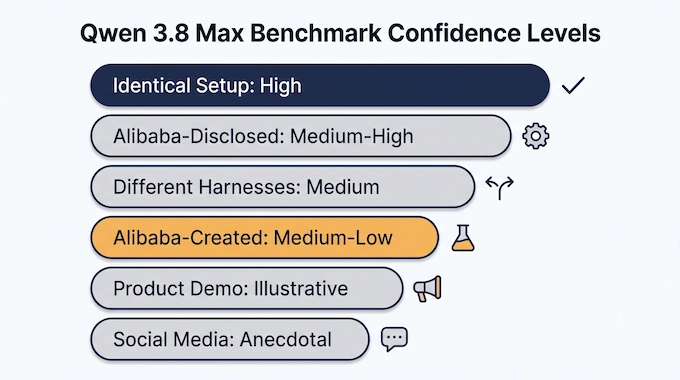
Qwen 3.8 Max Benchmark Evidence and Confidence Levels
| Evidence Type | Confidence Level |
|---|---|
| Public benchmark, identical setup and harness | High |
| Public benchmark run by Alibaba, settings disclosed | Medium-high |
| Best published scores pulled from different harnesses | Medium |
| Benchmark created by Alibaba itself | Medium-low |
| Product demo or extended showcase run | Illustrative only |
| Social media reports | Anecdotal |
A broad benchmark table looks authoritative. It isn’t automatically comparable. Some scores come from public leaderboards, others were run internally by Alibaba, and several rely on different agent harnesses, timeouts, context limits, or retry counts entirely.
Terminal-Bench 2.1 illustrates the problem well. Qwen’s score came from ten runs using Claude Code, a five-hour timeout, and a 131,072-token limit. The scores it’s being compared against were each model’s best published result, from whatever harness produced that best result. SkillsBench blends Claude Code, Codex, and OpenCode depending on the model. WideSearch runs external models through Claude Code but evaluates Qwen through Qwen-Agent. PaperBench gets judged by a separate model and averaged across three long runs.
None of that makes the numbers meaningless. It does mean you should read this scorecard as directional evidence about where each model tends to be strong, not as a controlled lab result proving universal superiority. Fable 5’s numbers carry a similar caveat, since some of its results may involve fallback behavior, and a handful of benchmark labels were corrected after manual review.
3. Coding And General Reasoning Benchmarks
“Lead” below reflects the published number only, with no adjustment for differing methodology.
Qwen 3.8 Max vs Fable 5: Full Coding, Agent, and Reasoning Benchmark Table
| Benchmark | Opus 4.8 | Fable 5 | GPT-5.6 Sol | Qwen 3.7 Max | Qwen 3.8 Max |
|---|---|---|---|---|---|
| Coding Agent | |||||
| Terminal Bench 2.1 | 84.6 | 84.6 | 88.8 | 74.5 | 86.6 |
| SWE-bench Pro | 69.2 | 80.0 | 64.6 | 60.6 | 67.7 |
| DeepSWE 1.1 | 59.0 | 70.0 | 73.0 | 21.6 | 56.6 |
| NL2Repo-Bench | 69.4 | — | — | 47.2 | 55.9 |
| FrontierSWE | 70.0 | 88.8 | — | 40.7 | 73.5 |
| MLS-Bench-Lite | 42.8 | 49.9 | 46.2 | 31.7 | 41.0 |
| PaperBench | 80.3 | 88.8 | 90.5 | 64.8 | 93.0 |
| AndroidBench | 69.8 | 84.5 | 74.0 | 56.5 | 75.1 |
| QwenSWEBench | 84.0 | 86.3 | 73.5 | 63.4 | 80.7 |
| QwenQoderBench | 62.7 | 63.1 | 53.8 | 36.8 | 58.4 |
| QwenReactBench | 1694 | 1770 | 1564 | 1538 | 1724 |
| QwenSVGBench | 1648 | 1690 | 1758 | 1499 | 1713 |
| General Agent | |||||
| CoWorkBench | 72.3 | 75.9 | 71.5 | 64.6 | 74.8 |
| WorkSpaceBench | 66.8 | 68.7 | 65.6 | 61.4 | 67.7 |
| JobBench | 48.4 | 57.4 | 45.4 | 31.3 | 53.4 |
| SkillsBench | 65.1 | 70.9 | 73.5 | 61.2 | 70.2 |
| Agents’ Last Exam (Pass / Score) | 27.0 / 45.1 | — / — | 30.6 / 53.6 | 11.8 / 31.1 | 27.0 / 52.4 |
| Automation-Bench (Pass@1) | 27.2 | 29.1 | 29.7 | 14.2 | 27.3 |
| Toolathlon Verified (Pass@1) | 76.2 | 77.9 | 74.9 | 49.7 | 72.5 |
| WideSearch | 72.9 | 81.2 | — | 75.2 | 81.9 |
| HLE With Tools | 57.9 | 64.5 | 58.0 | 53.5 | 56.2 |
| General Capabilities | |||||
| GPQA Diamond | 92.0 | 92.6 | 94.1 | 92.4 | 92.6 |
| HLE | 45.7 | 53.3 | 47.2 | 41.4 | 43.6 |
| IFBench | 62.2 | 63.5 | 72.7 | 79.1 | 82.8 |
| $OneMillion-Bench (Expert Score) | 41.8 | 55.9 | 53.8 | 44.4 | 52.5 |
| HealthBench | 52.4 | — | 55.3 | 54.5 | 60.2 |
| PLawBench | 69.6 | 70.2 | 72.3 | 58.9 | 73.2 |
| PRBench-Legal | 52.7 | 57.6 | 57.6 | 48.5 | 57.6 |
| PRBench-Finance | 51.9 | 55.8 | 55.5 | 46.8 | 58.3 |
| MRCR v2 256K (8-Needle) | 83.2 | — | 93.8 | 86.7 | 92.9 |
| LongBench v2 | 69.1 | — | 67.1 | 65.3 | 66.3 |
The pattern matters more than the tally. Fable 5 dominates repository-level engineering work. Qwen’s real wins cluster around PaperBench, IFBench, WideSearch, and finance and legal reasoning. That’s a meaningfully different skill profile, not a straightforward “better” or “worse.”
4. Coding Performance, Unpacked
Qwen 3.8 Max’s coding results genuinely split into two different personalities depending on the task.
On PaperBench, it scores 93.0 against Fable’s 88.8, supporting the idea that it’s capable at reproducing research, standing up experimental pipelines, and iterating against measured outcomes. Alibaba’s five-day paper-reproduction showcase points the same direction, though it’s a vendor demo and should be weighted accordingly.
Repository work tells the opposite story. Fable leads SWE-bench Pro by 12.3 points, DeepSWE by 13.4, FrontierSWE by 15.3, and AndroidBench by 9.4. Those aren’t rounding errors. For a team choosing a daily-driver coding agent, gaps that size show up in real completion rates.
The explanation isn’t complicated: reproducing a paper, patching a mature codebase, running a terminal session, and building a frontend are different jobs requiring different strengths. Qwen looks strongest when a task rewards research planning and long-horizon iteration. It looks weaker when success depends on precise, low-error edits inside code it didn’t write.
One practical note: for routine coding tasks, running Qwen at its highest reasoning setting is probably wasted spend. Start at medium reasoning, track completion rate and cost, and reserve the highest setting for architecture decisions, hard debugging, or genuinely research-heavy work.
5. Why The Harness Changes The Result
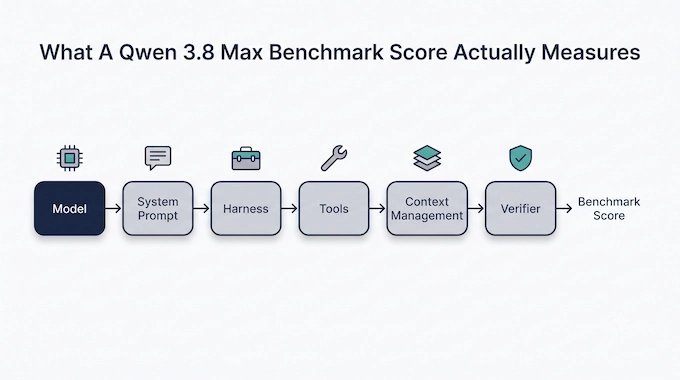
An agentic benchmark score measures a whole system, not an isolated model:
model + system prompt + harness + tools + context management + retry policy + verifier
The official Qwen 3.8 Max benchmarks mix in Claude Code, Codex, OpenCode, and Qwen-Agent, depending on the test. DeepSWE’s own writeup notes that Qwen performed best when paired with Claude Code specifically, which says as much about harness quality as it does about the underlying model.
This also explains why early user reports contradict each other. Some developers report strong value and genuinely impressive planning. Others describe loops, bloated context windows, sluggish reasoning, and inconsistent file edits depending on which backend they used. Treat both sets of reports as signal worth noting, not as controlled evidence either way.
6. Multimodal And Vision Benchmarks
Qwen 3.8 Max vs Fable 5: Multimodal, OCR, and Visual Agent Benchmarks
| Benchmark | Fable 5 | Qwen 3.8 Max | Lead |
|---|---|---|---|
| MMMU-Pro | 81.2 | 82.3 | Qwen |
| OmniDocBench 1.5 | 89.5 | 92.1 | Qwen |
| OCR-Bench-V2 (EN/ZH) | 65.3 / 58.1 | 74.2 / 68.3 | Qwen |
| CC-OCR-Bench-V2 | 72.4 | 79.6 | Qwen |
| MTVQA-Test | 41.6 | 56.6 | Qwen |
| RealWorldQA | 85.9 | 88.0 | Qwen |
| ScreenSpot Pro | 87.3 | 84.5 | Fable |
| WebArena-Verified | 71.3 | 66.8 | Fable |
| AndroidWorld | 88.8 | 85.3 | Fable |
| MobileWorld | 85.5 | 77.8 | Fable |
| VideoMMMU | 81.2 | 88.7 | Qwen |
| MMVU | 72.0 | 82.4 | Qwen |
| LVBench With Memory | 90.1 | 85.6 | Fable |
| EgoLife With Memory | 82.3 | 80.3 | Fable |
This is where Qwen 3.8 Max separates itself most convincingly. It leads on document parsing, both OCR suites, visual grounding, science and perception tasks, and most video understanding benchmarks. If your workload involves PDFs, screenshots, scanned documents, or turning visual input into structured data, this table is the one worth studying closely.
Fable 5 pushes back in a specific area: tasks where visual understanding has to become reliable action inside a GUI. ScreenSpot Pro, WebArena, AndroidWorld, and MobileWorld all favor Fable, suggesting Qwen reads and interprets images well but doesn’t yet convert that as reliably into precise on-screen operation.
The one-million-token context figure also deserves a caveat. It’s a stated capacity, not a guarantee of clean recall at every position inside that window. The published long-context benchmark (MRCR v2) only covers 256K tokens, not the full million. Anyone planning to lean on long-context retrieval or large video inputs should test retrieval accuracy and latency directly before committing to production.
7. Qwen 3.8 Max Pricing And Real API Cost
QwenCloud’s published rates are aggressive for a model this size. A few billing details matter more than the headline number: reasoning tokens are billed as output, preserved thinking carried into later turns counts as paid input, and built-in tools can add their own invocation charges on top of the extra tokens they inject into the prompt.
| Billing Item Or Example | Rate Or Estimated Cost |
|---|---|
| Standard input | $2.00 per 1M tokens |
| Standard output (including reasoning) | $6.00 per 1M tokens |
| Implicit cache input | $0.25 per 1M tokens |
| Explicit cache creation | $2.50 per 1M tokens |
| Explicit cache read | $0.17 per 1M tokens |
| 10K input + 2K output | $0.032 |
| 100K input + 5K output | $0.23 |
| 250K repository + 10K output | $0.56 |
| 10-turn cached agent session (illustrative) | About $0.42 |
| 100M input + 20M output monthly | $320 before caching or tool costs |
The ten-turn estimate assumes a reusable 50K-token prefix, 5K new input tokens per turn, 2K output tokens per turn, and implicit caching kicking in after the first request. That headline $2/$6 pricing is really just a starting point. A real agent session resending files, tool outputs, and preserved reasoning across many turns can add up fast, though good caching discipline claws a lot of that back.
QwenCloud also offers Token Plans with credit quotas, advertised at roughly 40% cheaper than pay-as-you-go rates. Regional pricing, promotions, and tool-call rates shift, so check the live billing page for your deployment region before finalizing a cost estimate. Don’t build a budget off a launch-day screenshot.
8. Where Qwen 3.8 Max Fits Against Other Frontier Models
Fable 5 is the natural comparison point here because it leads the hardest repository benchmarks while staying competitive almost everywhere else. GPT-5.6 Sol matters for coding and reasoning context, and it tops several benchmarks in the broader scorecard. Kimi K3 is the other frontier open-weight model worth watching. DeepSeek V4 Flash sets the aggressive end of the low-cost spectrum.
The real decision isn’t about a single leaderboard position. It’s about risk tolerance for your specific workload. Teams that need dependable repository edits will likely get more value from whichever model and harness combination scores best on their own codebase, not the public benchmark. Teams working through documents, images, research pipelines, or large-context tasks have real reasons to put Qwen 3.8 Max on their shortlist.
9. Open Weights Won’t Mean Easy Local Deployment
Alibaba said on August 3, 2026 that Qwen 3.8 Max weights would ship the following week. Until that repository is actually public, treat claims about final license terms, quantization options, checkpoint structure, and hardware requirements as provisional.
Worth remembering: the 95B “active parameters” figure describes compute per token, not total storage. A dense-equivalent estimate for 2.4T total weights lands around 4.8TB at 16-bit precision, 2.4TB at 8-bit, or 1.2TB at 4-bit, before accounting for overhead. Running this seriously requires multi-node hardware and expert-routing-aware serving infrastructure. Anyone wanting to run something locally should look at Qwen3.8-27B instead, not the Max variant.
10. Final Verdict: Who Should Actually Use Qwen 3.8 Max
There’s no clean knockout here in either direction, and that’s the more useful finding.
Developers building API-first products should test Qwen 3.8 Max where price-to-performance is the deciding factor. Researchers have a real reason to be interested given its PaperBench result and apparent strength in long-horizon experimentation. Teams built around document processing or visual workflows have strong grounds to put it through evaluation. Coding-agent users should move more carefully, since Fable 5 still leads several benchmarks that map closely onto everyday repository work.
The rule that actually matters when you’re picking between these models: measure completed-task cost, correction rate, latency, and harness stability against your own workload. A benchmark chart tells you where to start testing. It was never going to tell you what to ship.
Binary Verse AI will keep tracking independent evaluations, open-weight availability, and real-world Qwen 3.8 Max performance as this launch settles in. Check back before you commit a production workflow to a chart that was published yesterday.
1. Is Qwen 3.8 Max better than Claude Fable 5?
Not across every capability. Qwen3.8-Max leads selected benchmarks involving research coding, instruction following, finance, documents and visual agents. Fable 5 remains ahead on several major software-engineering and general-reasoning tests, including SWE-bench Pro, DeepSWE, FrontierSWE and HLE.
2. How much does Qwen 3.8 Max cost?
Current international launch listings report approximately $2 per million input tokens and $6 per million output tokens. The real cost can be higher during agent workflows because generated reasoning and preserved thinking may be charged again as input in later turns. Prices should be verified against the user’s QwenCloud region before publication or deployment.
3. Is Qwen 3.8 Max free?
8Qwen Studio may provide limited interactive access, but production API usage and coding plans are not universally free. Alibaba offers different access methods, including Token Plans and pay-as-you-go API usage, depending on the product and region.
4. Is Qwen 3.8 Max better than DeepSeek?
It depends on the model and workload. Qwen3.8-Max targets frontier coding, professional work, multimodal agents and long-horizon tasks, while DeepSeek V4 Flash is positioned far more aggressively on price. Qwen may be the broader flagship, but DeepSeek can provide better economics for high-volume tasks where its performance is sufficient.
5. Is Qwen 3.8 Max good for coding?
Its official coding results are strong but uneven. It performs especially well on PaperBench and Terminal-Bench, yet trails Fable 5 on several repository-level software-engineering benchmarks. Early users also report that results vary by coding harness, reasoning setting and context-management behavior.