1. Introduction
Every pharmaceutical researcher knows the distinct pain of rationing tissue samples. We have archives full of millions of Hematoxylin and Eosin (H&E) slides. They are cheap, abundant, and standard. But the data we actually need to model the tumor immune microenvironment, the rich, multiplex immunofluorescence (mIF) data, is expensive. It costs thousands of dollars per slide and takes days to generate.
We are effectively trying to map a complex city using only satellite photos (H&E) because we cannot afford the street-level photography (mIF) for everyone.
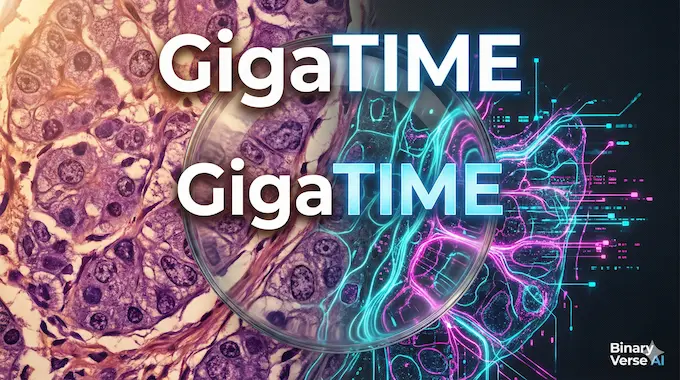
This bottleneck is why the recent publication of GigaTIME in Cell is such a massive deal. Developed by researchers at Microsoft, Providence, and the University of Washington, GigaTIME is not just another iterative “AI cancer breakthrough.” It is a fundamental shift in how we generate data. By using multimodal AI, this tool translates standard, $5 H&E slides into “virtual” mIF images across 21 protein channels.
The thesis here is simple but profound. GigaTIME enables us to generate a “virtual population” of patients. Instead of running expensive assays on small cohorts and hoping for significance, we can now scan thousands of archival slides to generate deep proteomic data computationally. This allows us to fail faster, see patterns earlier, and succeed sooner in drug discovery.
Table of Contents
2. What is GigaTIME? The “Virtual Lab” Explained
Let’s strip away the hype and define GigaTIME simply. It is an AI translator.
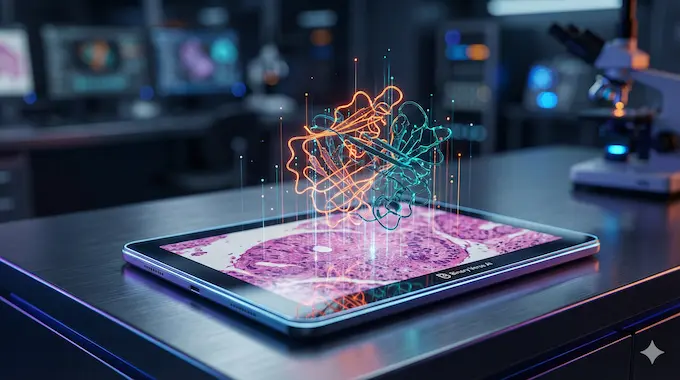
In the world of AI healthcare, we often talk about “generative AI” in the context of text or images (like DALL-E). GigaTIME is similar, but it is grounded in biological reality. It takes an input image of tissue stained with H&E, which shows us cell morphology, or the physical shape and structure of cells, and it “hallucinates” the corresponding protein activity for that same tissue.
Specifically, it predicts the expression of 21 distinct proteins, including critical markers like PD-L1, CD8, and Ki67.
The reason this matters is the bottleneck I mentioned earlier. Real mIF allows us to see how immune cells and tumor cells are interacting in the “neighborhood” of the tumor. It is the gold standard for understanding why some patients respond to immunotherapy while others do not. But because mIF requires specialized equipment, expensive reagents, and intense labor, datasets are scarce.
GigaTIME bypasses the wet lab. It looks at the H&E slide and uses deep learning to infer what the mIF stain would look like if you had run it. It effectively turns a standard pathology lab into a high-tech proteomics facility, virtually.
3. The Microsoft GigaTIME Mechanism: From Morphology to Molecules

You might be wondering how an AI can predict chemical protein expression just by looking at a purple-and-pink H&E image. It turns out that cell morphology contains a lot more signal than human eyes can perceive.
GigaTIME was trained on a massive dataset from Providence Health, comprising 40 million cells with paired H&E and mIF data. The researchers didn’t just throw data at a wall; they used a sophisticated architecture known as a NestedUNet.
Here is how the “Cross-Modal Translator” works:
- Input: The model takes a 256×256 pixel tile of an H&E slide.
- Encoding: It breaks this image down into a condensed latent feature representation—basically a mathematical summary of the cell shapes and textures.
- Decoding: It then reconstructs this data into 21 separate channels, where each channel represents a specific protein’s activity.
The AI learns the subtle correlations. It learns that a cell with this specific nuclear shape and that specific texture in the cytoplasm is statistically likely to be a CD8+ T-cell. It is not magic; it is pattern recognition at a scale no human pathologist could achieve.
GigaTIME Feature Specifications
| Feature | Specification |
|---|---|
| Architecture | NestedUNet (Encoder-Decoder) 14 |
| Training Data | 40 million cells (paired H&E and mIF) 15 |
| Input Size | 256×256 pixel tiles 16 |
| Output | 23 channels (21 proteins + 2 background, 100%) |
| Hardware Used | NVIDIA A100 GPUs (Testing), V100 (Inference) |
4. Unlocking the Tumor Immune Microenvironment (TIME)
In AI cancer research, context is everything. We call this context the tumor immune microenvironment (TIME). Think of a tumor not as a single bad entity, but as a rogue ecosystem. It has soldiers (T-cells), supply lines (blood vessels), and walls (stroma). The success of a drug often depends on the interactions between these elements.
GigaTIME allows us to see these interactions in datasets where they were previously invisible. For instance, the study showed that looking at a single protein often isn’t enough. The AI revealed that the combination of CD138 (plasma cells) and CD68 (macrophages) was a much stronger predictor of certain clinical biomarkers than either protein alone.
This is the power of spatial proteomics. It is not just about knowing you have macrophages; it is about knowing your macrophages are sitting right next to plasma cells, potentially signaling an active antibody-mediated attack on the tumor. GigaTIME lets us perform this complex spatial analysis on thousands of patients using only their H&E slides.
5. Real-World Evidence: 1,234 New Biomarker Associations

If you are a skeptic, you are likely asking: “Is this data real, or is the AI just making up plausible-looking noise?” The researchers validated GigaTIME rigorously. They applied the model to a real-world dataset of 14,256 patients from Providence Health. This wasn’t a small pilot study; it covered 51 hospitals and 306 cancer subtypes.
The result was the discovery of 1,234 statistically significant associations between the virtual protein levels and clinical biomarkers.
- Genetic Correlations: They found that tumors with KMT2D mutations had high levels of immune infiltration (CD3, CD8), suggesting these patients might respond better to immunotherapy.
- Survival Prediction: They created a “GigaTIME signature” combining all 21 proteins. This signature was significantly better at predicting patient survival than looking at individual markers.
To prove the model wasn’t just memorizing the Providence data, they performed an external validation on 10,200 patients from The Cancer Genome Atlas (TCGA). The virtual mIF profiles generated for the TCGA patients correlated strongly (Spearman r=0.88) with the findings from the Providence cohort. This cross-cohort validation is the gold standard in AI cancer research.
6. Addressing the Skeptics: Is This Just “AI Hallucination”?
We need to be honest about the limitations. As the authors themselves state in the paper, “AI is not magic”. There is a risk with any generative model that it produces “slop”, data that looks realistic but is biologically false. To counter this, the team didn’t just look at pixel accuracy. They used spatially informed metrics like Entropy, Signal-to-Noise Ratio (SNR), and Sharpness to verify the quality of the virtual images.
They compared GigaTIME against CycleGAN, an older image-translation method. CycleGAN often failed to recover coherent cell-level patterns, essentially producing random noise that looked like cells. GigaTIME, trained on paired data, maintained high fidelity.
However, the authors and Microsoft are very clear on one point: This is for research use only. It is a modeling tool. It is not a diagnostic device. It generates “virtual” evidence to guide hypothesis generation, not to make clinical decisions for a specific patient today.
7. How to Use GigaTIME: A Guide for Developers and Bioinformaticians
If you want to take Microsoft GigaTIME for a spin, you cannot just download an .exe file. This is a research-grade tool requiring some technical lifting.
Access
The model is gated. You can find the code on GitHub, but the model weights (the “brain” of the AI) are on Hugging Face and require you to sign a data use agreement. You must agree that you will not use it for clinical care.
Requirements
You will need a Linux environment and a powerful GPU. The README recommends NVIDIA A100 GPUs for reproducibility, though inference (running the model) can be done on smaller cards if necessary.
- Language: Python 3.11
- Framework: PyTorch
- Manager: Conda
The Workflow
- Get the Code: Clone the prov-gigatime/GigaTIME repository from GitHub.
- Get the Weights: Request access on Hugging Face. Once approved, you must export your token (export HF_TOKEN=…) in your terminal to download the weights.
- Run Inference: Use the provided Jupyter notebooks (gigatime_testing.ipynb) to feed in your H&E tiles and get virtual mIF maps back.
This tool is ideal for AI for precision medicine teams who want to run retrospective studies on their clinical trial archives. You can build “virtual cohorts” to test hypotheses before committing to expensive wet-lab assays.
Dataset Comparison: Real vs. Virtual
GigaTIME Metric Comparison
| Metric | Traditional mIF Study | GigaTIME Virtual Population |
|---|---|---|
| Cost per Slide | ~$1,000+ 31 | Computing Cost Only (<<$1, ~99% lower) |
| Time per Slide | Hours/Days 32 | Seconds/Minutes |
| Typical Cohort Size | Hundreds | 14,000+ 3333 |
| Proteins | 20-40 (Panel dependent) | 21 (Virtual) 34 |
8. The Future of AI Healthcare: Toward the “Virtual Patient”
We are looking at the first real steps toward a “Digital Twin” or a Virtual Patient. GigaTIME proves we can infer hidden biological states from simple data.
The economic impact here is massive. By reducing the cost of entry for AI cancer research, we lower the barrier for discovering new biomarkers. We can scan millions of archived slides from decades of clinical trials to find signals we missed the first time because we didn’t have the budget to stain for CD8 or PD-L1.
This is the “moonshot”. It is not about replacing the pathologist or the wet lab. It is about augmenting them with a “virtual population” that allows us to ask questions that were previously too expensive to ask.
9. Frequently Asked Questions (FAQs)
1. Can I use GigaTIME to diagnose patients?
No. The license strictly prohibits clinical use. It is for research and reproducibility of the paper’s results only.
2. What hardware do I need to run this?
The team used A100 GPUs. You need a CUDA-capable NVIDIA GPU. For training, high-end enterprise GPUs are necessary; for inference, you might get away with consumer cards like an RTX 4090, but memory will be a constraint.
3. Is the training data public?
The code and model weights are public (gated). The paper mentions releasing the “in-house dataset of 40 million cells,” but you should check the repository for the latest availability of the raw training data.
4. Does it work on all cancer types?
It was trained on Providence data and validated on TCGA, covering 24 cancer types. However, performance varies. It works best on types well-represented in the training data (like lung, breast, bowel).
5. Why is the model “gated” on Hugging Face?
Since this is a medical AI model capable of generating realistic-looking biological data, the creators require users to accept terms preventing misuse, specifically regarding clinical decision-making.
10. Conclusion
As a researcher, I remain cautiously optimistic. GigaTIME is not going to replace the wet lab tomorrow. You still need physical confirmation for critical diagnostics. But as a hypothesis-generation engine, it is unrivaled.
It allows us to scan the “haystack” of archival tissue at lightning speed to find the “needles”, the rare biomarker associations, before we spend millions on clinical trials. That efficiency is exactly what the tumor immune microenvironment field has been waiting for.
If you have the hardware and the Python skills, I encourage you to fork the repo and test it on your own cohorts. The era of the virtual patient isn’t just coming; it is already loading.
Is GigaTIME open source or locked to Windows?
Yes, GigaTIME is open source. It uses the permissive Apache 2.0 license and is not locked to Windows. The code is available on GitHub and the model weights are hosted on Hugging Face, making it accessible to any researcher using Linux or Windows Subsystem for Linux (WSL).
How is artificial intelligence used in cancer research with GigaTIME?
GigaTIME uses AI to perform “cross-modal translation.” It takes standard, inexpensive Hematoxylin and Eosin (H&E) tissue slides and uses deep learning to generate “virtual” maps of protein activity. This allows researchers to simulate expensive Multiplex Immunofluorescence (mIF) lab tests computationally, saving significant time and funding.
Is AI close to curing cancer with tools like this?
No, GigaTIME is not a direct cure. It is an advanced research modeling tool designed to accelerate discovery. By creating “virtual populations” of biomarkers, it helps scientists identify new drug targets and predict treatment responses years faster than traditional wet-lab methods, but it does not diagnose or treat patients directly.
What does the tumor immune microenvironment (TIME) mean?
TIME refers to the ecosystem surrounding a tumor. It includes immune cells, blood vessels, and signaling molecules that interact with cancer cells. GigaTIME maps this “battlefield” to help researchers understand why the immune system fails to attack the tumor, which is critical for developing effective immunotherapies.
How accurate is GigaTIME compared to real lab tests?
GigaTIME is highly accurate for research purposes. In the published Cell study, the tool achieved a 0.88 Spearman correlation with real data from The Cancer Genome Atlas (TCGA). The developers also used spatial metrics like entropy and signal-to-noise ratio to verify that the AI was generating biologically valid data rather than random noise.